Understanding The System
This may not be what you expect.
Yes, I’ll share some personal stories, but this isn’t about petty back-and-forths or taking sides. My goal is to make sense of what I’ve lived through and explain the patterns I’ve seen.
I’m not a writer, theologian, psychologist, therapist, historian, or church leader. I’m simply someone who has witnessed a lot and is trying to put words to the ripple effects of a complex system. What follows are my perspectives, drawn from lived experience and evidence.
In other words, these are my opinions. Take them with the weight you believe they deserve.
Lastly, if anyone finds a statement in this document that is factually and verifiably false, please reach out so I can acknowledge and revise it. I extended this same invitation to the Crossings Core Leadership in January 2025, and to date, I have received no requests for correction or redaction.
Chris
Version 1.1 – September 2024
- Understanding The System
- Preface
- Definitions
- Introduction – Countless Voices
- Part 1 – The System – A Criticism
- Part 2 – The Family at the Center of The System – Perceptions and Reality
- Part 3 – Biblical Manipulation
- Conclusion – What now?
Preface
“You should skip the funeral to come to the Men’s Retreat.”
In April 2018, I wrapped up what seemed like an ordinary men’s discipleship group meeting; no significant conflicts, groundbreaking revelations, nothing out of the ordinary. It was just another evening, and I didn’t think much of it as I headed home. But that night, one of the men in the group walked away from that meeting, and later, he shot himself. He didn’t survive.
The call I received the following day shattered my sense of reality. Clouds of confusion and doubt enveloped me as I replayed the events of the night before, desperately trying to trace the cord back to the wall. What had I missed? Worse, what had I said? What could I have done differently? Or more hauntingly, what didn’t I do to help? Were there signs I was too distracted or preoccupied to pick up on? Six and a half years later, the answers remain elusive, and the weight of that moment still lingers, stirring clouds of uncertainty that refuse to settle around me everywhere I go.
Outwardly, I held it together, as I tend to do (for reasons I can’t always explain), and sought guidance from my mentor at the time, Robert Cox, Senior Evangelist and Founder of the Crossings Church St. Charles County. His response was warm and kind, offering reassurance that I desperately needed. Yet, one piece of his advice troubled me profoundly. Robert suggested I skip the funeral, as attending would require me to miss part of the first session of the annual Men’s Retreat. He explained that doing so would demonstrate to everyone how seriously I take my commitment to God.
I knew in my head and heart that this wasn’t right, yet I felt an inexplicable compulsion to comply. It was a conflict I couldn’t fully articulate: a mixture of loyalty, fear, and the deeply ingrained belief that I needed to submit to my leader. I needed to please him.
In the years since, I’ve spent a great deal of time wrestling with a paradox that I cannot ignore:
This is a church that helps people.
This is a church that hurts people.
Though these statements contradict each other, they coexist as undeniable truths. The same practices that help people are also the ones that hurt people. Many cannot see past the help to recognize the harm, and so they struggle when the church is criticized. This is a nuanced reality, and it is why I have written so much.
My story with the Crossings Church St. Charles County could easily fill another book. Some chapters would celebrate moments of certainty and success. Others would be full of repentance and personal failure. Some would capture love, marriage, and the raising of kids. And some would record abuse, control, and manipulation.
My time at the Crossings wasn’t just one thing; it was many things, stitched together like a quilt.
The Crossings taught me that two things can be true at the same time. You can find belonging and still feel profoundly alone. You can be lifted up and quietly torn down. You can be told you are part of a family and realize you are replaceable the moment you stop playing your part.
The same hands that helped me out of the water were the ones that held me under. The same words that first opened my Bible were later used to close it when I searched for accountability. The same community that taught me sacrifice taught me to sacrifice myself.
That is the duplicity. The good is real, but it is never free. It is laced with control, expectation, and fear. And because the help feels holy, the harm is harder to name. For years, I could not see it. Now I cannot unsee it.
I don’t write these things now because I consider my 25 years in the Crossings a waste.
I write them because I consider those 25 years… complicated.
I was baptized at fifteen. Within a year, I was leading Cross Chat lessons, baptizing more than a dozen others, and was invited to speak at retreats. In my senior year of high school, I even led the first student-run Cross Chat in the church’s forty-year history, without an adult present. From there, the roles continued to accumulate: I was chosen to join a church plant, led the campus, teen, and adult ministries, and took charge of the church’s visual displays, videos, and website. I ran a ministry for nearly twenty years dedicated to helping men overcome compulsive behaviors. I was on stage frequently, opening services once a month and preaching at least once a year. Eventually, I rose to Core Leadership, the highest level of responsibility a lay leader could hold.
I was all in.
I do not write that to boast, because now I see it as a waste. The credentials I once clung to, I now regard as rubbish. I spent a life serving a system of church in the name of Christ, and now I struggle to separate the two.
I gave myself wholly to a holy purpose, convinced by confident leaders that they had the answers. Their System of faith, the powerful social pressures, the distorted power dynamics, and the way the Bible was leveraged. All of it worked together to keep me handcuffed to the Crossings Church.
I wasn’t just caught in it. I was a poster child for it. And I helped enforce it.
But… I thought they were right.
So when people rejected their message, I assumed it was because they were defiant.
I thought they were right. So when I heard stories of abuse, I believed leadership’s version of events.
I thought they were right. So when the abuse came for me and mine, I excused it.
I thought they were right. So when I realized they were wrong, it broke me.
This document is the result of trying to understand what I was caught up in. That understanding doesn’t undo the harm. The scars remain. However, the process provided me with a framework, one that I hope can help others do the same.
The first version of this document, completed in December 2024, was written for the Core Leadership of the Crossings Church. It was raw and direct. I only shared it with them, and later those who directly asked me for it, though it quickly became known, distorted, and dismissed by people who never actually read it.
Since then, in 2025, I’ve watched more than a hundred longtime leaders and members exit the Crossings. I’ve listened to their stories. I’ve kept writing. And I’ve rewritten nearly every part of this document, removing entire sections, reframing arguments, and adjusting my target audience.
I now write for three groups.
First, I am writing to the members of Crossings Church.
This is not an attempt to divide or cause discord. I won’t tell anyone to leave. That is a deeply personal decision. I already confronted leadership in January 2025. They refused to engage. According to Matthew 18, this document is my way of “telling it to the church.”
I’ve written this as a tool to expose how The System works. You may disagree with my descriptions, but I hope that the ideas stay with you. When the uglier sides of The System reveal themselves, I hope you find the clarity and courage to stand firm. Many of you chose to stay during the exodus of 2025. I hope this helps you understand what you’re fighting and what you’re fighting for.
Second, I write to former members.
If you’ve left, you might be stuck in the fog; confused, doubtful, angry, exhausted. I was too. And what I’ve learned since is that this isn’t just about one church in Missouri. This is about a wider pattern of spiritual abuse that exists in any system that demands total loyalty in the name of faith. I hope this brings clarity.
Third, I write this as a public warning.
This part feels most uncomfortable. I’m not a whistleblower by nature. I’m not out for revenge. But I think about my parents, who tried to gently warn me about what I was getting involved in. They weren’t part of the church, but it looked orthodox enough—no blood rituals, no outlandish teachings, just fundamental Christianity. They let me go.
And I went.
I left home the moment I graduated high school. Convinced by the church that my family wasn’t spiritually safe, I drove a wedge between us that took nearly a decade to undo.
So, yes, I’m publishing this publicly. I want it to be indexed by Google because the Crossings Church actively removes Google Reviews that offer warnings. They’ve protected their image; I’m offering a counterpoint.
The Crossings and those who lead it are not evil. But the Crossings Church St. Charles County uses a system of control that is harmful. And that system needs serious reform.
I write this with the awareness that many before me have already attempted to voice their stories. Accounts of spiritual abuse (though not always categorized as such at the time) have long been raised against the Crossings Church. Most of these voices have gone unheard or have been dismissed outright.
Definitions
Spiritual Abuse. Spiritual abuse is the misuse of power, authority, or influence within a religious or spiritual context to control, manipulate, or harm individuals. This occurs when religious leaders, institutions, or members exploit teachings, practices, or positions of authority to impose fear, guilt, or shame, often resulting in emotional, psychological, or spiritual harm.
Here is an article about spiritual abuse from Renew (a Crossings-approved resource): “Spiritual Abuse: 4 Twisted Values That Enable Churches to Hurt People”
Spiritual abuse twists a person’s faith and fractures their connection to their community by exploiting trust and instilling feelings of worthlessness, fear, and isolation. At its core, spiritual abuse is the weaponized misuse of authority, creating an environment of control and harm that leaves lasting scars on an individual’s relationship with both their faith and the people meant to support it.
The System. Like a car engine with multiple mechanisms and processes, The System of the Crossings Church is a collection of interlocking parts that work together to create something much larger than most realize. I will explore this in Part 1 of this document.
Core Leadership & The Family. The Crossings doesn’t have a board of elders or an oversight committee. They have something called Core Leadership. The majority of Core Leadership consists of a single family (referred to in this document as “The Family”) who serve as the Preacher, Campus Minister, and Youth Minister.
Cell Groups. At the Crossings, small groups are called “cell groups,” a name drawn from the idea that a cell is the smallest unit of the body of Christ. At The Crossings, participation in a cell group is not optional. It is considered an essential part of church membership, and one cannot be regarded as a member in good standing without belonging to one.
The Gossip Network. A key component of The System is a scripturally defended network of gossip, designed to funnel information upward to Core Leadership. Details shared in discipleship relationships are passed along to cell leaders, then to zone leaders, and ultimately reach Core Leadership, where they are used to inform decisions and maintain control.
Church Code. Every church has a code by which it perceives, understands, interprets, applies, and enforces biblical concepts from Scripture. Church Code isn’t unique to the Crossings, but the Crossings’ Church Code is distinctive.
Introduction – Countless Voices
The Scope of the Problem
I first became aware of stories of spiritual abuse and accusations that the church was a cult almost immediately after I became a member.
Whispers circulated about what people said after they left the church: stories of hurt, betrayal, and manipulation. Over time, a pattern became clear: individuals who left the church angry and deeply wounded often had their experiences dismissed by leadership as slander or bitterness.
Leadership seemed content to ignore some who left quietly, but those who voiced their hurt publicly were labeled divisive troublemakers, worthy of disfellowship. These stories are not rare. Several high-profile members leave under similar circumstances every year, while dozens more committed members quietly slip away.
I’m a data guy, so let’s talk numbers for a moment.
Between 2005 and 2024, the Crossings Church St. Charles County baptized nearly 900 people, based on an estimated historical average of 47 baptisms per year (likely a conservative estimate). The church began with 34 members. Today (as of November 30, 2024), it has around 385 active members: roughly 250 adults, 85 campus students, and 50 teens. When you include the approximately 90 members sent out on church plants, the total retained membership is about 475. This doesn’t account for individuals who later left those church plants, which I’m unable to track.
So if you take the 900 baptized and subtract those who have left, the numbers suggest a retention rate of roughly 50%.
Now, is that good? Is that bad? That’s actually hard to say. Industry-wide retention data is fuzzy at best, and the few studies that exist show wide variance across denominations, contexts, and age groups. Many churches struggle to keep even half of their converts long-term, especially among younger generations.
But the Crossings isn’t a typical church. It doesn’t claim to be. The messaging, both spoken and unspoken, is clear: leaving the church is not just leaving a community, it’s potentially leaving God. Church Code teaches that members should never leave unless it’s for a specific, sanctioned purpose; usually a church plant. The decision to leave rarely feels like an open one. Many stay, not because they feel safe, but because leaving carries a heavy spiritual and relational cost.
In most churches, leaving is difficult but acceptable. Members can step away without complication. At the Crossings, leaving is never normal. It is framed as rebellion, betrayal, cowardice, or even damnation. The numbers matter not only because of the large number of people who have left, but also because of the fear and condemnation surrounding the act of leaving itself. So instead of asking whether 50% retention rate is high or low, the better question is: What does it mean that hundreds of people, possibly thousands over the decades, have walked away wounded from what was supposed to be an unleaveable church?
This isn’t just a story about numbers. It’s a story about people. The pain isn’t limited to those counted in the baptism log. Many others came close, studying the Bible, attending events, trying to belong, only to walk away discouraged, judged, or quietly discarded when they didn’t conform. They don’t appear in the statistics, but they are part of the story.
We know the numbers don’t tell the whole story. If most people left the church amicably, looking back on their time as well spent before moving on to other things, I wouldn’t be writing this document.
Numbers don’t tell stories. People do. Over the decades, hundreds of individuals have shared their experiences in accounts of their time at the Crossings that cannot and should not be dismissed.
The Lindenwood Incident: A Case Study in Spiritual Abuse Allegations
Over the decades, a few notable “hater uprisings” have occurred. The first one I am aware of happened in 2012, sparked by an article in the Lindenlink newspaper targeting the Crossings Church St. Charles County campus ministry, then known as Across Between Campus Ministry (ACB).
The article highlighted several alleged abuses of power, privilege, and bullying by the ministry.
One such account involved Kerry Cox, who served as Evangelist, Campus Minister, and at the time, Lindenwood’s Student Activities Coordinator. In the incident, he was joined by Ben Mullins, his ministry disciple and future leader of the Crossings St. Louis church plant. The two showed up unannounced late at night at a dorm to confront a student who had recently left the church. To outsiders and likely to the former member, the visit came across as invasive and controlling, reinforcing the growing perception of ministerial overreach.
While the original articles are no longer accessible, they can still be found through the Internet Archive. It’s a clunky experience, but here are the links nonetheless:
Article 1 – Accusations arise: ACB crosses the line
Article 2 – ACB story prompts big response
Article 3 – The Legacy stands by their stories
The initial article spurred former members of the campus ministry and church to take to the comments and share their stories of spiritual abuse and church hurt. Two additional articles were released on Lindenlink, and the engagement therein even caught the attention of STLToday and Fox2.
People stormed to the comments, writing their stories both for and against the Crossings Church. Many ex-members shared incidents that “crossed the line” in their words and actions. Here is an example from March 22, 2012, attributed to someone named “Herman”.
“I was a part of this group for slightly less than a year. I do feel as though I was isolated from friends, family, and my significant other at the time. When I would attend meetings and he would not, they were very forceful in trying to convince him to come. However, when he wouldn’t, my relationship with him was hugely discouraged. After admitting to a prominent member of the group that I consider myself an agnostic, but just appreciate feeling that there are people who care about me, he vocalized his opinion that by not believing in Jesus as my savior, I have no soul and I am the equivalent of a dog. I don’t count as a human being. This is not hearsay. This is the message that was conveyed to me both verbally and nonverbally by this group.”
This story is compelling to analyze because it highlights exactly why the Crossings leadership would find it difficult to confront. On the surface, it may read as exaggerated or emotionally charged, casting doubt on its accuracy. And yet, when overlaid with countless similar accounts, clear patterns begin to emerge. While being called a dog isn’t part of “Church Code,” other aspects, such as pressure around relationships, isolation, and the expectation to convert and assimilate, are recurring themes. That’s not to suggest Herman is lying; rather, the truth is likely more complex than a simple binary.
I don’t know Herman personally or have insight into the full details of their experiences, so I cannot speak definitively to the truth of their claims. However, I can say that Herman’s allegations were not baseless. And yet, their words, along with every other critical comment, were dismissed by leadership as untrue and malicious attacks, reinforcing the Crossings’ pattern of disregarding criticism rather than engaging with it thoughtfully or empathetically.
The uproar eventually quieted, but the effects lingered. ACB faltered in growth and lost its recognition as an official campus ministry after refusing to comply with Lindenwood’s anti-proselytizing policy. Soon after, Kerry Cox was terminated from his role as Student Activities Coordinator. Yet none of this led to meaningful reform. Instead, the events were framed as persecution, and the church rallied financial support to bring Kerry back on staff as the campus minister.
In 2014, Kerry called me to ask what he could do to get the Lindenlink articles removed from Google search results. I told him he could file a claim, but he would need to prove libel, and Google is unlikely to act on something so small. Instead, I suggested focusing on serving the community in ways that attract positive media attention, since new stories naturally push old ones down in search rankings.
Three months later, Kerry changed the name of the campus ministry.
The ‘Survivors’ Incident: A Case Study in Spiritual Abuse Allegations
The second hater uprising against the Crossings occurred during the lockdowns in 2020, when a former member shared their story of spiritual abuse that went viral among ex-members. People took to social media to post their stories of church hurt, tagging the church and encouraging others to do the same.
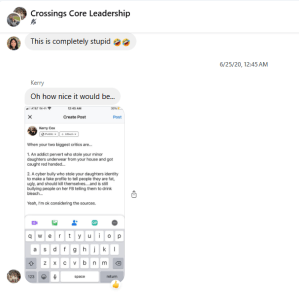
Again, leadership had big feelings about those sharing their stories of hurt.
Core Leaders exchanged details about individuals posting these accounts online, often labeling them as unreliable due to their “problematic” time at the church or perceived sinful lifestyle. It was not only the posters who were targeted. Those who liked, commented on, or shared posts criticizing the church were dragged into the discourse of a private group chat. I know this because I have nearly two years of those conversations archived.
Such narratives allowed leadership to dismiss the critics outright with phrases like “Consider the source,” a sentiment Kerry Cox repeated several times throughout the uprising. This approach attempted to discredit the voices of those who left, further insulating the church from accountability and silencing meaningful dialogue about its practices.

This series of public posts led to a private Facebook group called “Survivors of the Greater Alton & The Crossings Church(es),” which became a platform for 100-200 ex-members to share their stories and provide support to one another.
While it’s fair to say that a degree of groupthink fueled the momentum and that some prominent voices may have been drawn to the attention, we’re not being honest if we reduce the entire uprising to a few toxic, attention-seeking twenty-somethings trying to hurt the church. These were people with real stories, real concerns, and real pain that cannot be dismissed so easily.
I considered sharing screenshots of stories here, but I didn’t feel right doing so without permission.
Interestingly, many of those former members’ stories were shared inside the Crossings. They’d been screenshotted on Facebook by a current member who infiltrated the private Facebook group where survivors were sharing their experiences. That member was feeding these stories directly to Kerry, which is when I first heard about this.
Concerned, I asked Kerry who had infiltrated the group. He said, “I, nor anyone in our leadership, did so, nor did we have any prior knowledge of.”
Kerry’s language seemed deliberately crafted. He knew exactly who created the fake account to spy on the group; it was a member of his own family. He was distancing himself from the initial act while benefiting from the visibility it gave him.
When I asked why he would allow this, Kerry explained, “This will help keep us safe in case credible threats are made against us” (which Kerry claimed were already happening). He added later on a Zoom call that it would also allow leadership to stay informed about what people say about the church, guiding future steps if a former member ever wanted to return to the church.
At its core, that is the story. A group of people, many of them criticizing the church for overreach and control, were being secretly spied on by the very church that had already hurt them.
This uprising, similar to the previous, resulted in little to no reform. The playbook remained consistent: reject that harm had occurred, defend the church’s actions, demonize dissenting voices, conduct an internal loyalty campaign, and frame the church as the victim against accusations of victimizing others.
Even when some of the “survivors” desired an open forum to share their grievances and engage with church leadership, Robert refused, citing a lack of New Testament precedent for such remedial steps. For the survivors, this refusal reinforced the narrative that the leadership was above accountability, leaving no room for reconciliation or meaningful reform.
As a result, the group grew more organized, directing their efforts at the church’s public image by flooding its Google and Facebook pages with negative reviews, many of which simply shared their personal stories. The surge was so substantial that the church petitioned Google to remove the reviews, which was successful as Google interpreted the influx as an undue “review bomb.” Similarly, Facebook reviews for the church were turned off entirely in response to the backlash.
This effectively silenced the stories, ensuring they would not remain visible to the broader public.
The Exodus Incident: A Case Study in Spiritual Abuse Allegations
In January 2025, more than 100 people left the Crossings Church St. Charles County. I’ve heard three people, myself included, blamed as the divisive culprits behind the exodus. But the truth is far more complex and, honestly, fascinating.
It began fairly innocuously, as all upheavals do.
Act 1: The Building Push
From my perspective, the decision to build a $6 million (which eventually became nearly $8 million) church was made unilaterally by Robert and the Core Leadership. A loan was secured externally, but a special contribution was held in 2020, along with an additional contribution in 2024. Inspired by a ministry in Idaho that found success through sports outreach, Robert and Kerry became enamored with the idea and moved forward with plans to construct a gymnasium-style “church” on land adjacent to Veritas Christian Academy in O’Fallon, MO. Many members were left perplexed by the decision, frustrated by the lack of input, and/or concerned (given the church’s disorganization) about whether a sports ministry could ever actually succeed.
The first time we set foot in the building, without an occupancy permit, I recall watching faces range from bewilderment to excitement. It depends on the ages.
As construction delays mounted, Robert announced that the church would hold its first service in the new building on Easter 2024. The problem was that the building wasn’t finished, and no occupancy permit had been secured. Still, Robert insisted it should be completed within five weeks to meet his self-imposed deadline.
What followed was a frantic push across the church. Leaders and members were expected to drop everything to bring Robert’s vision to life. Each small group was assigned a classroom and given a packet of design ideas to make the space “special” for kids. This meant creativity, construction, painting, and late-night labor —scheduled after hours so that volunteers wouldn’t interfere with the main contractors. Initially, groups were given a meager $200 budget, which was later increased to $1,000 following complaints.
But, as is typical at the Crossings, everyone pulled together to get it across the finish line. Still, frustration was becoming more apparent. As I walked the halls, I overheard a growing number of complaints, from both those who would eventually leave and those who would stay.
Act 2: Pressure Cooking
A few months later, the church hosted a “Grandparents Day” potluck, another vision from Core Leadership. The problem was that the building didn’t have enough power to handle the number of crockpots brought in. Members scrambled to find extra generators, but even then, the event fell short. The crowd was large, the food ran out, and when some members voiced concerns afterward, their feedback was brushed aside. For several, the experience raised a quiet question: was it really worth pouring so much time and energy into propping up leadership’s vision?
In early October, the first major family left the church. Bart and Tanya B., longtime followers of Robert and Rita, announced their departure. They explained that their adult children no longer felt comfortable returning because of how they had been treated, and the couple decided it was best to attend a church where their kids could reconnect. While many leaders accepted their decision, top leadership reportedly reacted with frustration and even a sense of betrayal. Some went further, making sure others were informed of the full story.
Every October brings its own challenges at The Crossings. The annual Spooktacular is both a fun tradition and a heavy financial and time burden. Each small group is tasked with creating a themed “set,” requiring weeks of planning, coordination, and labor, another all-hands-on-deck event.
Compounding the October pressure is the annual Leadership Planning meeting, held around the same time. All leaders are summoned to hear the presentation of the coming year’s theme and church-wide events. Although they have no input in shaping the calendar, they are expected to take ownership of specific events. Their hearts and commitment are often “challenged,” especially if a small group hesitates to claim responsibility.
Between the Easter push, the scramble to set up the new building, the busyness of summer, the work and fallout from Grandparents Day, another four-week all-hands effort for Spooktacular, and the demands of Leadership Planning, October became relentless, especially for leaders.
Immediately after Spooktacular came another church-wide event the Crossings had been experimenting with in recent years: a Chili Cookoff potluck meant to extend the Halloween festivities. This sparked another wave of leadership concerns, with several suggesting it be changed to a bake-off for easier execution. Those requests, however, were largely dismissed as evidence of “a lack of purpose” or “hard-heartedness.” The reality was that requiring each small group to prepare enough chili to feed hundreds was time-consuming, logistically complex, and costly.
From what I’ve gathered, Brian and Leah W., longtime members of Core Leadership, began voicing concerns to the Core Leadership about the very culture at the heart of the group itself, which, to my understanding, went largely unresolved.
In December, another of Robert’s visions emerged: Christmas Around the World. Once again, every group was assigned a themed set to build and the responsibility of preparing enough food to feed hundreds; this time piled onto the already frantic holiday season and an overloaded church calendar.
From my perspective, it was one of the worst-organized events I’d seen at the Crossings in years. While I had already planned to leave the church in the coming weeks, it was clear that very little love, energy, or thought had gone into organizing it. Even the layout, developed and approved by Core Leadership, felt poorly planned. At one point, they floated the idea of having every group serve food outside to free up space for tables and chairs… in December.
I wouldn’t be alone in thinking that the energy, attention, and money could have gone to feeding people who actually needed it. Instead, it funded yet another push to fulfill one of Robert’s ideas.
Within a week or two, the proverbial poo started to hit the fan.
Act 3: Falling Dominos
I bumped into Travis J. at Target, a founding member of the Crossings Church St. Charles County, who told me his immediate family had decided to leave the church. This was going to cause some ripples. Travis’s extended family had long-standing connections across the church and its plants.
Within a week after speaking with Travis, Juan and Summer B., former Core Leaders and founding members of the church, messaged the broader leadership group, announcing they were leaving so Juan could heal from the damage his past sin had caused. Reactions varied. Some leaders expressed sadness, others frustration. Core Leadership exited the chat, indicating they would “share the full story for anyone who wanted it.”
From here, things escalated rapidly.
At this point, the church’s Gossip Network lit up. Core Leadership felt that Juan and Summer were badmouthing them. Juan and Summer felt the same about Core. It turned into a game of telephone, with stories likely exaggerated on both sides. To be clear, beyond a few text messages, no one really knows what Juan and Summer were saying behind closed doors, or what Core Leadership was saying behind theirs.
Regardless, the game of telephone kept escalating, and people began to take sides. Many aligned with Core Leadership, likely giving them the benefit of the doubt, just as I had done for decades in situations like this. On the other side, some genuinely felt Core had mishandled things with Juan and Summer in the past. But most, from what I could tell, didn’t care much about what Juan and Summer had said. They simply didn’t like that Core was leading a loyalty campaign again, and many were still carrying similar hurts from their own experiences of overreach and what I would call spiritual abuse.
Act 4: The Loyalty Campaign
It was at this point that Core decided they needed to have a meeting about what to do about Juan and Summer.
This is when Brian and Leah W. decided it wasn’t appropriate to hold a meeting focused on how to handle Juan and Summer leaving the church. Instead, they suggested an all-leadership meeting to address the broader issues they had raised back in November. That suggestion appears to have been rejected. They were told the meeting would not happen and that if they chose not to attend the upcoming Core meeting, it would be considered a voluntary removal from Core by abdicating their roles.
This only fueled the Gossip Network, with stories circulating throughout the church and clear sides beginning to form. Around this time, I had been quietly working on the first version of this document and shared it with a few trusted people to get feedback. I wondered whether I was overreacting and wanted an outside perspective. But even without wide distribution, rumors about “Chris’ writing” began to spread. I had planned to sit down with Robert before formally sharing the document.
Then someone informed Core Leadership that my family was planning to leave the church. And in line with the familiar criticism playbook I had seen used time and again, I knew that once I was seen as an outsider, nothing I said would carry weight. So I sent a more concise version of the document to Core and informed them that my family would no longer be members of the Crossings.
Shortly after, Core called an all-leadership meeting to present “their side of the story and move forward in unity.” But instead of a formal presentation, leaders arrived at the church to find Core Leadership seated up front near the stage. There would be no sermon, just an open mic session for airing grievances.
I wasn’t at this meeting, but based on accounts from both “sides,” the meeting was a disaster. With more than a hundred in attendance, it lasted more than five hours. Little was accomplished, but much was said. Robert concluded, as he often does, that if people are not on board with the Crossings Leadership, then they should find a church where they can be on board with their leadership.
Which is exactly what happened.
For many, it wasn’t just one thing. It was an accumulation: distrust of Core Leadership, disillusionment with the building push, distaste at the lack of humility on display, and years of overlapping negative experiences that finally added up to something undeniable.
To me, this suggested there wasn’t a clear “side” to present, just a growing number of people beginning to notice the same patterns I had seen. It’s also fair to acknowledge that some degree of groupthink likely influenced the dynamic. Still, after speaking with many former members in the months since, it’s clear that (for their own reasons) this leadership meeting marked a tipping point. For many, it was the last straw.
The following week, each “zone” (a collection of small groups) met at the church. Robert led one meeting, Tom W., the husband of a non-Family Core Leadership member, led another, and Kerry led a third. Their message to the congregation was that it wasn’t “clear” why people were leaving, but it was clear that some were wolves in sheep’s clothing, and their reasons for leaving were largely unjustified.
The meeting didn’t sit well with many members, and in the weeks that followed, dozens more left the church, with even more departing in the months to come.
Confusion and tension spread through the membership. One member posted in the church’s Facebook group, asking for compassion toward those who left, reminding everyone they weren’t abandoning God. An admin deleted the post after receiving positive feedback. That deletion reportedly inspired at least two more families to leave.
Act 5: The Dust Settles
The church has made very few public statements about the Exodus, and a general aura of confusion still lingers among members about its root causes. Robert and Kerry have both claimed from the pulpit that the church has baptized more people this year than ever before, framing it as evidence that when Satan persecutes the church by people leaving, God responds by blessing it with growth.
The truth is far more complex than a soundbite or sermon could capture. When the dust settled, more than a hundred longtime members had walked away from the Crossings. More continue to slip out the exit doors, never to return. Together, they represent hundreds of years of service, Church Code knowledge, and loyalty, disregarded as nothing more than numbers. New numbers in. Old numbers out.
In the time since, the same playbook was used on us that we had once used on others. Kerry and Robert have had plenty to say about me, about Juan and Summer, and about Brian and Leah.
But the Exodus wasn’t caused by one person or one moment. It was a slow-building, collective realization, the result of several converging factors that occurred all at once, many of which I will explore in this document.
From my perspective in December, I was genuinely caught off guard by the level of strife unfolding. I had intentionally avoided sending my document to emotionally impacted leaders, worried it might interfere with their processing and sharing their own experiences in their own words.
So I sat quietly, unsure if I was doing the right thing.
It’s easier to blame someone like me with a conveniently timed “angry letter.” Or maybe Brian W, a former Core member who resisted the loyalty campaign. Or perhaps Juan B, whose kind and honest departure rattled the narrative.
Trends Analysis
Awakenings
“This is the Bad Place!”
– Eleanor Shellstrop
The Good Place is one of my favorite shows, and Eleanor’s epiphany, “This is the bad place,” lands with both weight and precision. It is the kind of realization one is glad to have reached, but it always carries a bitter edge. Everyone I know who has left the Crossings has had a similar experience. I have talked with them, heard their stories, and read hundreds more.
I remember the first time Robert and Kerry turned the tables on me. As I tried to make sense of what was happening, my mind went back to the long trail of so-called “haters” who had left the church. I thought about the stories I once dismissed, stories about Kerry and Robert, about bullying, manipulation, and control. Back then, I could not see it. But now it was happening to me. And I had to come to terms with the reality that we were not the good guys. This was the bad place.
With decades of stories to draw from, the pattern is undeniable. If the data reflects reality, the evidence suggests that the Crossings Church St. Charles County causes significant harm and does so frequently.
Former members often describe a mix of frustration, voicelessness, hopelessness, and doubt. Beneath the emotion, consistent patterns emerge. These include stories of gaslighting, boundary violations, unchecked leadership, bullying, social punishment, and a culture built on isolation and dependency. Even when allowing for possible bias, many of these accounts still read as clear examples of spiritual abuse.
At the very least, they reveal a recurring pattern of harm that has marked the Crossings throughout its existence. And with so many bodies left in its wake, the church has developed a playbook for how to handle the criticism it has earned.
The Criticism Playbook
An unofficial playbook exists for how the Crossings Church handles criticism. I first recognized it during the Lindenwood hater uprising. While writing this, I aimed to provide evidence to support my analysis. Please watch this brief interview Kerry gave to Lindenwood University’s News. I will reference this interview as evidence in this section.
Spin the Narrative. When controversy arises, the church reframes the story to protect its image. For example, when someone leaves upset about how they were treated, the story inside, spread through the Gossip Network, is that they drifted spiritually, disobeyed, or were emotionally unstable. Rather than asking what might have driven people away, leadership highlights their own steadfastness and casts the church as the faithful remnant standing firm amid “spiritual attacks.” Hater uprisings have happened and will happen again. When they do, Core Leadership leans on the benefit of the doubt built into The System, spinning themselves as the wounded party.
Deflect and Minimize. As part of that spin, the church has become skilled at deflecting and minimizing criticism. In the LU interview, Kerry responded to multiple allegations by reframing them as a single, resolved conflict. By doing so, he stripped the broader movement of legitimacy and implied that it was all exaggerated. Criticism is dismissed as overblown or fueled by personal hurt. Dissenters are labeled bitter, wounded, or unstable, anything to undermine credibility. Inevitably, someone invokes Matthew 18, insisting that “if they had a problem, they should have just talked about it,” according to Church Code. Serious patterns of harm are reframed as isolated misunderstandings, never signs of deeper dysfunction.
Accept Zero Accountability. At the Crossings, members are trained to take full ownership of everything, all the time. Being defensive is often viewed as a sign of spiritual immaturity. But that standard stops at the top. When leaders are criticized, accountability evaporates. Excuses like “I did not do anything wrong” or hollow apologies such as “Sorry if you felt hurt” protect leadership rather than repair damage. No correction. No change. Just a clear message: the problem is not them. It is you. Kerry’s tone in the interview made this stance obvious. No matter the volume or consistency of criticism, the ministry acknowledged no fault and offered no apology.
Refuse to Engage with Outside Critics. Critics outside the church, whether former members, concerned loved ones, or even other clergy, are disregarded. They are labeled uninformed, biased, or antagonistic to God’s work. By dismissing outside voices as irrelevant, leadership insulated itself from accountability and kept members focused inward.
Tell Half-Truths Where Necessary. The LU interview also revealed this tendency. Kerry claimed that people of all walks and faiths are welcome in ACB. That was technically true. As a campus organization, ACB could not openly discriminate, and diversity was often viewed as part of its mission. But anyone familiar with the church knows this framing is misleading. Full membership required abandoning any beliefs or practices that conflicted with the Crossings’ interpretation of Christianity. A Muslim student might have been welcomed on paper, but would not have been considered a true member until fully conforming to the church’s doctrine. This is how the playbook works. When silence no longer works, leadership shares selective details that support their version of events while omitting the context that matters. The result is a half-truth convincing enough to reassure loyal members while bending reality just enough to maintain control.
Taken together, these tactics form a consistent pattern. Criticism is spun into persecution, minimized until it seems trivial, and deflected back onto those who raise it. Leaders often refuse to accept accountability, ignore outside voices, and bend the truth just enough to maintain control. The result is a system designed not to grow healthier through critique, but to silence dissent, protect the image of leadership, and maintain loyalty to the church at all costs.
Overlapping Trends
The stories shared during these uprisings tended to shake life at the Crossings. Many members felt genuinely betrayed by old friends who publicly shared their experiences of church hurt at the hands of the Crossings Church. Yet, in hindsight, these uprisings provide valuable insight into the collective thoughts and feelings of those who have left.
Reflecting on these stories, it is clear that while some elements may have been exaggerated or even false, others resonated profoundly and aligned with recurring patterns. Dismissing the entire account because of potential embellishments would be shortsighted. When viewing these stories alongside the collective voices from the uprisings and the consistent, high-profile exits that occur each year, clear trends emerge, revealing patterns of harm and discontent that should not be ignored.
While the consequences of the uprisings described in this section were all tangible, ranging from damaged reputations to fractured relationships, they had little to no lasting effect on the structures and systems of the Crossings Church.
This is mainly because the criticism was not regarded as legitimate feedback from people who had been genuinely hurt. Instead, it was framed as a spiritual attack, demonic in origin.
Internally, the leadership dismissed it as opposition from “the world,” claiming the controversy stemmed from the church standing firmly on the Truth of God’s Word. A truth, they argued, that the world inherently rejects. Those people saying terrible things about the Crossings just hate God and God’s Word. This narrative insulated the church from introspection and reinforced its systems, creating a cycle where external criticism was seen not as an opportunity for growth but as persecution to be resisted.
The church has actively insulated itself from criticism and protected its public image by rebranding and removing negative feedback left on the church’s Google Business Page.
Based on these voices from the past and my own experiences, I wrote this around a simple but troubling thesis: the leaders of the Crossings Church St. Charles County believe that saving people requires controlling them. They would never describe it that way. Yet the system I outline, drawn from first-hand experience and reinforced by these case studies, demonstrates exactly that.
To explore this thesis, I have divided the document into three parts. First, I examine The System: how it functioned and the consequences it created, both immediate and long-term. Next, I turn to The Family at the Core and their role in sustaining the system. Finally, I show how the Bible was wielded as a tool of control under the guise of spiritual authority.
Part 1 – The System – A Criticism
My dad loves vitamins.
Like, really loves them. He swears they’re the answer to most problems.
Every time I was sick, “Well, you haven’t been taking your vitamins.”
Every time I was tired or run down, “Chris, I told you, take your vitamins.”
I don’t doubt his sincerity. He truly believes they work. And maybe he’s right. But I never had a deep reason for skipping them. I just forgot, or I didn’t like how they made me feel, or how weird they made my pee. Eventually, I stopped taking them altogether—no dramatic moment. I just drifted.
The point is, you can’t make someone take their vitamins.
But imagine if someone tried, not through force, but through a carefully built system. A system that rewards the faithful, isolates the resistant, and convinces everyone that vitamin-taking is the only path to health, wholeness, and belonging.
People might get healthier, at least on the surface.
But under that surface, agency starts to slip away. Doubt becomes dangerous. And the group convinces itself it is helping, while quietly removing the freedom to choose.
That’s the tension I keep coming back to when I consider The Crossings Church. Is it worth “helping” people appear spiritually healthy if the process is rooted in manipulation?
The vitamin analogy may be clunky, but it has shaped how I think about what I experienced at The Crossings Church, and how I try to separate that System from Christianity itself.
Because I believe this matters. Taking someone’s freedom to instill faith, even for a good reason, is at best short-sighted and fragile. At worst, it becomes something harmful. That harm took a while to name, but I feel it now. It hollowed me out in ways I didn’t understand until I finally stepped away.
I have spent the last couple of years on a quiet quest. Not to cause drama. Not to stir up division. Just to understand the system I got caught up in. Initially, I thought the problems stemmed from personality flaws or leadership quirks. I assumed the people involved were trying to help.
Maybe they were. But good intentions do not undo harmful systems.
With distance, the picture becomes clearer. I can finally see the patterns. These disparate parts assemble to produce faith, but create a byproduct of so much more.
I call it The System.
The System Defined and Its History
“It’s been called that before, but not by you.”
– Gandalf
I like naming things. As I started writing this document, I found myself calling what I was seeing “The System.” I didn’t choose that name to sound dramatic or sinister. I picked it because I find value in putting words to things. It gives shape to what we’ve felt but couldn’t quite put into words. It helps us see the structure, not just the symptoms.
I call it The System because that’s exactly what it is, an interconnected collection of parts and mechanics designed to produce a specific outcome. Your body is a system. Your car is a system. Your job, your school — all systems. Everything runs on systems, so there’s nothing inherently sinister about pointing out that a church has one too.
But by naming it The System, my aim through this document is to connect the seemingly disconnected experiences, practices, and teachings that do not just coexist. They work together. They reinforce one another. And together, they create something much bigger than the sum of their parts.
That is why I wrote this document, and why I have extended so much patience and kindness to the leadership of the Crossings Church St. Charles County. I am not convinced they see the damage The System has created. They believe it is biblical. They think it’s beneficial. And they believe that those who question it are opposing the very model Jesus established.
But The System was not modeled by Jesus. It is not culled from the texts of Scripture. It is a Frankenstein’s monster of curated ideas and movements, pieced together over decades.
Crossings Church History Lore
Church Growth Movement. As the story has been passed down to me, Robert’s preacher mentor was swept up in the Church Growth movement that spread through evangelical Protestant circles in the 1970s. At the time, Churches of Christ were in decline, and this mentor found a spark, a renewed mission to revive the “brotherhood” through intensity and a strategic focus on numerical growth.
From that foundation came a belief that anyone who has spent time around Robert would likely recognize: if a church is growing, it may be a sign that God is blessing it. But if a church is shrinking or stagnant, then something must be spiritually failing.
The Church Growth Movement is the foundational idea of the Crossings Church: an obsession with growth.
The Boston Movement. From what I can tell, Robert spent time preaching at two different Churches of Christ but ultimately left both, frustrated with elders who didn’t support his philosophy or methods.
Around this time, Robert and Tim Gill started the Greater Alton Church (of Christ) in Tim’s basement. Along the way, Robert pursued training from a variety of churches, regardless of denomination or doctrine, in an effort to understand what fueled their growth. In the late 1980s, as the story goes, Robert and Tim received training from the International Church of Christ, then known as The Movement or the Boston Movement.
The Movement was doctrinally aligned with Robert and Tim’s Church of Christ background, so the appeal was clear. Here was a rapidly growing network of highly evangelical, discipleship-focused congregations spreading across the country and beyond. For leaders already focused on church growth, it must have seemed like the blueprint.
If you’re unfamiliar, much has been written about The Movement, which I’ll list below.
- Discipling Dilemma: A Study of the Discipling Movement Among Churches of Christ: Yeakley, Flavil R., Jr.: 9780892253111: Amazon.com: Books
- REVEAL Library: What Does the Boston Movement Teach? (Volumes I-III)
- ‘Boston Movement’ Apologizes – Christianity Today
The Movement eventually became the International Church of Christ. A simple Google search of “ICOC abuse” or “ICOC Cult” will return an overwhelming number of results.
The International Church of Christ has faced widespread allegations of spiritual abuse, authoritarian control, and emotional manipulation, stemming from its rigid discipling structure and aggressive evangelism tactics.
Critics have pointed to a culture where members were expected to confess sins in detail to disciplers, submit to hierarchical authority, and prioritize church growth above all else, even at the cost of personal boundaries, mental health, and family relationships.
Former members describe an environment of fear, guilt, and pressure, where questioning leadership was equated with questioning God, and leaving the church often meant social isolation and spiritual condemnation.
That summation should feel disturbingly familiar to anyone who has experienced The System at the Crossings Church. In fact, after writing about The System in November/December 2024 for version one of this document, I’ve heard ex-ICOC members refer to the inner workings of their churches as “a system” or “the system.”
It is a safe assumption that Robert did not fully align with everything the trainers taught. Instead, he pulled the concepts that fit his vision and disregarded the rest. According to the lore, the Movement eventually approached Robert about formally joining their network. He declined, reportedly because he did not want to be under the authority of a leader outside his own church. Protecting local autonomy and maintaining control remained a priority (key ideals within the Churches of Christ).
What Robert seemed to adopt from the Movement were practices like evangelical small-group Bible studies known as “Bible Talks.” When I first started attending his church in 2001, my first point of contact was at one of these gatherings. Bible Talks served as low-stakes entry points into the church, designed to introduce visitors to both doctrine and community before calling them to deeper commitment.
In 2004, at the Crossings Church, Bible Talks were rebranded as Cross Chats. At the time, I thought it was just a name change. What I did not know was that, just a year earlier in 2003, the International Churches of Christ and their widely known Bible Talks were facing growing scrutiny under a wave of abuse allegations.
Beyond Bible Talks, Robert also seemed to borrow heavily from the Movement’s intense focus on discipleship, building a structured discipler-and-disciple model. As in the ICOC, this model carried a foundational expectation: every disciple must eventually become a discipler. If they do not, they are viewed as not functioning properly within the body.
The last central borrowing from the ICOC is the evangelical Bible studies. These studies were created and refined within the Movement, and the Crossings Church St. Charles County simply lifted and shifted them. Seeking God, The Word, Sin, The Cross, Discipleship, Repentance, and Baptism, along with occasional studies like Counting the Cost and the lesser-used The Church, form the core sequence. I will break these down later in this section, but the point is clear: the fingerprints of the Movement are all over the Crossings.
Small Groups Movement. Sometime later, Robert became intrigued by the global small group movement and decided to implement it across the church. Inspired by the explosive growth of what was then the largest church in the world, which expanded through its decentralized network of cell groups (or house churches), he made small group participation an essential part of church membership.
Seeker Sensitive Movement. Lastly, and this is a story Robert has proudly repeated from the pulpit and in leadership circles, he trained at Rick Warren’s Saddleback Church to study its approach to growth. From that experience, he adopted a new style of Sunday preaching and embraced a seeker-sensitive model for the church. It was a natural extension. Bible Talks were already operating as seeker-friendly on-ramps, so applying that same strategy to Sunday mornings fit right into the structure he had already built.
The System. Taken together, these movements assembled to create The System, built on performance, control, and relentless growth. Drawing from the Church Growth Movement’s obsession with numbers, the ICOC’s rigid discipling structure, the seeker-sensitive polish of Saddleback, and the cell group strategy of the global small church movement, the Crossings Church became a machine. A System. One that equates spiritual success with visible results, demands conformity under the guise of accountability, and cloaks control in the language of care.
In The System, leaders and members construct a curated world of faith and fellowship…an illusion maintained with smiles, warm welcomes, and carefully staged connections. New guests are swept into this world through emotionally charged love bombing. They’re invited to “study the Bible,” unaware that these studies have been socially engineered to guide them toward a single, predetermined conclusion. Conditioning tactics are subtly embedded throughout, planting seeds of indoctrination under the guise of spiritual discovery.
Once a guest is baptized, the warmth fades. Attention shifts, expectations change, and the new member is left to navigate an undocumented Church Code enforced not by rules but by social pressure. Their identity is rewritten; now, a “disciple,” first and foremost. Confused, they begin chasing the social rewards that once seemed freely given. The social structure of the group is designed to condition loyalty to The System, slowly replacing outside relationships with internal ones. Discipleship becomes synonymous with obedience to leaders. At the same time, evangelism is viewed as both a spiritual duty and a proof of salvation.
Leaders maintain power through an informal Network of Gossip, shaping reputations and reinforcing control behind the scenes. Faith is gradually conflated with dependence on The System itself. Members are incentivized to defend the group internally and externally, with loyalty treated as the highest virtue. Over time, the psychological conditioning takes root so deeply that imagining another way feels impossible. Faith, hope, and love become tainted and mutated into tools of control, fear, and manipulation. And leaving the church feels and is often framed like abandoning God.
The System is bad.
The System seeks to control people in order to save them.
From here, let’s dig into the mechanics of The System.
The System That Preys On The Lost
To understand The System, it’s best to examine its mechanics, and that means walking through the experience of someone entering it. But we can’t actually start there.
Just like a retail store, the most revealing work happens before anyone walks through the doors. Behind the scenes, energy, strategy, research, and careful design go into crafting the environment long before the first impression is made. Before we explore what it feels like to be drawn into the Crossings, we must begin with the thought processes, philosophies, and curated facade engineered to shape that experience in advance.
Welcome to the Show
There’s no more truth out there than there is in the world I created for you. The same lies. The same deceit. But in my world, you have nothing to fear. I know you better than you know yourself.
-Christoph (The Truman Show)
Nothing in The System is what it seems on the surface. Everything is engineered, optimized, and mechanized. It starts before a guest ever enters the church’s front door. It starts with mindset. A mindset focused on perpetuating The System.
Evangelism at the Crossings is the first major component of The System. The word itself comes from the Greek euangelion, meaning “good news.” In a typical evangelical church, evangelism refers to the act of sharing that good news of Jesus and is encouraged as a natural outflow of one’s faith. At the Crossings, it is something else entirely. Evangelism is systematized, rigidly structured, taught through scripts and playbooks, and ultimately used as a measure of one’s faithfulness.
In an effort to reach people as efficiently as possible, The Crossings has adopted tactics commonly associated with multi-level marketing schemes and cult-like organizations. The church believes that if you work the steps, the steps will work. In the process, nuance, empathy, and decency are cast aside to keep The System working.
I am not labeling Crossings Church a cult, although many have used that term to describe both Crossings Church in St. Charles County and the International Churches of Christ, which influenced many of their practices. The reality is more complicated.
A Numbers Game. Evangelism at the Crossings is a numbers game, and they both accept and deny this. On one hand, there’s a lingering stigma in the church against mega-churches, seen as shallow or watered-down Christianity. On the other hand, Robert readily admits the focus on growth, justifying it by saying, “Every number represents a soul.”
Robert often reinforces this mindset by saying, “Hand out a hundred church cards, and maybe one person will come. But a personal invite has a much higher success rate.” Throughout any given year, metrics like active Bible studies, names on whiteboards, and conversions are meticulously tracked to gauge the health of cell groups based on their evangelistic output. Underperforming Leaders are personally challenged about their evangelistic efforts and leadership, implying that a stagnant group reflects a lack of holiness or commitment. This leads to Leaders trickling down this challenge to their members.
In the process, people begin to look less like people and more like numbers.
Instilling a Performance Mindset. Members are reminded weekly, if not more often, of their purpose: bringing more people to the Crossings Church (and no other), which is often conflated as “sharing their faith”.
There is constant pressure to turn every interaction into an evangelistic opportunity. Members are trained, much like in multi-level marketing, to treat every setting as a mission field. Eating at a restaurant becomes a chance to befriend and eventually invite the waiter. In-store shopping is preferred over curbside pickup, as it allows for spontaneous conversations and invitations. Relationships with classmates, coworkers, neighbors, family members, and even strangers in public are all framed as divine appointments waiting to happen.
The Church Code is clear, however. Failing to act on these opportunities is treated as a sin and often framed as telling those individuals, “Go to Hell.” This framing places immense responsibility on members, turning everyday interactions into moments of eternal consequence and leaving little room for genuine, unpressured relationships.
What happens in the process is that well-trained members and leaders begin to view people as less than human.
Target Lost Demographics. Officially, everyone is welcome at the Crossings Church regardless of race, wealth, background, or status. But anyone who has been around for more than ten minutes will notice how unusually young the church is. That has always been both a point of confusion for older visitors and a selling point for teens and college students.
I remember the pitch that first caught my attention.
“Our church isn’t full of stuffy old people. We’ve got tons of teens and campus students.”
That line stuck with me. It made the church feel fresh, alive, and different.
As I think about those demographics now, I come back to the vitamin analogy.
It is not wrong to focus on people who might need help. It is not bad to invite those who are hurting, doubting, or drifting. Jesus said it is not the healthy who need a doctor, but the sick.
The issue is not the invitation.
It is the intention behind it.
In the larger picture of how The System works, these groups are not just welcomed. They are selected. Their youth, their pain, and their uncertainty are not incidental. They are strategic.
Because if you can convince someone to take their vitamins before they know what they are swallowing, you do not have to worry about whether they would have chosen it for themselves.
Young people:
Robert, both from the pulpit and in informal conversations, has often referenced a Pew Research Center survey claiming that if a person has not accepted Christ by a certain age, they are unlikely ever to do so. Based on this, he argues that the church must focus on targeting young people to give the kingdom its best chance at gaining more souls.
Teenagers are in a formative stage of identity, attachment, and autonomy. When a church positions itself as a surrogate family or spiritual authority during this time, it can short-circuit the natural role of parents and rewire a teen’s sense of belonging, loyalty, and self-worth.
Without the grounding presence of family context, the teen tends to view the church as their primary emotional support system.
That can feel empowering in the moment, but it also makes them deeply vulnerable to manipulation, control, and conditional acceptance. If the teen later questions the group or steps away, they risk not only spiritual confusion but also a profound sense of loss and rejection.
In short, targeting youth may prove successful, but it can leave lasting damage in its wake.
Broken people:
Robert has often shared from the pulpit a story about visiting Marvin Phillips’ church and being inspired by the idea of creating a place where people could find healing. A church filled with ex-adulterers, ex-prostitutes, ex-drug addicts, and others who had turned their lives around. It became another model he wanted to replicate.
The Crossings Church now offers a wide range of “healing ministries.” If you are unfamiliar with the church, think less in terms of miraculous healing and more in terms of psychology filtered through a biblical lens. These ministries aim to help people find hope and healing for their hurts, habits, and hangups.
There is room for debate on whether that healing comes from genuine spiritual transformation or from therapeutic methods delivered by unlicensed leaders. Regardless, a downstream consequence emerges when The System targets this demographic.
Targeting people in pain sounds noble. But someone dealing with addiction, trauma, or deep emotional wounds is often just looking for hope and something to hold onto. That kind of desperation makes people easy to mold. If The System offering healing also demands loyalty, performance, and total buy-in, then it stops being care and starts being control.
People can mistake compliance for healing. They suppress their real struggles to fit the script, becoming who the group needs them to be rather than who they truly are. And when that pressure builds, it eventually breaks them.
This setup has an even darker side. People credit God for their transformation, but the church acts as the middleman. The church becomes the source of healing by proxy. And once that connection is cemented, leaving the church starts to feel like backsliding into the life they escaped.
Unchurched:
Robert often highlights, both from the pulpit and at conferences, that the Crossings Church is filled with people who were not raised in a church. He frequently celebrates that many members, especially leaders of their church plants, are converts with no prior church background. This framing is repeated often, even though all three of the current Senior Evangelists at the Crossings Church and its plants were baptized at different Churches of Christ.
This focus on reaching the unchurched is treated as a badge of honor, a sign that the church is doing something right. But it also reveals something more profound about who the church is built to attract and who is trusted to carry its culture forward.
Over the years, I was taught and I taught others that we should not focus on inviting religious people into The System. It does not work effectively. They push back on our emphasis on baptism or want to argue scripture. What was not said out loud, but rings loud and clear now, is this: the people we should focus on are the ones who do not know enough to question us. Blank canvases to paint on. Lumps of clay to shape.
Again, targeting unchurched people may look like a noble mission, but it comes with consequences within The System. When someone has no prior church background, they are often unfamiliar with theology, boundaries, or healthy spiritual practices. That makes them easier to impress, easier to influence, and easier to control. Without a frame of reference, they may accept harmful teachings as usual and confuse conformity with growth. Over time, this creates a church culture built not on shared conviction, but on accepted submission.
Concentric Circles = Lifers:
When brokenness, youth, and spiritual inexperience meet, the picture comes into focus.
The Crossings Church St. Charles County is not simply ministering. It is targeting. And the ones who fall into this overlap are the most vulnerable. A young person from a fractured background, with little to no spiritual foundation, often finds faith here. Sometimes they find healing. But they also begin to lose themselves. Slowly and quietly, they pull away from their family. From friends. From the person they once were. Their dreams begin to shift. Their desires start to shrink. Everything begins to bend to fit the shape of this new faith.
The ones who match this mold often stay for life. They become lifers. Sold out, heart and soul. It would take a collapse of everything they believe, even to begin to pull them out. Until then, they will give everything. Their energy. Their future. Their children. Because they believe this church gave them something better. A better family. A better marriage. A better purpose. A better shot at making it to heaven.
When that belief takes hold, surrendering your life to the church no longer feels like a cost. It feels like the only way forward. But what has been offered is not freedom. It is loyalty disguised as purpose. It is control dressed in hope. It is slavery sold as salvation.
It worked on me.
Stepford Smiles. At The Crossings, nearly every meeting is designed with guests in mind. Sunday worship is intentionally seeker-sensitive, crafted to make people from diverse backgrounds feel at ease with the tone and content. The same applies to Cross Chats, small group evangelistic events, and almost every other social gathering connected to the church.
These meetings are highly curated. Lessons are practical and straightforward on the surface; easy to follow but carefully designed to draw guests deeper into The System. During Cross Chats, members participate in discussion using an unspoken communication tier system. They don’t share real struggles or vulnerabilities around guests. Instead, their answers are rehearsed and sanitized, modeled to serve as examples for the guest in the room.
As with any sales process, there’s a strategy behind it. This isn’t just something that happens naturally. It’s taught and trained, and deviations are punished.
Members are trained to follow a clear, though unwritten, set of rules during guest-centric events. These rules dictate how they speak, how they carry themselves, and how they interact. Everything is shaped around the guest experience. The guest knows none of this.
At The Crossings Church St. Charles County, nothing is organic. Every meeting is a performance with a purpose: to engage, impress, and convert the guest.
Processes that Dehumanize.
I’ve always struggled with salesmen. Ask anyone who knows me. I don’t trust people who act like they’re for me when they’re really just working a quota. A good salesman makes you believe the decision is yours, but it’s not. You’re a number. A prospect. A step in their funnel. They are not thinking about how this car payment will affect your life. They are thinking about commission.
I expect that in a car dealership. So I guard myself.
But when the same strategy is applied to a young, emotionally raw, spiritually hungry person, the result is more dangerous. They are not guarded. They are open. And in The System, that openness is exploited.
People are not seen as people. They are seen as projects.
Members are taught, trained, and then expected to guide prospects from point A to point B, not through honest connection (though that may happen from time to time), but through practiced steps and strategic nudges.
At the Crossings, evangelism is not an overflow of love. It is a system. A funnel. A strategy. It resembles the methods of a Multi-Level Marketing company more than the organic relationships Jesus modeled.
Guests, in closed-door meetings, are added to whiteboards along with a summary of their life, their struggles, and the current point in the process the member is with the prospect. This is known as “whiteboard time.” The stated purpose is prayer and accountability, but it creates a culture where people are tracked, managed, and moved forward through a pipeline.
We are told that “every number represents a soul.” That line is used often. But in practice, it serves as a way to soften the obsession with Church Growth. Nothing is left to chance. To make The System work, people just need to work The System. And getting people into The System is a funnel.
It is not love. It is sales.
In The System, every birthday party, every wedding, every hangout becomes an outreach event. Every interaction is loaded with purpose. Members are often reminded that a single misstep could cost someone their soul. This pressure filters into the smallest behaviors. Smile more. Don’t look tired. Ask good questions. Avoid church drama. Keep the vibe fun and light. Make it feel different than the world.
These rules are never written down, but they are taught. Everyone except the guests knows the Church Code. Guests must be shielded from the cracks. The illusion has to hold. Like Truman, they can never realize a show is being staged around them or that they are being subtly conditioned.
It is for these reasons that I claim The System is a dehumanizing facade. You cannot claim to love someone while secretly working an agenda on them. This is how cults and MLMs operate. People are not treated like humans.
In The System, the wolves are not outside the flock. They’re running The System.
Preying on the lost is not a flaw in The System, as I once thought.
No, it is The System.
And it turns ministry into machinery and people into projects. The process is misguided, dehumanizing, and dangerous.
How to Lose Yourself in Ten Weeks
I didn’t grow up in church. I didn’t know much about God.
I always felt a little out of place, even when I had friends.
I was just self-aware enough to never feel at home in my own skin.
Acceptance never came easily. I clawed for it wherever I could find it.
Then I was invited to a Bible Talk, and everything changed.
I found the belonging I had always wanted.
For the first time, I felt like I was someone.
I got baptized. I was in.
I didn’t stop to ask why. I didn’t need to.
I was finally part of something.
I was someone.
I chased the rabbit and got lost among the saved.
By the time I stopped for air and looked around,
I couldn’t recognize where I was
Or who I had become.
The Hook
The System creates a facade of spiritual perfection and acceptance, offering guests only a carefully curated lobby before entering The System. This is inherently disingenuous and serves to avoid scaring off potential members by hiding the group’s intense social dynamics.
The guest’s journey often begins with a chance encounter: meeting someone from the Crossings at work, school, or a social event. This could also stem from a pre-existing connection, like family or mutual friends. The guest is being targeted by a trained member of the church from the outset, though the guest is unaware of it. Their experience with the Crossings Member feels like genuine friendliness in a cold and indifferent world.
Once connected, the guest is inundated with attention. Invitations to hang out, often in group settings, create an impression of belonging. Ministry members take special care to widen the guests’ network within the church, introducing them to others from their small group and managing an environment that feels warm, welcoming, and supportive. Guests quickly feel seen, valued, and accepted. All of this creates an intoxicating experience for someone who may have lacked such connections.
If this were organic and not trained behavior, I would not criticize it. However, at Crossings Church, “love bombing” is taught, even if not by that specific name. Love bombing is a tactic often used by cults to make guests feel intensely cared for while subtly encouraging deeper involvement.
By design, these interactions at the Crossings are intentional and calculated. From the first meeting, the guests are drawn into a funnel that aims to guide them from casual acquaintances to committed church members.
At their first church event, guests experience an overwhelming sense of inclusion. They are asked about themselves, meet several friendly faces, and witness people who seem genuinely happy and invested in each other’s lives. Again, this is a good thing in reality, but all too often, this is a facade at the Crossings church. These carefully maintained dynamics ensure the guest feels welcomed and intrigued, increasing the likelihood that they will return.
The result is predictable: the guest is captivated by the newfound attention and validation. For many, this group represents what they’ve been missing. They find a sense of home, family, and purpose in the church. The social benefits alone are compelling enough to hook them into continuing their involvement. From this point forward, the ministry leverages this connection to guide the guest through The System’s next steps.
Evangelistic Bible Studies
A 2024 lesson, performed by Kerry Cox, regarding Evangelistic Bible Studies is available here: Intro to The Way of Discipleship: Transforming Lives Through Bible Studies | Antioch Collective – YouTube. I’m sharing it as a clear reference point for the dynamics discussed in this section, which reflect actual teachings from the church.
After guests have been thoroughly immersed in a grand network of new friendships, love, and acceptance, they are ushered deeper into the group’s beliefs and dynamics of dependence.
Once someone has attended two or three evangelistic events, they are invited to a personal Bible study.
These studies are framed as an organic exploration of faith guided by a cell leader and the person who first invited them. In reality, this study is a meticulously pre-scripted sequence of passages and themes designed to guide the guest toward a specific outcome: baptism and full integration into The System.
These studies are ripped directly from the International Churches of Christ, but I will concede that Robert has made subtle edits here and there over the years.
This structure is rarely disclosed to the guest, as the intent is to make the process feel natural and unpressured, avoiding the perception that the guest is part of a funnel.
It should feel organic, even though it is anything but.
The studies are highly curated and streamlined, covering the Crossings’ concept of essential Christian teachings. And yet, in my opinion, they are a consciously curated set of ideals cherry-picked from scripture for what I can only see now as an intentional sequence of increasing pressure and manipulation. The people leading these studies are rigorously trained to conduct these studies with precision, memorizing the sequence of passages, corresponding talking points, and probing questions designed to elicit specific responses. Training often includes role-playing sessions, where leaders model how to handle objections or hesitation from guests. This calculated approach drives the results needed within the guest: personal commitment and emotional vulnerability.
Seeking God
The Seeking God study feels non-committal on the surface, but it quietly lays the foundation for The System.
It opens with the idea that God wants to bless us, but will do so only if we seek him. What does that mean? It is not clearly defined, but it means try harder. Try with everything. Give more, do more, be different, then, and only then, can God bless you.
And what is a blessing? According to the study, it’s a good life. A healed heart. A strong family. A purpose worth sacrificing for. It sounds good, and it is vague enough to mean anything The System wants it to mean.
As the study progresses, the student is shown that the Kingdom of God is worth giving up everything for. Friends. Dreams. Priorities. Comfort. If their friends and family do not understand, that is expected. Radical faith looks strange. But God will reward it.
Finally, the student is told that none of this is an accident. God set this meeting in motion. God brought them to the Crossings. And one day, God will use them to do the same for someone else.
The Word
This one zeroes in on the Bible as the ultimate authority above the student, their friends, their family, or anyone else. The message is clear: the Bible is your judge. You must do everything it says. You must believe everything correctly. Misinterpretation is dangerous. Misapplication is worse. The student is warned that misunderstanding Scripture can lead to God’s wrath.
Religious traditions of their upbringing ought to be reconsidered if they contradict God’s Word.
So what happens if they do not know how to interpret it? They listen to someone who does.
For a young, unchurched, or wounded person, the subtext is loud and clear. Interpretation is not up for discussion. There is one correct way to read the Bible, and the church is offering it. Everyone else is either completely wrong or just somewhat wrong.
If the student disagrees, questions, or drifts from the interpretation being taught, the stakes are eternal. It is not presented as a perspective. It is presented as truth.
And the person guiding the study becomes the one holding that truth.
Sin
The third study, focused on sin, is where things get more serious.
A brief overview of sin is presented, followed by the leader sharing a safe and rehearsed confession. This is meant to model vulnerability and prompt the student to open up.
If the student holds back, the leader takes note. They may begin to say the study is not going well because the student is not being open. The leader is trained to pivot in this case by ratcheting up the intensity of the challenge.
If the student does open up, the leader is trained to respond with grace and kindness in the moment. But behind the scenes, those private confessions are often shared across the church’s Gossip Network. This is usually framed as seeking advice or getting help, but it creates a pattern where private information is no longer private.
This is where emotional control begins.
We should acknowledge that this overlaps with a tactic known in cult research as a loaded confession. Two things happen. First, vulnerability is used to create emotional dependence. Once the guest shares their darkest moments, a power dynamic is established. Second, the group now holds knowledge of their secrets. That knowledge creates fear; fear that if they ever leave, those secrets might be known, judged, or used against them.
It is also in the Sin study that the student is introduced to the idea of inherited brokenness.
They are sinful.
They are lost.
They are hellbound.
The good life that God wants to give them is impossible with sin.
Only God can fix them. Only this path can save them.
The Cross
This short study connects the student to the idea of penal substitutionary atonement, though it is never called that. The heart of it relies on inserting the student’s name into a passage from Isaiah to make the message hit harder. The expected response is remorse. Tears are often seen as a sign that it worked. Among the men, this study is sometimes skimmed or folded into the Sin or Discipleship study.
Discipleship
In the “Discipleship” study, the tone shifts again. The student is given an overview of what it means to be a disciple, boiled down to three core expectations: obedience to Jesus (as interpreted through the Bible and filtered through the church), bearing fruit (always defined as making more disciples), and displaying love (measured by attending every church event without fail).
The study ends with a warning. This commitment is for life. It cannot be taken lightly. It might cost them their friends, their family, or everything else they hold dear.
At this point in the funnel, the guest has been drawn in by high-touch marketing, a polished showroom of community and purpose, and a few curated test drives of faith. Now they are in the little car salesman’s cubicle. Numbers are flying. Expectations are set. The pressure is on. And though no literal contract is signed, the challenge to commit is clear.
Repentance and Baptism
These used to be two studies, but for momentum, they are more often than not collapsed into a single session.
The focus of the study is absolute surrender to Christ. To turn away from the old and give way to the new.
The final step is Baptism. The key here is that this means dying to yourself. What does that mean? The old you is gone. There’s a new you. The study concludes by asking the student if they want to make the decision to get baptized. It is an absolute rarity for someone to get to the baptism study and say no.
The Confidence Studies.
Emotionally charged. Excited by new friendships. Afraid to lose them. Drawn in by the thrill of faith exploration and all the new information flooding in week after week.
It all feels electric. But none of it is accidental.
Every moment is crafted to build trust, to create comfort, to lower defenses. The guests don’t know it, but they’re being slowly pulled into something carefully engineered. What feels like spiritual momentum is emotional manipulation. What appears to be a warm welcome is actually a well-rehearsed strategy.
They’re being hacked by a System designed to bring them to faith.
And that System has been running for decades, leaving a trail of wounded people behind.
I never called any of this a con. Not once. But recently, in a sermon about this year’s so-called “persecution” (speaking of The Exodus) Kerry paused mid-lesson (Link: @~32 mins) and said, “No one conned you. We were always clear about the call of Christ and the expectations that came with it. Anyone who says otherwise is full of it.”
Ironically, that’s the moment it clicked.
I hadn’t seen it as a con job before. But now? I can’t unsee it.
Because he’s right… in part, the studies lay out some expectations. Sometimes vaguely. Sometimes clearly. You’ve got to take your vitamins.
But what students don’t know is that they’ve been led like sheep to the slaughter. They build trust through emotional love-bombing, vulnerability loops, and orchestrated community to make people feel accepted and understood. It’s engineered trust.
Guests are slowly introduced to demands through friendly studies and vague expectations. Only after trust is established do the deeper, non-negotiable parts of the Church Code get revealed.
Members are isolated from outside relationships, and are taught that this group (maybe only?) has the truth. That’s a textbook method of reducing external grounding and increasing control.
The System makes people feel like they came to a conclusion when, in reality, it guided them every step of the way. People act on emotion before they fully understand the cost.
Before they know it, they’ve willingly given up the keys to the kingdom, and not exactly to Christ…but to a group operating in his name.
That’s exactly how a confidence game works.
The con artist doesn’t lead with the ask. They lead with charm. With connection. They build trust. They make it feel safe. By the time you realize what’s happening, you’re in too deep to walk away clean.
The goal of this con isn’t just to trick someone once. It’s to keep them in. That’s what this System does. It sustains the confidence loop. And the Front Door of The System are these Studies.
There are healthy ways to do what the Crossings is attempting. But they’re slower, less efficient, and the results aren’t guaranteed. What makes the Crossings method so “effective” is that it’s a numbers game. People are dehumanized. They’re pushed through a funnel designed not to foster faith, but to manufacture disciples of The System. Faith in Christ may or may not be a byproduct of the experience.
Dependence on The System
Once an idea has taken hold of the brain, it’s almost impossible to eradicate.
– Dom Cobb, Inception
So far, we’ve explored how The System at the Crossings Church creates a carefully curated environment to draw in a specific type of person. Young. Unchurched. Wounded. Searching. We followed that journey through the front door, from the emotional welcome of Cross Chats to the guided studies that move a guest toward baptism and membership.
Now we turn to what happens next.
New members are assigned to a small group, called a Cell. At the Crossings, every member is expected to be part of a Cell. While exceptions have existed, full membership is not recognized without being in a cell. There is no path around the small group structure. It is not optional. It is essential. Members are not allowed to choose their own small groups; instead, they are assigned by Core Leadership.
Within these groups, where discipler-to-disciple relationships are formed, a budding faith begins to take shape. What felt personal and spiritual slowly becomes something else.
It becomes dependence on The System.
This shift is gradual. It unfolds through a network of teachings, relationships, and routines that begin to define not just what you believe, but how you live, who you trust, and what you fear.
The key to this transformation is how The System fuses spiritual growth with group loyalty. A relationship with God is quietly tied to your relationship with your leader, your standing in the group, and your willingness to follow instructions. Over time, this creates a version of faith that is not rooted in God, but in the structure itself.
Following the dehumanizing logic of the process-focused funnel, many people become disillusioned soon after conversion because the dynamics change. Many more fall away in the phases I will outline next. The System treats these as acceptable losses—a natural selection where only the compliant survive.
The System is not built to keep everyone. It is built to produce and train the most loyal, most committed, and most controllable disciples.
Phase 1 – The Shift
Once someone is baptized, their experience begins to change. They move from being a warmly welcomed guest, surrounded by lovebombing and affirmation, to something else entirely.
The fun begins to fade. The expectations come into focus. They are no longer being courted. Now they are being coached. And every part of their life is subject to the Church Code.
So what is the Church Code?
It is a mix of biblical interpretation, church dogma, cultural norms, and unspoken expectations that govern daily life at the Crossings Church. The Church Code is treated as if it is simply “what the Bible says.” Sometimes it is informed by Scripture. Sometimes it is not.
I will unpack that distinction more in Part 3.
For now, what matters is the shift in tone. The warmth and connection that brought someone in is replaced with correction and accountability. The energy that once welcomed you is now focused on reshaping you. Your leader becomes less of a friend and more of a coach, judging your technique, measuring your performance, and reinforcing the Code.
Most of the Church Code is unwritten. That leaves new members walking through a field of landmines, never knowing which step will trigger approval or disapproval from the people who, over the last several months, have become the most important voices in their lives.
It’s confusing. But by this point, the new member has been trained to trust The System. The Bible Studies that led them here have already conflated the Church Code with Scripture. They’ve been primed to accept that this is what faith looks like.
Learning and meeting these expectations blurs the line between spiritual guidance and social control. The result is a culture of constant scrutiny and quiet pressure to conform.
Furthermore, the demands of purity, obedience, and discipline add another layer of complexity. What started as a joyful connection to God quickly becomes a test of your ability to perform.
The busyness inside The System is one of its biggest bait and switches. From the outside, it may look like you are just joining a small group or attending church on Sundays. But once you are in, the expectations multiply.
You’re not just signing up for church. You’re signing up for both Sunday services, because volunteers are always needed. You’re signing up for two to four small group meetings each month, depending on your group’s cadence. You’re signing up for weekly “guy/girl” discipleship meetings. You’re signing up for evangelistic events, usually one or two a month. You’re signing up for a ministry to serve in during the week. Altogether, the average member spends over 40 hours a month at or with the church.
That’s more than a full-time workweek, and it doesn’t even account for the informal hangouts (many of which are ‘mandatory’), the constant group texts, the social media engagement, or the emotional labor required to stay in good standing.
The flurry of activity is presented as usual. Church Code backs it with scripture, usually the passage from Hebrews 10:25. If you express concern or feel overwhelmed, you are reminded that you agreed to this during your discipleship studies and sealed it at your baptism.
Life becomes crowded. Pressure builds. And eventually, it becomes clear: what once felt personal and meaningful was part of a carefully structured system.
Phase 2 – Reliance to Dependence
Returning to the metaphor, acculturating to a new church filled with unwritten rules can feel like navigating a minefield… You never know what will set something off. In that environment, the leader who brought you in becomes your guide and lifeline. At first, you rely on them because they know where it’s safe to step; over time, that reliance can harden into dependence.
That leader becomes their translator, their guide, and eventually, their judge. When they are pleased with a step, they make it known. When they are concerned, they make that known just as clearly.
Their approval becomes the measure of spiritual success and of social standing. Soon, the two are so tightly bound that most members cannot tell where one ends and the other begins.
This dynamic is unhealthy in any setting, but in a religious context, it is especially damaging. The leader’s opinion becomes the lens through which members interpret their standing with God. If the leader is pleased, they assume God is pleased. If the leader is disappointed, they think God is as well.
This is not unusual at the Crossings Church St. Charles County. It is normative. Intentional or not, it is a byproduct of The System.
As a result, personal faith is quietly replaced with performance. And that performance is graded by someone else. In this process, the line between God and man begins to blur. The more a person seeks their leader’s approval, the more space The System has to replace divine guidance with human control.
To be clear, leaders at the Crossings are not explicitly trained to control those they disciple. They are, however, trained to expect obedience. When a leader corrects or challenges a Church Code violation, compliance is assumed. It is the default expected behavior. Any hesitation or pushback is branded as rebellion, pride, stubbornness… a mark of being a bad disciple.
In The System, leadership overreach is not checked; it is rewarded. Leaders are entrusted, challenged, and expected by their leaders to enforce the unwritten Church Code in those they disciple. No part of a disciple’s life is off-limits. Church Code seeps into everything: what to wear, what car to buy, who to date, what college to attend, how much time to spend with family, how to behave when guests are present, when to do homework, and a litany of other everyday choices.
The leaders are not simply helping disciples navigate a minefield. They’re following the same map that The System gave them —a map they were handed by their leaders, who were handed it by theirs. The dangers marked on it may be imagined, real, or exaggerated, but both leader and disciple move as if every step could set something off.
In reality, the map is a tool of control. It keeps everyone looking to someone above them for direction, measuring every move against the boundaries The System has drawn. No one is truly free to decide where to step, only to follow the path they’ve been told is safe.
Phase 3 – Dependence to Leadership
Every member brought through The System is made aware, either directly or indirectly, that there is an ultimate good they are expected to fulfill. Bring more people to Christ through The System. I say it that way because activities outside the church’s walls are often seen as suspect or shortsighted. What good is it to feed the poor if we are not also absolutely sure they are getting their vitamins?
From the first Bible study, the seed is planted. One day, they are expected to be in the discipler’s chair. That pressure to perform never fades. Even after a member becomes entirely dependent on The System, the next expectation is waiting. They must lead.
Most people do not understand the criteria that determine who becomes a leader in the church. That is because none of it is written down. It is in the form of evaluation sheets used for interns, but those forms are just a formality. The Church Code sets the real rules.
According to that code, a leader must be trustworthy. But in practice, trustworthiness is not measured by character or wisdom. It is measured by perceived loyalty and adherence to The System. It is not your discipler who decides when you are ready for leadership. It is The System.
Through the Gossip Network, top leadership watches for signs. Who sacrifices the most? Who converts new members? Who follows directions without hesitation? Those are the traits that mark someone as having the right stuff for leadership. And those decisions are made from the top down.
In this way, leaders are not chosen for their spiritual maturity, their compassion, their understanding of scripture, or even their willingness to take on the demands of the role. They are chosen because they have proven, through action and silence, that they are loyal.
If someone is loyal, they are trustworthy.
Leadership brings status. A new tier. A new social circle. It is both a role and a reward. The process resembles the previous funnel, but once someone advances to leadership, the pressure intensifies.
Before this point, leadership tends to soften the weight of the Church Code. Members are still seen as drinking spiritual milk. Leaders hold back the harsher expectations and demanding tone (to the members’ faces). But once someone ascends into leadership, the gloves come off. They are expected to eat the steak, even if their discipler needs to force-feed it to them. And they’ll eat it every day.
The busyness that already consumes members, those forty or more hours of church activity per month, only expands. Leaders are expected to attend two or three additional meetings a month. They are responsible for discipling others one-on-one. They prepare lessons, plan events, manage group texts, and offer on-call emotional and spiritual support.
For many leaders in The System, their job becomes a means of sustenance. Their real purpose in life is discipling their people.
I have complicated feelings about this. No one is being dragged into leadership against their will. These leaders offer themselves willingly as living sacrifices on the altar of a System that confuses faith with loyalty. That is true. But it is also true that The System depends on their labor. Without them, it cannot function.
Over time, they are led to believe leadership is the highest expression of spiritual maturity. And perhaps more dangerously, they begin to believe that leadership is who they are.
But leaders are not special. They are not honored with the first fruits. Those go to the ones above the table. Leaders simply belong to a higher caste than the average member, but they are treated far more harshly.
Top leadership knows that they cannot force hundreds of people to take their vitamins, so they’ve built a System that trickles down control in the name of God.
Interestingly, leaders who perform well for long enough and prove their loyalty and absolute allegiance to the church and those who run it are often rewarded with a kind of absolution in the form of a longer leash. Over time, they lose sight of the control dynamics that brought them here. As long as they stay in their lane, they can live out in the pastureland of the church with relatively little interference. They just cannot leave or challenge The System.
In my experience, this loosening often trickles down to their small groups, easing the grip of The System. Over the last decade, it has created a conflicting culture within the Crossings Church. This tension played a significant role in The Exodus described in the introduction to this document.
Consequences of Dependence
These phases illustrate how a new member is gradually introduced to dependence on the church. This is without even touching the other dynamics that reinforce dependence on The System, which I will address in Part 3. For now, I want to focus on what that dependence produces.
Immaturity: In a “please your leader” culture, the line between devotion to God and allegiance to leadership blurs. The System uses that blur to let control masquerade as spiritual growth.
Much of what pleases a leader is rooted in Church Code; sometimes loosely connected to Scripture, sometimes not at all. As a result, members are not deepening their faith in Christ or their understanding of the Bible. They are deepening their faith in The System.
Over time, this produces a church full of people whose loyalty to The System is unwavering, yet whose grasp of Scripture is shallow. Their spiritual confidence rests not on knowing God, but on staying in good standing with those who claim to speak for Him.
Isolation: Isolation is a hallmark of high-control environments, and at the Crossings Church, it is woven into the fabric of discipleship. While it is rarely called isolation, the Church Code makes its expectations clear: relationships with non-members should be treated as outreach opportunities, not genuine connections.
Members are subtly, and sometimes overtly, discouraged from forming deep relationships outside the church. Friendships, family ties, and even professional networks are often framed as distractions or spiritual threats. If someone outside the church is not “on the same page spiritually,” members are warned that spending time with them may weaken their faith. Time spent with “the world” becomes a liability, especially if that time is not used to invite or influence actively.
This is why someone studying the Bible is subtly and gradually encouraged to break off any dating relationship they may currently be involved in, unless that person begins to attend church.
This mindset is evident in the campus ministry. Many students come from out of town and hope to return home during school breaks. But the Church Code teaches that even temporary distance from the church community puts their faith at risk. Students who express a desire to go home are warned and challenged. If they leave anyway, they often find their messages go unanswered. The group cuts contact. Leaders frame this withdrawal as concern for their spiritual health, but the impact is clear. It is social punishment through distance.
Even college decisions are shaped by this logic. Students are expected to attend “the right” schools, ideally near the Crossings or one of its affiliated ministries. If a student chooses to attend school elsewhere, even near a church plant, they are treated with caution. They may be warned, viewed as spiritually vulnerable, and only slightly more trusted than someone who left the church altogether.
Beyond students, the Church Code discourages any kind of exit.
There is no acceptable reason to leave the Crossings Church.
A new job in another city? That shows selfish priorities.
Moving to care for a family member? These are your real brothers and sisters.
Burned out and overwhelmed? Your heart must be hard.
Need to move somewhere due to health reasons? Trust the good physician.
This is not to say there were never exceptions. In my 25 years inside The System, a few members did leave in good standing. Even then, it took relentless campaigning on their part. Good standing never meant leadership supported the decision. It only meant they chose not to make it a public problem. Privately, the Gossip Network did its work, ensuring that no one felt safe following them out.
One family chose to move back to the state where their daughter lived, hoping to rebuild the relationship and regain custody. The general response from top leadership was essentially, “Do what you want, but this is unwise. You are putting your marriage at risk and your family’s salvation at risk.”
The most extreme form of this tactic is the way members are warned about what will happen if they leave. They are told implicitly or explicitly that their lives will unravel. Their addictions will return. Their marriages will fall apart. Their children will resent them. And they will risk losing their relationship with God.
Other churches, they are told, do not disciple. Other churches do not reach the lost. Other churches do not teach the right things.
Everything must be kept inside the Crossings Church, like an oasis from danger, a safe pen to have shepherds watching over them. Even mental and emotional healthcare is expected to stay in-house unless leadership decides otherwise. Members are encouraged to seek help from within the church, reinforcing the belief that the Crossings is the only place where people can truly grow, heal, and belong.
Over time, this messaging produces an “us versus them” mentality. The outside world becomes a source of suspicion. Members are taught to surround themselves only with those who follow the same Church Code. The result is not just social isolation. It is psychological insulation. It narrows perspective, limits critical thinking, and deepens dependence on the church for identity, approval, and direction.
Even when someone is physically out in the world, the Church Code still applies. Members are trained to see outsiders not as people, but as missions. That framing shapes every interaction. And within that mindset, relationships are only truly formed within the church.
Many former members have looked back and realized just how far they drifted from the people who once grounded them. The shift happened slowly, quietly, under the surface. But over time, the message took hold: the only safe place is here. And if you leave, there will be nothing left for you out there.
Spiritual Abuses: When a system dehumanizes people, especially unchurched and vulnerable individuals whose frontal lobes have not fully developed, blurs the line between faith and dependence, and isolates them from friends and family under the weight of unchecked authority, it creates fertile ground for spiritual abuse.
Supplanting God’s authority with a human proxy is dangerous ground. Two thousand years of church history can explain why, just as clearly as 20 years of so-called “hater” history surrounding the Crossings can demonstrate the same.
When an undocumented Church Code exists as an authoritative creed for leaders, they can do anything. They can say anything.
Leaders redirect someone’s major, claiming it reflects God’s will.
Leaders dictate when family vacations can take place.
Leaders can coerce a relationship breakup because they don’t believe it’s good.
Leaders frame mental illness as a failure of faith.
Leaders approve or arrange relationships under the banner of God’s plan.
Leaders expect someone to quit a job that competes with church time.
Leaders share private confessions in meetings without consent.
Leaders discourage outside counseling, warning it may weaken faith.
Leaders pressure disciples to abandon personal dreams for church goals.
Leaders dissolve friendships that lack their blessing.
Leaders recruit members to confront friends to prove loyalty.
Leaders suggest skipping a funeral for a church event as a sign of genuine faith.
None of this is theoretical. It has happened. It is happening.
It was vital to discuss these tactics because while they themselves are problematic, so much of what follows in the breakdown of The System will leave the inexperienced reader with the question, “Why wouldn’t they just leave?”
They won’t leave, because they’ve become indebted and dependent on The System. To leave is to risk everything. So, they stay. And within The System, the members are entered into a centrifuge that leaves them trapped.
Social Engineering for Christ
“He poisons your minds to obtain that which he desires.”
– Master Splinter on Shredder
(Teenage Mutant Ninja Turtles, 1990)
There used to be a ride at Six Flags St. Louis called Tom’s Twister. Even as a kid, it felt too old to be still running, but we loved it anyway. Riders stepped into a spinning cylinder and leaned against the wall. The room spun faster and faster until the floor dropped out, the force pinning us in place. I could lift my legs and still not fall. The thrill was beating gravity. The trade-off was that I was stuck, disoriented, and fighting the urge to throw up.
After about thirty seconds, though, something strange happened. I stopped feeling like I was spinning at all. My brain adjusted. The outside world became a blur, the thing that felt off. Inside the ride, even restrained, disoriented, and pinned next to someone’s growing pool of barf, I felt safe. I knew the motion. I knew the rules. Even as the ride warped my senses, it still felt like everything was just right.
Much of life inside the Crossings Church feels like that centrifuge. Things unacceptable anywhere else become normal. Excuses are made. The benefit of the doubt is paid like a tithe. Members comply with The System because they trust it and even take pride in it. Inside the church, it looks normal. Outside is what looks strange.
Most people would never jump from a car moving at twenty miles per hour. Even trained stunt professionals know the risk. But at the speed The System spins its members, leaving can feel unsafe, dangerous, and wildly uncertain. And so they stay, spinning in cycles that go nowhere.
We have explored how someone comes through the front door of The System and how it shifts them from reliance to dependence to leadership. There is another layer, a more intense spin that happens inside. Mechanisms of social conditioning that are taught, trained, and enforced. Social dynamics that reward and punish specific behaviors.
I have spent considerable time quantifying what I witnessed at the Crossings Church. Everything described so far, while inherently manipulative and dehumanizing, serves primarily to groom people to stay. Once inside, the social dynamics keep them there.
Humans are endlessly complex… and painfully predictable. We have long known that basic psychological tactics can hack people. Sometimes these unfold naturally, which is why our brains respond to them in the first place. But inside The System, where faith and control blur, it becomes hard to tell which way is up or down. All a person knows for sure is that, like on Tom’s Twister, they are no longer in control of their own movement.
Let’s start with the social rewards The System offers.
Social Rewards
“Everything is Awesome”
– Lego Movie
Love Bombing: I’ve already explored the love bombing that takes place at The Crossings Church, so I won’t go much further here except to reinforce one thing. The social rewards at The Crossings are not organic. They are taught. They are expected. And members are held accountable for how well they perform them. With so many rules about how to treat guests, it becomes clear that the love being offered isn’t just about caring for people; it’s about showing genuine affection. It’s about creating the impression of care. The goal isn’t just to extend Christlike love. It’s to sell belonging.
Hyping: A standard social reward at The Crossings Church is the practice of hyping stories about members who display extreme loyalty to The System, often framed as faithfulness to God. These stories circulate informally through the Gossip Network or are elevated to the pulpit. When someone’s actions are spotlighted from the stage, the rush of public recognition can feel electric.
The stories usually feature a member making a significant sacrifice. A large financial gift during a special contribution. Quitting a job that conflicted with church commitments. Enduring persecution at school or work. But the most praised stories almost always involve conflict with family. Leaders describe how someone stood up to their parents, how The Family accused the church of being a cult, and how the member stayed loyal. That loyalty is treated as faith. It is celebrated. It is shared among leaders. It is passed around like a trophy.
I am not suggesting churches should avoid affirming faithfulness. But The System tends to hype one kind of story. The type that reinforces submission, sacrifice, and devotion to The System.
This praise serves a dual purpose. It affirms the individual. It also sends a message to everyone watching. This is what we value. This is what we expect.
Investing: At the Crossings Church St. Charles County, certain members are identified as worthy of investment. When this happens, a leader (whether a small group leader, zone leader, or core leader) takes on a more intensive role in that member’s discipling relationship. The stated goal is to train them for future leadership. It’s framed as a reward for faithfulness and presented that way to the member.
Because of that framing, the member is primed to accept even more personal and intrusive direction. The message is consistent. You have been chosen. Submission is the key to growth. Many of those who receive this kind of attention eventually become interns and, later, leaders themselves.
Shipping: I’m 40 years old, so the term is a little newer to me, but the church actively sets up romantic relationships among single members. Dating outside the church is not explicitly forbidden, but it’s clearly against the Church Code. Social punishments reinforce that message, which I’ll unpack later.
For young people in the ministry, being shipped feels like a big deal. It’s presented as an affirmation. It signals you are seen, respected, and trusted. But like everything else in The System, it isn’t organic. It’s strategic. Loyalty is the entry ticket. The people who get set up are the people who comply.
In my case, Sara and I were nudged toward each other by core leaders. They encouraged her to think about me and encouraged me to think about her. They orchestrated “coincidental” overlaps in our schedules. And to be fair, it worked. I love my wife. I was awkward and needed help, and I am grateful for her. But looking back, it is complicated. Our relationship might never have started without those manipulative nudges.
Why would the leaders do this? I’ve given that a lot of thought. Part of it, I think, is that they genuinely love love. But I also started to notice something in the 2010s. Couples who get together in The System rarely leave it. When your relationship is arranged, affirmed, married, and counseled by the church, coupled with the recurring messages that members can’t achieve a good marriage alone, it can start to feel like the church owns relationships. And that they won’t survive without the church.
I’ll return to this later in the document, but it’s worth noting now. The System rewards loyalty in various ways. On the surface, it feels good. But that’s what makes it so effective. It creates bonds that are hard to question and harder to break.
Retreats: The Crossings Church offers a full calendar of retreats each year, including Men’s Retreat, Women’s Retreat, Marriage Retreat, Youth Camps, Campus Retreats, and more. They’re branded as fun, challenging, faith-building, and life-changing experiences. And in many ways, they are. They’re energetic. They’re immersive. They leave members with a ‘spiritual’ high.
But like everything else at the Crossings, there is an intention behind them.
Kerry used to say, “Someone can sit in a small group once a week for a year and only make so much progress, but get a weekend away with someone and you can make that progress in just a weekend.”
That word, progress, didn’t mean spiritual maturity. It meant assimilation. It meant getting someone to buy in.
I’m going to resist the temptation to break down how manipulative these events are, especially church camps… that’s for another book.
These retreats aren’t just getaways. They’re not just bonuses. They’re tools. They are designed to stir emotion, accelerate attachment, and lock in loyalty to the church while calling it growth.
Social Rewards in Conclusion
Too often, the Crossings Church St. Charles County flies under the radar. The tactics are overlooked because the surface seems clean and orthodox. The theology sounds right enough. The branding feels familiar to the broader evangelical world. But behind the polished exterior is a System built on control hiding in plain sight.
Look, I don’t get upset when my job pays me for doing good work. Or when people like my content and subscribe to my Patreon. It’s not manipulative when love is shown and social rewards happen naturally.
But like everything else in this document, we have to be honest about how these things function at the Crossings. A lot of what’s presented as love or encouragement is not organic. It’s structured. It’s taught. It’s meant to produce an outcome.
That’s the point. Intention is what makes something manipulative. If it’s planned, reinforced, and measured for effectiveness, it is not just encouragement. It is a strategy. And in the case of The System, these rewards are designed to steer people further into The System.
Social Punishments
“You can’t sit with us.”
– Gretchen Wieners
I didn’t enjoy unpacking how many of the good things at the Crossings Church St. Charles County are not always what they seem. But I take even less joy in laying out the social punishments that are common at the church.
If The System stokes emotional highs to condition members, it stands to reason that it also leverages emotional lows to achieve the same goal. Social rewards and punishments are two sides of the same coin.
I am confident in making the claim that most members have either experienced or witnessed these dynamics firsthand.
Withdrawal. As explored earlier, new members are intentionally showered with attention and support. This includes both “love bombing” and what I’ve referred to as “investing.” But those rewards can vanish just as quickly as they arrived. Warmth can turn to coldness. Attention can shift to indifference. And for those who are perceived as non-compliant, this shift can feel sudden and jarring because it is never acknowledged in the first place.
This withdrawal becomes a form of social punishment. It sends a message. You are not doing enough. You must try harder. And many do. They chase approval that never fully comes. They scramble to earn back the love and attention they once had. And without realizing it, they’re being conditioned. This is behavior reinforcement, plain and simple.
In my case, I was protected from this dynamic early on. My “story” and how well I was performing gave me a kind of shield in my first couple of years. But that changed when I joined the campus ministry.
For about a year before that shift, Kerry would often hype me up. He said he couldn’t wait for me to join campus. He said God had big plans for me. He made it sound like I was going to change the world. I believed him. I wanted to serve God. I thought the VIP treatment meant I was doing something right. I felt honored when he picked me to be in his small group.
However, after I arrived in campus, everything changed.
The texts stopped. The calls stopped. I couldn’t get any time with him outside of scheduled meetings. It was like someone flipped a switch. I spiraled. I questioned everything. Was I not trying hard enough? Did he finally see the real me and decide I wasn’t worth it?
I asked him directly, and he brushed it off. Told me I was imagining it. We’ll get to gaslighting later, but that moment was the start of something that stuck with me.
What makes this kind of withdrawal so damaging is not just the coldness itself; it’s what it does to a person’s mind. You start to doubt yourself. You question your worth. And when answers never come, you dig deeper into The System, hoping performance will fix it.
I know how this sounds to those still in The System. Many will write my experience with Kerry off as bitterness. I get that. But as I began organizing these thoughts, I had to look back at my own story. This wasn’t something I stewed on for years. I moved past it. I did the hard work of climbing out of that spiral without help from those who had dismissed me, because I was told it was all in my head.
I might have chalked it up to one of Kerry’s weaknesses and let it go. But when I watched the same pattern happen to other people, over and over throughout decades, it kept the story fresh.
It could be a weakness. Maybe he just didn’t really like me. Or perhaps I wasn’t performing the way he wanted me to. But at some point, intention stops mattering. When one person holds that much power and their attention is the currency of belonging, what they choose to give or withhold shapes people. Whether they mean to or not.
I would argue it is intentional.
Accountability/Challenges/Talks. Any perceived breach of the implicit social norms or expectations at the Crossings Church St. Charles County, intentional or incidental, sinful or not, is met with “talks.” Often positioned as corrective, accountability, and/or helpful, these discussions address fringe behaviors that may not be biblical or salvation-related but are deemed breaches of Church Code.
These talks are anything but discussions. Instead, they are a tactic leveraged to communicate the group’s expectations.
The range of offenses is almost limitless: clothing choices, social media activity, missing “optional” meetings, attending a gay wedding, dating outside the church, or even simply focusing too much on school or work.
These talks, or confrontations, are as structured and deliberate as any other interaction at the Crossings Church. Typically, the leader or member initiating the talk will bring a friend along as a “wingman” to reinforce their position (also loosely based on Matthew 18:15-20).
Suppose the person being confronted appears defensive, deflective, or fails to fully submit to the leader, regardless of the validity of the leader’s claims or advice. In that case, the member risks gaining a reputation of being prideful or arrogant. As we’ll explore later, this reputation has significant implications within the church’s social structure.
Over the years, I have experienced countless talks.
- I was talked to about dating my girlfriend shortly after we became Christians, as leaders feared we’d lose sight of God.
- I was told to “tone it down” around guests during Cross Chat.
- I was confronted about my finances by someone who only considered me irresponsible by reputation alone.
- I was talked to about liking a Facebook post that contained humor that leadership disagreed with.
- I was confronted about how my daughter likes “boy things.”
- I was talked to for leaving the last 35 minutes of a seminar I had already attended to take my daughter to a sporting event.
I’ve been talked to for saying too much, for saying too little, for saying the wrong thing, for not saying the right thing, about cell lessons, Cross Chat lessons, how I handled situations with my kids, how I handled situations in my cell group, how I handled situations at my job, and how I handled situations with my wife.
These talks act as fences for The System. They work to reinforce the Church Code and are designed to keep members in line with the expectations of Crossings Church leadership at that time.
Fear of “being talked to” drives behavior at the Crossings Church.
Public Shaming. Talks that do not quickly resolve with compliance often escalate into more public forms of correction. At The Crossings, public shaming is rarely overt, and to their credit, it is generally frowned upon. But it still happens, just in subtler ways. Passive-aggressive comments. Indirect critiques delivered in front of others. These moments leave a mark.
One of the most egregious examples I experienced happened at a leadership event. My wife and I had stepped down from Cell Leadership the year before due to family issues. It was a surprise, then, when Robert, during a leadership meeting I was invited to without explanation, announced from the stage that I would be assigned a Cell Group to lead.
He said, in front of the whole leadership team, “It is time for Chris to grow up.” Then he moved on like nothing unusual had just happened.
I was stunned. I had not volunteered for this responsibility. It was being handed to me along with a public critique of my maturity. The message was clear: this assignment was not a request. It was an expectation. And rejecting it would be framed as immaturity or spiritual weakness.
How could I turn it down? They did not ask. They announced it. They made it embarrassing to say no. And they did it in a way that would make me look bad if I pushed back. By stating it publicly, Robert lowered the odds that I would resist his plan. That is not leadership. That is manipulation.
While moments like this may not happen often in formal leadership settings, they are common in peer-to-peer interactions. Teens might “put each other on blast” or “call out their crap” in front of the group. These moments are framed as tough love, but they serve two clear purposes. To assert spiritual superiority. And to enforce conformity.
Both are symptoms of a deeper issue. These behaviors reflect the culture of control and correction embedded within the Crossings. And even when they are not officially sanctioned, they are familiar. They are taught through example. And they are harmful.
Reputation Management – Spiritual Credit Reports. Members of the Crossings all have a spiritual credit report, quietly maintained behind the scenes. Every “talk,” every concern, and every clash with a leader since the Evangelical Bible Studies began is logged. Most members never see their report, but it follows them. And when leadership needs to decide on who to trust, who to promote, who to caution others about, they pull it up. Sometimes that report reflects the truth. Other times, it reflects whatever story leadership has decided to tell.
Sometimes that reputation is well-earned. Other times, it is carefully cultivated and reinforced through what I call the Gossip Network. That is not speculation. It is something I witnessed regularly during my years in Cell and Core Leadership at the Crossings.
Reputations carry serious weight in the social dynamics of the church. Everyone wants to feel accepted and aligned because, as we have already discussed, members are conditioned to believe that being “right” with their leaders means being “right” with God. Over time, that pressure forces people to conform, to prove themselves, to “earn back” their good name not just with the group, but before God.
While some forms of social punishment are not officially codified, reputation management is central to how the Crossings Church operates. That is where the Gossip Network comes in. I like to name things, and this one fits. It is the communication system of The System. It is how information flows.
Leaders are expected to report what they learn about their people. That information is then passed up to zone leaders and into Core Meetings. These are not just casual updates. This is how leadership keeps tabs and how decisions are made.
This dynamic is more common than most people realize. I know, because I used to think it wasn’t real. So I want to walk through a few case studies that show what it looks like in practice.
Case Study: Sara the “Unwise”. Sara (my wife) worked with Hannah Cox, a Core leader at the Crossings Church St. Charles County, for years at a local preschool. Over time, Hannah began confiding in Sara, venting about issues with her family (mainly Rita and Ashlee). At the time, Sara was a youth leader under Ashlee’s direction, and she came to me with concerns about what Hannah was saying. The more she heard, the more her respect for Ashlee began to erode. That felt dangerous to me, not only relationally but structurally, so in an effort to protect The System, I contacted Hannah and told her that the way she was confiding in Sara was causing problems.
I expected Hannah to recognize that she had overstepped and maybe reset some boundaries. Instead, Sara immediately noticed a shift. Hannah stopped talking to her altogether. She would avoid eye contact. She turned cold. I wasn’t around to see it, so I repeatedly told Sara it was in her head. I gaslit her. For The System.
Not long after, Sara began to notice a reputation following her that she was “unwise.” The label came after she comforted a younger member in Hannah’s cell group who was struggling emotionally. Apparently, Sara’s kindness disrupted a narrative Hannah had been working through with that member. Essentially, she was trying to convince the girl to get over her ex and move on.
That was all it took. Hannah made the call, and the label stuck. It followed Sara for years.
No one would say anything directly to Sara about this, but leaders would reference it out of nowhere: “I know you’ve been told you’re unwise in the past, so…” One even told her to check with me before giving advice to anyone. Ministry became something that required clearance.
For years, she lived under the weight of that label. Confused and uncertain if she was losing her mind, I continued to side with The System. I gaslit her on behalf of Crossings leadership, paying them the benefit of the doubt.
To this day, Sara still struggles to believe she is intelligent, wise, or capable. And that struggle reaches beyond leadership. It shapes her whole life. Neural pathways have been formed that will not easily be undone.
Case Study: Jake and Wes. My first night at a Core Leadership meeting instantly confirmed what I had spent years denying. Reputation management was real.
That night, Kerry Cox was hunched over his laptop, barely looking up when he said we needed to talk about a situation between Wes, the senior evangelist of the Collinsville church plant, and Jake, the campus minister there. Jake had tried to confront Wes about something, and apparently, the conversation hadn’t gone well. Kerry kept typing while the rest of the room spent the next 45 minutes dissecting the situation.
They rehashed Wes’ history. He was prideful. He was arrogant. He needed to be more humble. Then they pivoted to Jake. He was too timid. He needed to speak with more authority. He needed to stop letting Wes walk all over him. This went on and on, a full 45-minute calibration of who Wes was, who Jake was, and how both of them should change.
Eventually, Kerry perked up and clarified that Jake had already confronted Wes. So Robert said, “Let’s just call him.” They did. Jake answered, totally unaware that 12 people in Wentzville had just spent nearly an hour dissecting his perceived inadequacies. Jake confirmed the confrontation happened and that Wes actually responded well. No issue. Case closed.
They thanked him, hung up, and immediately moved on to the next topic.
At the end of the night, someone asked what I thought of my first Core meeting. I said I thought it was odd that we spent 45 minutes discussing a non-issue that had nothing to do with our church. I braced for pushback, but all I got was a patronizing chuckle and a “You’ll get it eventually” type of response.
But that moment stuck with me. Because what happened in that room is how reputation management works. The Wes and Jake situation was over before it started, but that didn’t stop the group from deciding who was right and who was wrong based entirely on past performance and the group’s collectively calibrated narrative.
Human brains form pathways. And sessions like these, even when based on flimsy or exaggerated claims, leave a mark. They shape how people are seen. They shape how people are treated. And once that pathway is formed, it’s hard to unsee what you’ve been trained to expect.
And this isn’t just about leaders. If you are a member or former member of the Crossings Church St. Charles County, I can all but guarantee that your name, your life, and your reputation were discussed in a meeting at some point.
Once a reputation is established, it becomes the lens through which all subsequent interactions and situations involving that person are interpreted.
This practice has significant implications for life in the church, as reputations are wielded not only as tools of judgment but also as mechanisms of control, shaping the trajectory of a member’s involvement and standing within the community.
These are bad practices that have real-world consequences that have literally nothing to do with the Christian faith at all, and only have to do with one’s own standing within The System.
Case Study: Chris is Divisive. In September 2021, I stepped out of Core Leadership. In December 2021, I stepped down from Cell Leadership. That same night, Robert stood on stage and repeated a message three times:
“If you’re not on board with what the leadership of the Crossings is about, then there’s the door.”
Each time, I thought, should I leave now, or would that be too disruptive?
I was always aware of how my actions would be perceived and used against me. I wanted to control how people talked about me when I was not in the room. I worked hard to maintain a good reputation, without even realizing it. I had equated my standing in the group with the health of my faith. I believed their opinions of me reflected what God thought, because they were wise and experienced.
So when I started holding top leadership accountable, I knew it would cost me. I tried reasoning with them several times. Each time, I was dismissed, blame was shifted, and I was told I was the problem.
I struggled with the hypocrisy I saw. Not one rooted in Scripture, but in what I was beginning to recognize as Church Code. It seemed more important to them to be right, even when their position was indefensible, than to make things right with me.
And I sat in that for a long time.
There were deeper things at play. So I stayed quiet. I stepped back. I only spoke with my discipler and maybe one or two others I trusted. However, I mostly kept my concerns to myself.
Meanwhile, the Gossip Network was at work.
Since The Exodus, several people have come to me and apologized. They admitted they had been told to keep their distance, that I was being divisive and disruptive. I was not surprised. I had assumed as much.
While I was trying to understand The System relatively quietly, I noticed people around me becoming more distant. Conversations faded. Invitations stopped. It would be unfair to assume that everyone was warned about me, but I would suggest that a general vibe existed, suggesting that people knew that even being seen with me could tarnish someone’s reputation.
Once the label was in place, it became like a mark on a credit report. I couldn’t see it, but I was never told directly; however, it changed how people treated me. It limited my access. It shaped how I was perceived, and it followed me everywhere.
Looking back, after writing this document and watching others I care about treated according to reputations assigned to them simply because they were my friends, it is hard not to feel disheartened. There was no fair process, no effort to understand… only a label. And that label stuck.
Spiritual Credit Reports in Conclusion. I cannot stress three points enough. They bear repeating.
First, this is real. Spiritual Credit Reports exist for every member of the church. They are informal, which makes them easy to deny, but they are real. Core Leadership calibrates them in every meeting using information from the Gossip Network, observed behavior at church events, and active monitoring of social media posts discussed in their group chat. I know this because I have the records.
Second, this is intentional. I did not believe that for a long time. I thought it was a leftover habit from unhealthy seasons. But after seeing how central these reports are to The System, it is clear the Gossip Network is no accident. It is institutionalized. It is the mechanism by which these reports are managed, maintained, distributed, and acted upon.
Third, this is psychologically damaging. Convincing someone, without ever saying it outright, that they are unwise, deviant, deceitful, dangerous, or divisive, and then reinforcing it through the power dynamics already described, is profoundly harmful. It wires people into confusion and a skewed sense of self, forcing them to navigate identity markers completely outside their control and knowledge. The damage can be permanent.
One final point. No one at the Crossings Church St. Charles County is allowed to manage their own “credit report” on top leadership. Raise an issue more than a week after a conflict, and it will be dismissed as disunity, disloyalty, or bitterness… a knife in the back. Leaders, on the other hand, are free to maintain their own mental ledgers of members’ faults, often based on anecdotal evidence, and bring them up months or even years later. When they do it, it is called being “wise.” When a member does it, it is “keeping a record of wrongs.”
These Credit Reports are not “accountability.” This is not normal.
Conditional Acceptance. These social dynamics in The System lead members to internalize a sense of conditional acceptance: comply, or you don’t belong. But again, the framing isn’t direct. It never is with the Church Code.
Instead, members come to believe this is simply how Christianity works. After all, isn’t it written, “if you do what is right, won’t you be accepted?”
This isn’t all that unusual. Most social structures work this way. What pushes it into spiritual abuse territory is the way members are taught to equate group acceptance with God’s acceptance. If they’re good with the group, they believe they’re good with God. And when a leader can arbitrarily decide who is in or out, they end up holding the power to control behavior in deeply unhealthy ways.
The result is a membership, especially among younger people, who become desperate to earn the acceptance of their leaders and peers. Fearing they will be unaccepted, they will perform to whatever degree the group requires or risk “falling away”. This conditional acceptance creates a system where love and community feel transactional. Members are left constantly striving to prove their worth, further entrenching their dependence on the group.
To current members, this may sound exaggerated. But after decades inside the church, I cannot count how many times I have heard both current and former members admit that fear of their cell leader’s reaction or the dreaded “talk” was a significant reason they stayed on track and performed as expected.
Fear, not faith, became the motivator.
Group Isolation. Earlier, I mentioned that accountability talks are constant at the Crossings, and they rarely cease. But there is one instance when they do. At the Crossings, a common tactic used for members who do not conform is isolation. This can take subtle forms, such as being left out of plans, excluded from group texts, or quietly removed from activities, or it can be more overt. Peers and leaders begin to treat the person with indifference, and the message becomes clear: they are no longer in good standing.
I have experienced this myself. When I stepped out of Core Leadership, only one person reached out to me. No one else even acknowledged that I had left the group past the initial texts. The same thing happened when I stepped down from Cell Leadership. After months of silence, only two fellow leaders checked in to see how I was doing. I wasn’t doing okay.
This isolation happens in a few different ways.
Incidental: Incidental isolation happens when someone falls out of a relationship simply because they are not connected through The System any longer. This makes up some of what I experienced after stepping out of core, but the trend persists through the ex-member’s stories. When they got out of leadership or stopped going to cross chat or left the church, communication subsided. Many times, this isn’t intentional; it’s a byproduct of The System.
People in The System are far too busy doing “Doing their father’s business” to focus on someone who’s not in the trenches with them.
This is a byproduct of the systematic dehumanization within the Crossings Church System. People are not treated as people. Once you fall out of the funnel or outside the mechanized relationships the system facilitates, the isolation is intense. And it is enough to make you wonder whether the relationships you had were ever truly real or if they only existed because of The System.
This isn’t really spiritual abuse. It’s neglect.
Intentional to change behavior: In some cases, isolation is used as a tool to correct a member who is perceived as out of step or unwilling to get back on program. It becomes a form of social pressure meant to encourage repentance or renewed commitment. The evangelistic structure of the church is built on the powerful emotional pull that love bombing creates. When that attention is suddenly and fully withdrawn, the result is a confusing and destabilizing environment for the member.
This type of isolation allows leaders and loyal members to begin withdrawing fellowship unofficially. No one communicates directly with the person being targeted. Instead, leaders quietly instruct others to distance themselves, often framing it as spiritual caution or concern. The member begins to feel the weight of disapproval not through open dialogue, but through isolation.
Regardless of whether intentional or incidental, this practice is problematic. Relationships are not mechanical, and structures built on relationships through process fail in such circumstances. Intentionally withdrawing fellowship from a member because of their behavior without informing the member of such a withdrawal will inevitably confuse the member, leaving them to sense that something has changed. When they call it out, they are going to be redirected in an even more confusing manner. Which leads to…
Gaslighting. Gaslighting is another term that has a particular connotation with older generations. I will acknowledge that not everything is “gaslighting,” but that gaslighting is real. Gaslighting occurs when someone manipulates another into doubting their perceptions, memories, or experiences, ultimately making them question their sense of reality.
At the Crossings, gaslighting is a subtle but pervasive form of coercion that, while rooted in deceit, is rarely acknowledged as such. What matters most to The System is that members are made to feel powerless. Those who can wield this tactic with skill use it to confuse, disorient, and wear down detractors until they are left in a state of doubt and disorientation.
Gaslighting infiltrates every aspect that we’ve described so far.
Members who raise concerns, express doubts, or question The System are often told they are being divisive, overthinking, or lacking faith, while their concerns or criticisms are largely disregarded. The blame shifts onto them, and their experiences are dismissed. A handful of stories from ex-members is enough to reveal the pattern of gaslighting.
If a member confronts a leader about a Church Code infraction or overreach, they are often gaslit into believing their own heart is the real problem and the leader has acted without fault.
During accountability talks, a member who defends themselves or voices discomfort or disagreement is met with a barrage of Church Code and Scripture. The focus shifts from the original infraction to a supposed problem with the disciple’s heart (which will impact their Credit Report). Manipulating someone into ignoring their internal sense that something is wrong and convincing them they are the problem is gaslighting. Rewriting reality to preserve a power dynamic is gaslighting.
In these interactions, the leader’s ability to reshape reality (a desired trait in well-trained leaders) in the moment leaves the member confused and stripped of self-trust. It ensures that the next time a talk happens, the member will comply. And if there is ever a need to confront a leader for that leader’s actions, it will likely never be attempted, out of fear of the consequences. When speaking up feels more dangerous than staying silent because self-doubt has taken root, that is gaslighting.
When public shaming occurs, gaslighting often follows. Suppose a member feels singled out or embarrassed. In that case, they might be told, “It wasn’t about you,” or “You’re just taking it personally,” dismissing their feelings, reframing the correction as a non-issue, and brushing off concerns as overreactions or signs of spiritual immaturity.
Gaslighting also shapes and sustains reputations. When Spiritual Credit Reports are maintained for calibration, management, and action, members are unable to access them. Unlike a secular credit report, there is no request process. Instead, they are told such a thing does not exist, then challenged about their insecurity, their heart, and reminded to focus on the purposes assigned to them by The System. Meanwhile, that very conversation is added to the Spiritual Credit Report for future use.
Gaslighting is especially insidious when paired with restrictions, isolation, and conditional acceptance, as it works to erase any recognition of the punishment altogether. When members feel excluded or sidelined, they are often told that it’s all in their heads; that no one is treating them differently, and they’re imagining the change in dynamics.
This tactic deepens their dependence on leaders and peers as they seek reassurance and guidance to navigate what they’re told are personal shortcomings rather than systemic issues.
By infiltrating every layer of the system, gaslighting ensures that members remain compliant, doubting their instincts and aligning themselves more closely with the group’s expectations. This pervasive tactic creates an environment where individuals feel isolated, trapped, and increasingly dependent on the very leaders and peers perpetuating the harm.
This invalidation leaves members questioning their perceptions and experiences. Even when they sense something is wrong, they are made to feel like they are the problem, not The System. And in a system in which the power distortions are blended with heaven and hell implications, it’s not a far stretch to see how spiritual abuse can occur frequently.
Social Dynamics At Work
The Social Rewards and Social Punishments at the Crossings create a centrifuge that confuses and disorients members, causing them to lose sight of the outside world. All of it is designed to produce conformity and loyalty to The System.
I have spent time trying to understand how much of these rewards and punishments are intentionally applied versus how much occurs organically. It is a mixture of both, shaped by the complex power dynamics that will be explored in Part 2 of this document. That is why I have taken the time to document these social dynamics. No one within The System would openly acknowledge them as real. At most, they might admit they exist but claim they are merely unanticipated consequences of less mature areas of the church.
They may not even be able to see it, because they have been convinced since they entered into The System to believe that The Crossings Church St. Charles County is only good.
But this is a church that helps people, and a church that hurts people.
For me, the question of whether The Crossings leadership is aware that they wield these social dynamics was answered when I considered what most members with more than a few years in the church have likely heard whenever someone leaves.
Often, in closed-door conversations, the topic of how to treat someone who has left The System arises. For decades, the guidance to members was to be “kind” and “intentional” toward those who left while also withholding the “benefits of the kingdom”.
The direction is pretty straightforward: be nice, but don’t go out of your way to comfort former members or give them a space to participate in the goodness of the Kingdom, because they chose to leave it. “They should feel the sting.”
This was often framed loosely using the parable of the prodigal son, with leadership emphasizing that the father didn’t chase after his wayward son. The implication was unmistakable…love them, but keep your distance until they return on the church’s terms, feeling how cold it is without The System..
This, to me, signifies that top leadership at the Crossings, from whom these teachings/directives derive, is aware of the weight of the social dynamics within the church. They understand these dynamics and leverage them.
The System at work
For years, I saw these disconnected little quirks around the church.
When I learned how multi-level marketing schemes operated, I thought, Huh… that sounds a lot like us.
When I studied how cults manipulate people, I thought that sounds a lot like us, too.
When I stepped down from leadership and people stopped talking to me, I thought, This feels systematic.
When Kerry prioritized his “rightness” over basic decency, I thought, there’s something deeper going on here.
In late 2024, I started writing down my thoughts. What began as scattered notes on small observations and frustrations quickly started to form a pattern. I realized these weren’t isolated quirks. These were not accidents. This was a system.
That is why we were all trained to follow up with someone we met on the street within 24 hours, because we had to keep the lead hot. That is why so many members misplaced their faith in God and redirected it into obedience to their leaders. That is why the downstream consequences of Church Code planted in the Bible studies show up everywhere in the Church’s culture. None of it is disconnected. It all works together.
And once I saw it, everything clicked.
I also know I have only scratched the surface. My experiences are just one thread in a much larger web of stories. So many others have felt the pressure, the manipulation, the slow erosion of their trust and autonomy.
What grinds my gears the most is this: The System is not unique to the Crossings Church. It is not an accident. It is not organic. It is an imported structure, a playbook lifted from the International Churches of Christ and quietly installed in a new setting by Robert. It might have been given a facelift, but the blueprint remains.
The best evidence I can offer is this. Everything I have written about, The System and its effects, also describes the ICOC. The overlap is undeniable—the culture, the tactics, the language, the control, even the trauma. The history of Hater-Aid that follows the Crossings is full of stories that mirror the ones told by former ICOC members. Different names. Different buildings. Same bruises.
The System begins with a carefully curated environment of faith and fellowship. Leaders and members maintain a polished image, creating a space that feels warm, spiritual, and safe. Guests are welcomed with emotionally charged love bombing and quickly invited to “study the Bible.” What they do not realize is that these studies are socially engineered. Conditioning tactics are woven throughout, designed to guide emotional responses and build trust. Seeds of indoctrination are planted quietly and deliberately. Once baptized, the dynamic shifts. The attention fades, and the new member is expected to internalize and obey the undocumented Church Code.
From there, identity is rewritten. The new member is no longer just themselves; they are now a “disciple,” and that title becomes the defining lens for how they see the world. Their schedule is filled with meetings, events, and ministry responsibilities, keeping them constantly busy. In the midst of this flurry, many find themselves confused, but they keep going, chasing social rewards and trying to regain the connection they first felt. External relationships begin to dissolve. Discipleship shifts from spiritual growth to obedience. Evangelism becomes both a duty and a measure of one’s salvation. Reputation is quietly managed through the Network of Gossip. Who is loyal, who is struggling, who needs “extra help”—these categories shape how people are treated.
Over time, faith becomes dependence on The System itself. Loyalty is the highest virtue. Members are encouraged to defend the church, both publicly and in private conversations, because questioning it would be considered disloyal. They are driven to become leaders themselves as the highest good God has for their lives. After years of conditioning, it becomes nearly impossible to imagine following God outside of this framework. Even love, hope, and faith are reshaped to serve the goals of The System. Doubt is reframed as rebellion. Leaving feels like abandonment, not just of the church, but of God Himself.
Readers, hooking people into a church with complex emotionally charged and manipulative practices, creating a structure that facilitates internal dependence and isolation from the outside world, performs systematic and trained social rewards and punishments to coerce desired behaviors, all to produce disciples that are loyal to the the Church, conflating God with man, and blurring the line between status and faithfulness, facilitated through inescapable small groups, a network of gossip that facilitates reputations… This is not Christianity. It’s The System.
One might find faith in this System, but the data suggests that they are bound to experience countless abuses and a faith that can barely exist beyond the Church’s walls.
I cannot state this subtly, or it will lose its impact. Everything I’ve just described is straight from the cult tactic playbook. This is dangerous. It is harmful.
And while I’ll fight on the hill that the Crossings Church St. Charles County is not really a cult, that word “really” is doing a lot of work.
The practices intentionally taught and trained at the Crossings Church are undeniably “cult-adjacent.”
It is for all of these reasons that the thesis of this document remains intact: The Crossings Church St. Charles County has come to believe they need to control people in order to save them.
Churches, like the people who comprise them, are flawed. But the Crossings’ System goes beyond ordinary imperfection. It creates an environment where spiritual abuse isn’t just possible but probable by design.
Solution to The System
For all the reasons above — the harm, the deceit, the abuse — The System should not be allowed to continue.
It must be dismantled and reformed.
And yet, meaningful change would require action from Core Leadership. They’ve chosen to dismiss both this work and countless other criticisms.
I battle wasting words. To be transparent, it feels hopeless. I cannot see a path forward unless the owners and operators of The System change their ways, which feels more than just unlikely.
Core Leadership not only refuses to acknowledge the harm, but they’ve fully embraced The System as God’s design for the church.
To demonstrate this, I want to share a text I received from RJ Catizon after I reached out, hoping to meet and discuss my concerns with the church. I had hoped my document might spark some reflection or change.
I’m hesitant to include this, knowing it may close the door on future conversations with the Best Man from my own wedding, but I’m sharing it because it speaks to the deeper reality of what it means to attempt real, lasting change from within The System.
“Lastly, it’s clear in both your words and tone that there’s bitterness toward Robert—especially in the way you described people as “just cogs in his machine.” Hebrews 12: 14-15. That could not be further from the truth. We are working to grow God’s Kingdom by making disciples, and we do that by following the plan Jesus laid out and commissioned to everyone in Scripture: “Go and make disciples of all nations, baptizing them…and teaching them to obey everything I have commanded you” (Matthew 28:19–20). If you’re bothered by what you perceive as a “machine,” I would encourage you to be careful not to fight against a biblical outline of disciple-making that Jesus Himself modeled for us to follow, and challenge you to look at how you are creating Disciples yourself. Our goal has never been control—it’s been obedience to Christ’s mission and if you disagree with that-it’s ok. Just don’t tear us down as you go and engage in disciple making for yourself.”
I appreciate RJ’s measured and thoughtful response. However, it’s essential to highlight a few tactics embedded in his message, as they reveal the kinds of dynamics you’ll face if you attempt to challenge The System from within.
“Bitterness” – In my experience, any criticism of The System is treated as a direct attack on Core Leadership. To criticize The System is to criticize them. I’ll explore this more in the next section, but for now, understand this: pushing back against The System will almost always be perceived and labeled as bitterness. Your heart will be questioned. Your purpose will be challenged.
As explored, the Playbook never handles criticism in good faith. Their starting point is suspicion, assuming your motives rather than engaging your message. So be clear-headed. Be prepared. If you speak up, the blowback will likely come for you, not your argument.
”Hebrews 12:14-15” – RJ attempted to leverage a phrase in Hebrews “…that no bitter root grows up to cause trouble and defile many” to suggest that my bitterness is the reason I wrote this, which is defiling many. I’ll let the reader decide on my motives, but please be aware that if you plan to challenge The System, Scripture will be leveraged authoritatively against you, if not to condemn you outright, then at least to muddy the waters.
How you choose to engage Scripture in your fight is up to you. I have decided not to use Scripture to justify my points in this document for two reasons.
First, I do not believe I can do so with integrity. I am no longer willing to use the Bible to command or condemn anyone. That is not my role.
Second, I have seen how The System responds when challenged with the Bible. It dismisses the critic’s interpretation of Scripture outright. Because of that, I will not waste time arguing from a framework they are unwilling to engage in good faith.
Instead, I am pointing to evidence: real-world harm, real people affected. It is up to them to reconcile how their interpretation of Scripture has contributed to that harm.
“…be careful not to fight against a biblical outline of disciple-making that Jesus Himself modeled for us to follow.” –
…
…
I have a lot to say about this, but I’ll save that for Part 3. For now, just know that if you choose to fight against The System, you need to know that Core Leadership will strawman your arguments and pit you against God himself.
For those who wish to fight, as many have claimed to do, I recommend addressing a few systemic issues that could serve as lynchpins to dismantle the control mechanisms of the Crossings Church St. Charles County.
Learn: Educate yourself on high-control groups. A great starting point is the wealth of material available on the International Churches of Christ. I’ll include resources at the end of this document. Taking time to learn will help you and others recognize the patterns of those moments when you realize, “they’re doing that thing.”
Being able to spot it is essential. That’s how you begin to take the power out of the dynamic.
Speak: See something, say something. I know that is easier said than done, but if you genuinely believe The System is harmful and you want to fight it from the inside, then fighting requires action. You’ll often have to put yourself into situations that you had no involvement with.
When you see The System at work, call it out. Say something. That is where resistance begins.
Organize: I do not know how to talk about this without, at best, encouraging divisiveness and, at worst, fueling a church split. But culture change does not happen in a vacuum. It happens when like-minded individuals identify an issue and work to address its root causes to bring about real and lasting change. That requires working across the aisle rather than against the opposition. Efforts must be organized with those who share the same perspective, partnering with them to engage Core Leadership in the work of bringing real change to The System.
Recommended Changes: There are changes that you can advocate for that could mitigate the harmful effects of The System.
- Documentation: The steps for membership, steps to become a leader, official stances on “secondary” issues, all should be formalized, documented, and published for all consumption. Too much of The System runs on ambiguity of expectations and process. Documentation could help remove some of the dependency that I described.
- Remove Small Group Mandate: I still hold that this mechanism traps people within The System. The membership should work towards dismantling the Small Group Mandate. Small Groups could run as they do in literally every other church the Crossings models itself after, as optional growth opportunities that run periodically, giving members and leaders a break.
- Involve the Parents: Much of what happens at the Crossings takes place behind closed doors. The System often inserts itself between teens and their families, weakening parental influence and increasing dependence on the church. If this is intentional, they will never change it. If not, then call on the Youth and Campus ministries to make sweeping, systematic changes to truly partner with parents —especially those who are not part of the Crossings.
No parent should be unaware of what their child is being taught or what they are becoming involved in. While the church has occasionally dabbled in parental involvement, my experience suggests these efforts are more about solving logistical issues (attendance and transportation) than fostering genuine partnership.
In a healthy setting, this will drive more membership at the Crossings.
I could offer more insights on what could help the Crossings Church become healthy. Still, there is a truth that anyone familiar with the dynamics of the church is aware of; there is another, larger, and more problematic area to focus on.
Throughout this document, I’ve referred to the beliefs or actions of “The Crossings Church,” “Top Leadership,” “Core Leadership,” or “the Powers that Be.” But let’s not dance around it any longer: everyone familiar with the Crossings Church knows exactly who I mean.
The reality is that the problems I’ve outlined, the dehumanization, social punishment, loyalty-driven manipulation, and the obsession with control, The System itself, are only going to change if they decide to change. That is what we’ll explore next.
Part 2 – The Family at the Center of The System – Perceptions and Reality
“There are two Core groups. There’s ‘Core,’ and then there’s the ‘Core Core.’”
– Anonymous Core Member
Before my first Core meeting, two separate members of Core leadership told me that within this inner circle was an even smaller circle, one we would never truly be part of. At the heart of Core Leadership, the foundational leadership of the Crossings Church, lies a single, tightly-knit group of couples, all belonging to the same immediate family.
The Coxes and Catizons are at the center of almost all leadership and controversies at the Crossings Church. They are a common thread in the stories shared by ex-members, and they play central roles in several high-profile conflicts each year between themselves and other prominent church members.
Let me state my thesis clearly: a single extended family occupying every key leadership position in the church is problematic in perception and in reality.
I will tell stories throughout this sequence that will reflect interpersonal conflicts I have had with the Cox/Catizon family. Since I have already been accused of this multiple times since penning the original draft of this document, I have forgiven them for what they did to me. And yet, it would be foolish to act as though those things never happened.
So, my goal in addressing this is not to cast unwarranted blame or “throw shade” at the Cox/Catizon family, but to examine how one family that created and runs The System holds all the power and then to elaborate on the consequences of that power, both in reality and in perception.
In my experience, criticism directed toward the Cox/Catizon family is rarely received as constructive. Instead, it is often treated as an attack on their character, making it all the more difficult to address the structural concerns arising from their centralized leadership roles.
From here on, because I like to name things, I will refer to the Cox/Catizon family as “The Family” for simplicity of writing and reading. This shorthand is already used around the Crossings (sometimes negatively and sometimes in a neutral manner), but I do not intend to use it as a sign of disrespect. I am using it neutrally.
Naming something gives shape to the vapor, making the abstract concrete. And while that clarity matters, I can’t forget these aren’t just concepts… They’re people. Regular human beings, with thoughts, feelings, hopes, dreams, fears, and doubts. They are people who helped me. People who hurt me. People I did life with. Decades of both. And at the end of it all, they’re still just that: people. And I will treat them as such.
I want the reader to understand that my criticism is not vilification. The System I’ve dissected is harmful. It harms. But the people inside it often believe they’re handing out vitamins. That’s the tragedy. There is good being done, but it comes at a cost—a price. Do not lose sight of that tension: this is a church that helps people, and yet, this is a church that hurts people. The distinction matters, and it demands nuance.
The Family & The System
Beautiful… unethical… dangerous. You’ve turned every cellphone in Gotham into a microphone.
– Lucious Fox (The Dark Knight)
The System at the Crossings Church does not exist in a vacuum. It is built, maintained, and reinforced by the people who lead it, and at the core of that leadership is The Family. The Family is not just a biological connection between a few key figures. It is a generational stronghold. A dynasty. A closed loop of power that passes through bloodlines, marriages, and inner circles. This isn’t incidental. It is strategic. The System operates as a machinery of obedience and social control. The Family ensures that machinery runs exactly as it was designed.
To understand The System, you have to know how The Family functions. The Family acts as both the architects and the enforcers. Policies are rarely written down. Instead, culture is shaped through sermons, conversations, and carefully curated examples. The Family sets the tone; what is acceptable, what is suspect, what earns favor, what invites rebuke. And because The Family has been in power since the church’s beginning, their preferences become doctrine. Their opinions become truth. Their biases become policy. It becomes Church Code.
The connection is most apparent in moments of tension. When someone questions the system, The Family responds not just as leaders, but as protectors of something much bigger than doctrine. They protect the culture of control. They guard the mythology that has built their reputations. Their response is rarely neutral. It is swift, defensive, and always framed as a spiritual correction. That correction, however, almost always benefits the structure that keeps them at the top.
Leadership at Crossings is not earned through discernment, empathy, wisdom, or theological maturity. It is earned through loyalty —loyalty to The System and, by extension, loyalty to The Family. When someone rises within the ranks, they are not just agreeing to serve; they are also committing to leadership. They are agreeing to protect. They are trained to replicate The System, and often, to answer to The Family.
In that way, The Family isn’t just a group of people. They are, like Batman, an idea… and an icon. Something to emulate. Something to submit to. Their lore runs deep across the church, their reputation precedes them, and sometimes even they seem trapped by it.
They are the Church Code embodied by actual people who all play specific roles: the patriarch, the matriarch, the enforcer, the heir apparent, and the guardians of legacy. Their names may change depending on the season, but their influence remains. And with that influence comes control: social, spiritual, and emotional.
The Family and The System are not merely connected; they are inseparable. The Family built The System to preserve its authority. They rule as despots, casting themselves as royal overseers whose guidance and control are, in their minds, necessary to guard and lead the church. Their word is final for anyone wanting to operate well within The System.
The Gossip Network begins and ends with The Family; every line in the church runs through their hub. With the ability to watch and listen, they don’t simply manage organizational details… they shape the atmosphere of the church itself. They decide which stories circulate, whose reputations rise or fall, and how the membership feels about one another. In this way, The Family functions like the rudder of the The System, quietly steering its course.
The System protects The Family by silencing dissent, rewarding loyalty, and erasing accountability. One cannot function without the other. And for those caught inside, that reality is often hidden under layers of charisma, community, and carefully curated trust.
Reality vs Perception
And after that description, we need to step back and address something before getting into the details. There exists a duality of reality and perception that I’ve observed The Family battle over the past 25 years.
As they are the figureheads of the church, they incur the most criticism. And yet, reviewing stories of past members, this criticism isn’t about something said from the pulpit or the decisions with the music, or how the children’s ministry is run; it is about the interpersonal conflicts that they find themselves in again and again, and again, and again. These conflicts are disseminated outward through The Network of The System, and most people hear the filtered details of what the conflict was, how it was handled, and what everyone else is saying about it.
Rarely does anyone directly inject themselves into such a conflict with The Family, because The System has trained people that it would not be prudent. The Family is to be considered above reproach, and while they often talk ambiguously about their sinfulness, confronting them can feel like boxing a cactus mixed with a redwood tree. Useless and self-harming.
Because interpersonal conflicts are often a hodgepodge of perspectives, it’s nigh impossible to discern where reality ends and perception begins. My argument is that both are issues, and both need to be addressed.
As I will demonstrate through this section, The Family, while not corrupt in the typical Evangelical sense, holds unilateral power over every aspect of the church and The System that runs it.
Some will argue that Core Leadership exists to democratize power. Still, in my experience, that is an illusion crafted to make it appear there is a committee, but power lies solely in the hands of The Family.
To better state the problem, in any other organizational context, this would be an obvious issue. Imagine a medium-sized business with 400 employees, managed at every level by six members of the same family; it would be an HR nightmare.
Yet, at the Crossings Church, there is no HR. There is only The Family.
To organize my thoughts, I have divided these sections to examine the most problematic aspects of The Family’s centralized power and how that propels The System.
Problem 1 – Lack of Accountability
“You have no business questioning the Ministry.”
– Dolores Umbridge (Harry Potter and the Order of the Phoenix)
According to Church Code, the function of deep relationships within the church is “to hold one another accountable.” Accountability is a cornerstone of life within the Crossings Church, and I explored this thoroughly in the previous Part. And so, we come to the first issue: can the members of The Family be held accountable for their sins and for their roles in the interpersonal conflicts that occur within their relationships in the same way that the common member is held accountable? Or are there, in fact, two standards —one for them and another for everyone else?
The answer to that question can really only come from someone who has attempted to hold one of them accountable in the past. Most people, because of The Family’s importance and status within the church, tend to give them the benefit of the doubt when trying to make sense of situations that have occurred behind closed doors. It is only when someone directly attempts to hold a Family member to account that they see the dynamics firsthand, and the consequences are often jarring.
This creates a disparity between perspectives. Those with experience see the lack of accountability as a serious issue, while those without it often dismiss it as a matter of perception. I want to offer my own perspective through a few of my past experiences. This is not to gossip or to persuade anyone to accept my story at face value. Instead, these examples are intended to show how I attempted to hold members of The Family accountable, and how I was treated in the process.
The Kerry Cox Texting Incident: A Case Study in The Family Accountability
In January 2023, Kerry Cox, who was my son’s cell leader at the time, failed to inform him which small group he would be transitioning into after the cell splits. As any leader who has participated in a cell split would know, this is a clear violation of protocol.
Cell splits, by the way, are an annual event where Core Leadership enters a room and reorganizes all the small groups in the church, guided by the Gossip Network, some light input from small group leaders, and their own so-called expertise. This process is often a significant source of anxiety, frustration, and even exits from the church.
In response to growing perceptions within the congregation, a few rules and procedures have been added over time. One example: if someone is being moved out of your group, it’s your job as the small group leader to call them and let them know where they’re going. This is meant to prevent confusion, offer some sense of closure, and inform the member of their next assigned group.
I wrote extensively about this process in the previous version of this document, but scrapped most of it. It already proves the deeper point: those within The System have very little agency over their faith. And because this is such a uniquely Crossings-specific tradition, I won’t go into much more detail other than to say this plainly. Eight people in a room cannot accomplish what they’re attempting to do. They mask this reality by claiming that God’s hand is guiding the process, a sentiment often used to swat away dissent from both small group leaders and members alike.
So, with such a rigid process in place, and Kerry neglecting to call him, my son was left in limbo until his new cell leader eventually reached out. After witnessing the turmoil of the past year, which I will address later in this document, I texted Kerry to point out that this “feels like a miss.”
Kerry’s response was dismissive and deflected responsibility. He said that Ian was essentially “like a guest”.
I stated my concerns about treating him in that way and moved on, assuming no further action would be taken. However, months later, according to a member of Core, the issue was addressed. Robert reportedly “gave ‘it’ to Kerry” over his handling of the situation.
Despite this internal reprimand, I received no follow-up or apology from Kerry until I brought it up with him again nearly a year later. I appreciate that apology, but for the year prior, I was left having to deal with the ramifications of his pridefulness.
Robert yelled at Kerry. Was Kerry truly held accountable for his actions? No.
Did Kerry feel he was held accountable? I can’t speak for him, but based on how events unfolded, it seems The Family considered the matter resolved, even though the core issue remained unaddressed.
This story, while simple and relatively low stakes, highlights the tension between reality and perception in The Family’s approach to accountability.
This issue was extremely straightforward. I hoped this would be a lay-up of an apology so I could feel some sense that my church’s leadership could own up to something they did wrong.
Instead, he fought me on it. Blamed my son for not being connected and then ignored my concerns. Behind the scenes, it was addressed internally, but the failure to reconcile with me, the person directly affected, left the situation unresolved, resulting in further destabilization of my faith and only serving to sharpen my disillusionment.
I would sit in sermons, listening to The Family preach about love and working through problems, discipling people, and all of the things, only to watch my son be excluded because of the reputation they themselves held against him. He was a member of the church, but Kerry had decided he wasn’t trying hard enough. So he was excluded.
I confronted Kerry, per Matthew 18. What else was I to do? Am I just supposed to do that daily until Kerry repents? That’s nonsensical. When your leadership fails to acknowledge the harm they are doing, and there is no option for accountability, what are you to do?
This is not an isolated incident.
There is a pattern of The Family lacking proper accountability.
The Wiring Incident: A Case Study in The Family Accountability
In early 2024, I became involved in an incident that involved Kerry and Tim V.
The story summarizes that Tim had volunteered to work for free instead of a special contribution to do the electrical work needed in the new church building. Kerry Cox felt the work was progressing too slowly. Kerry complained to a few church members about his problems with Tim, two of whom had contact with Tim to explain Kerry’s frustration. Tim called Kerry. The conversation became heated. After the call, Tim received notification from a member of the church’s security team that Core Leadership labeled him a security threat. Thus, any chance of reconciling was shut down. Tim and his family left the church abruptly.
This is a simplified summary of a complex situation, shared in the interest of time. Full details are available for anyone interested. I became involved because it appeared to be an abuse of authority within the church. Can someone within The Family, wielding executive power across the church, unilaterally decide to kick someone out of the church via the Security Ministry?
If the account shared was accurate, how could I not get involved? Moreover, I felt compelled to step in, sensing I might be the only one willing to do so. I spoke and took notes to everyone directly involved, including Kerry, Tim V, and a handful of other members.
In my investigation, I discovered that the most egregious part of the story, that Kerry had Tim placed on the security threat list, was only an indirect result of Kerry’s actions.
While Kerry did call the head of the security ministry to state that Tim had “kind of threatened him intentionally,” (his words), he did not explicitly instruct them on what to do with that information.
Tim’s addition to the security threat list actually occurred due to a lack of competent policies and oversight within Crossings Church and its Security Ministry. I addressed the Security Ministry issues separately from The Family, and the leader of the Security Ministry reached out to Tim to apologize.
It could be argued that Kerry knew exactly what he was doing when he informed the security team of what had transpired… attempting to set the dominos in motion.
While that remains just an assumption, it is worth noting for clarity and context. Kerry stated that he was “shocked” when he learned of the actions taken by the security ministry, which is under his authority. However, even five days after the incident, Kerry had not contacted the Security Ministry to address his apparent “shock.”
Reality and perception…
While the worst of the story is left to hearsay and assumptions, the insights I gathered from these stories, including Kerry’s own words, displayed serious gaps in his approach to leadership accountability and conflict resolution.
Here’s what I observed and communicated to Kerry during this confrontation
Gossip and division. Kerry should not have spoken negatively about Tim to other members of the church (Romans 16:17, Matthew 18:15-18, Titus 3:10).
According to Tim V, Kyle L, and Matt C, Kerry criticized Tim, his work, and his urgency on the wiring project. When Tim confronted him about “talking [shit] behind his back,” Kerry denied it. That denial was a lie and escalated the situation further.
When I confronted Kerry with my findings, he denied gossiping. Then he spent a long time talking negatively about Tim, saying it was needed for context. Only when I quoted his earlier comments did he admit to involving others, calling it “problem-solving.”
That explanation fell apart. Matt C, whom Kerry involved, had no role in the project and no way to help. He was simply present. Which meant Kerry had lied again. He later said he couldn’t remember if Matt was there. I chose not to press further.
I reminded Kerry that the Crossings teaches members not to talk about others, but to go directly to them. Had Kerry followed that, or not lied, this might have gone another way. However, throughout our conversation, he was argumentative, defensive, and evasive.
Escalating rather than de-escalating. Kerry also failed to handle Tim’s emotional call with the self-control and humility expected of a leader.
When Tim reached out, Kerry had the chance to calm things down. Especially since Tim was donating tens of thousands of dollars in labor. Instead, Kerry let his temper escalate things.
I am not excusing Tim’s part. I spoke with him after talking to Kerry. However, I reminded Kerry of scriptures on leadership and temperament—specifically, James 3, Proverbs 15 and 16, 1 Timothy 3, and Ephesians 4. They all stress gentleness, peacekeeping, and self-control.
Had Kerry de-escalated, things might have gone differently. Instead, he remained argumentative, defensive, and deflective.
Telling Tim to leave. During our first call, Kerry said, “Tim said he’s ‘done with this church.’ So I said, ‘maybe you need to be done.’” He then added more about Tim being divisive.
In the heat of that call, Kerry effectively told Tim to leave. When I followed up, he didn’t deny that this was his message.
I reminded him that the Crossings uses a process called “marking” to disfellowship someone, based on Titus 3:10. This is supposed to be a rare and serious measure reserved only for significant issues. Kerry claimed he wasn’t marking Tim.
But right after that call, he contacted the Church Security Ministry about a so-called “threatening” statement Tim made. Kerry also brought up past warnings about Tim’s divisiveness, which are the first step in the marking process. If he wasn’t marking Tim, why mention the warnings? It was clearly a way to justify his actions.
I told Kerry, according to Church Code (not the words I would have used at the time), he had no biblical authority to push Tim out of the Church. Again, he was argumentative, defensive, and deflective.
I gave Kerry three clear Church Code recommendations:
– Acknowledge his role in escalating the conflict
– Apologize and seek reconciliation
– Reflect and realign with the biblical standards he teaches
To my knowledge, Kerry has done none of this. He has not apologized and believes he was justified in his actions. Yet everyone I spoke with, even those who defend him in other cases, agreed he mishandled this.
In the end, Kerry’s gossip, his behavior during the call, The Family’s response, and the security alert created a painful experience for Tim and his family.
They were quietly removed from the community, left with real church hurt and no acknowledgment or apology.
The pain didn’t stop there. It lingered, and it will continue to echo in their lives.
All because Kerry could not be wrong.
The Wiring case is not an isolated event. It is a clear example of how The Family handles conflict and refuses accountability.
Family vs Commoner Restoration Perceptions
So, can a Family member be held to account? The answer is simply no. Only members of The Family are permitted to hold other Family members accountable, and even then, reconciliation is neither demanded nor expected in the same way it is for the common member.
I’ll close this section with one particularly sensitive area of reflection, one that I believe exemplifies the complexity of the reality vs. perception duality, especially as it relates to how The Family’s public sins are handled.
Over the years, congregation members have noticed a recurring pattern: when a Family member commits a particularly egregious sin, they tend to be swiftly removed from their leadership role(s). Yet, within a matter of months, they often return to their previous roles, on stage leading worship or back in their other leadership capacities.
To be clear, I fully support love, grace, and restoration. These, in my opinion, are core tenets of the gospel. However, this practice creates a problematic perception: if a Family member can be restored to leadership in mere months after a significant transgression that involves sexually victimizing several members of the church, why are the same rules not applied to the rest of the congregation? What even are the rules?
As discussed earlier, reputation management is a significant component of The System. In practice, then, when commoners sin, it can often result in a years-long process of rebuilding trust, often without any direct acceptance from Core Leadership that this reputational management is occurring in the first place. Meaning that these reputations are burdens carried by members, requiring them to demonstrate long-term patterns of repentance, compliance, and reliability in the HOPE that it will regain favor and restore them to their previous status.
This is not to match and compare sins. Still, I know several leaders removed from their positions due to much less severe and consequential behavior than that committed by members of The Family, and even after years, the commoners remain barred from those roles.
For example, a regular member of the church was removed from the worship team based on a perceived lack of seriousness in his relationship with God. This judgment was primarily tied to his admission that he had been inconsistent in his personal quiet times. He was removed from the team and was never invited back.
In contrast, a member of The Family engaged in months of inappropriate sexual behavior involving multiple individuals. They then spent additional months vilifying the victims and lying about their actions. They were immediately removed from the worship team.
And, they were invited back to the stage within a handful of months.
Whether this is seen as a real problem or not may be a matter of perspective, but the truth remains: Family members seem to have their spiritual credit report wiped far more easily than the common member.
In conclusion
These two stories, along with a general observation, are only a drop in the bucket when it comes to the lack of accountability within the Crossings Church’s top leadership. As this Part continues, we will see this dynamic surface again and again.
Coupled with The System’s programmatic spiritual dependency, this power dynamic, whether a real problem or only perceived as such, becomes excruciatingly painful for members. They are left with no choice but to submit under the weight that The Family holds.
The Family’s lack of accountability is something that many only dare whisper about, and more concerningly, many simply accept it.
When I brought my concerns about my treatment by The Family to my Cell leader, who was part of Core at the time, his response was telling: “You know those guys. What are you going to do if they don’t apologize?”
It was a question that struck me then and echoed for years as I tried to put it into words: What am I going to do if they never apologize? What will you do if they never apologize? Are you actually concerned with right and wrong? With truth and justice? Or are we content to accept that their bad behavior and their ability to operate above the rules that apply to everyone else is just the cost of doing business in a “successful” disciple-making ministry? So why rock the boat, right?
Neither of us could have imagined that the conversation would eventually lead to a small book on the topic. However, the point remains: this pridefulness is The Family’s default mode of operation and is far from healthy. It left me feeling isolated, reflecting on the conflicts that had come before mine, conflicts always told from The Family’s point of view, and I realized I was left with two choices. I could ignore their untouchable status and move on within The System, or I could leave the church in search of something healthier.
Kerry and Robert often preach about their own sinfulness in some form or another, but the reality is much different when it comes to accountability. After hearing countless stories from current and former members about attempts to hold them accountable, the outcomes are always the same. The only people worthy to identify the sins of The Family are The Family.
Members are only left to hope that The Family acts appropriately.
The System runs on that hope.
Problem 2 – Protectionary Stance
A lion does not concern itself with the opinion of sheep.
– Tywin Lannister (Game of Thrones)
The issue is further compounded by the “us vs. them” mentality within The Family, where a defensive stance often precedes humility and reconciliation.
When an accusation is brought against a member of The Family, the Member is presumed innocent until proven guilty, a presumption rooted in the tightly knit dynamics of their intense relationships. This creates a dynamic in which members of The Family can act poorly yet still receive the benefit of the doubt unless the evidence against them is incontrovertible (a rarity in such cases, in which subtle manipulation, coercion, and “he-said-she-said” conflicts occur behind closed doors).
It is essential to begin this section by acknowledging the ongoing tension between reality and perception when discussing the challenges of a single-family-led congregation. The lines often blur when trying to understand why Robert, for instance, may act one way in one situation and differently in another.
Thus, I want to avoid the trap, one I’ve personally been victim to by The Family several times, of assigning motives without sufficient context or details. Instead, I aim to share a series of anecdotes that illustrate how a protectionary stance within The Family has repeatedly precluded opportunities for reconciliation.
The Marijuana Incident: Case Study in The Family’s Protection
In 2021, it came to light that a member of The Family had provided marijuana gummies to a church member who was experiencing severe chronic back pain. The situation escalated when the recipient’s ex-addict wife consumed some of the marijuana, and their children, who were leaders in the church, discovered the incident upon realizing their mother was high.
This occurred before Missouri legalized medical marijuana and before the church had established any formal stance on the issue, which at the time of writing this has never officially been stated outside of the closed-door meeting I’ll soon discuss.
During that same week, it was also revealed that another member of The Family regularly used medical marijuana. These revelations sparked a quiet rebellion within the leadership, who were upset both by the secrecy surrounding the drug’s use and the unauthorized sharing of a Class 1 narcotic.
A meeting was called to address the issue. On one side was a group of cell leaders from around the church who were upset by the drug use and the drug share. On the other side was The Family + Core Leadership (of which I was a part), most of whom weren’t concerned about the morality of the situation.
The meeting began with Robert delivering a short sermon presenting a scriptural outlook on using medical marijuana. Chaos followed, and grievances and opinions erupted from all sides (I have my meeting notes from this discussion as a reference). While much of the outrage from the Cell Leaders seemed rooted more in legacy legalism than scriptural arguments, a few key dynamics are worth noting.
First, The Family member at the center of the controversy chose not to attend the meeting, citing back pain as the reason for their absence, but Robert also stated they “felt too hurt” to face the angry group. While it’s understandable that no one wants to face a hostile crowd, their absence was inconsistent with the Crossings’ interpretation of biblical reconciliation. Moreover, the act itself, providing an illegal controlled substance, was indefensible, regardless of intent or outcome. They should have been there to reconcile.
I’ll ask the reader to keep in mind that these case studies are not about judging the actions of the offending event. I’m not here to litigate or air that they take weed. I don’t care. The point is to detail how The Family, in this case, comes together to defend one another.
In the face of long-standing leaders expressing frustration and threatening to leave the church, Robert vigorously defended his family members. He cited Paul’s advice to Timothy to drink a little wine for his stomach as a parallel to his family member’s actions, framing it as a compassionate response to someone in pain.
While I don’t know if Robert intentionally bent his interpretation of Scripture to favor his immediate family, it left me questioning whether he would exhibit the same level of advocacy for someone like me.
Would he craft a sermon and facilitate a discussion for someone outside of The Family? Would he draw the same hard line, stating, “If you’re not on board with ‘The leadership’ of this church, you should find somewhere else,” if the actions in question didn’t involve someone so close to him? Finally, would he go to these lengths to advocate for someone who chose not to face those she had wronged?
Further, in The System, people are used to every aspect of their lives needing to be an open book, so finding out that their leaders are doing something they considered immoral and doing it secretly is quite jarring, to say the least.
While the backlash spiraled into accusations and stances that were unhealthy, Robert could have led with humility and kindness, which would have transformed angry critics into understanding listeners. Instead, the “we did nothing wrong” stance nearly caused a mutiny within the leadership. Furthermore, Robert turned the tables on the Cell Leaders, acting as though their accusations of wrongdoing harmed The Family, which “had done so much for all of them.”
Again, the challenge lies in distinguishing reality from perception. While the rebellion ultimately subsided, leaving members with scriptural applications to consider, one clear takeaway remained: Robert is willing to defend his family’s actions, even if it means showing long-time, faithful leaders the door.
Update 2025: Everything in this Case Study was written in November and December of 2024. Two things struck me while reediting this document for publication. First, it is striking how similar this scenario was to The Exodus I described in the introduction. The System has a playbook, and it rarely diverges. Second, many, if not all, of the leaders who were present that evening during the Marijuana Coup eventually did leave during The Exodus. It may be easy to dismiss this as individuals holding on to bitterness. Still, these Case Studies, along with the multitude of similar stories of former members, reveal a consistent pattern of behavior from The Family that has followed them for years. For many, The Exodus was simply the last straw before they finally took the door Robert had shown them so many times before.
The COVID Retreat Incident: Case Study in The Family’s Protection
Another anecdote occurred via text in the week following the 2022 Marriage Retreat. After the event, there was a notable amount of grumbling among participants due to a significant number of attendees contracting COVID during the retreat. Criticism toward the church apparently began circulating among members and non-members, which is when the texting started.
A recurring dynamic I witnessed in Core leadership was the tendency to focus on “perceived” criticisms, situations where potential critiques were preemptively constructed, allowing the group to calibrate its position against criticisms. This isn’t to say that actual criticisms about the 2022 COVIDfest didn’t exist, but this example highlights how even made-up concerns are weaponized against members via their reputations.
In this text exchange regarding multiple people complaining about the church, a Family member said, “I just find it funny that Jill (that is not her name) was taking pics maskless with people who were not social distancing but masked with people in the social distancing room. Just confused.”
Jill was in my small group, and we’d been working on helping her think critically about her criticisms and how she reacts to her emotions. I responded, “Has Jill been critical or negative about things?”
The Family member continued to express confusion about Jill’s behavior, adding that she’d been hard and negative towards her husband over COVID.
I replied, “I don’t know all the variables of their previous arguments, but a couple arguing about what to do with the pandemic seems kind of normal. Again, I could be wrong there and I don’t have all the info. But as far as the social distancing thing, are we to tell people they shouldn’t use social distancing options unless they are strictly 100% social distancing? If Jill is upset with the church or something for spreading COVID, then we’d need to talk about her decision to break social distancing. Otherwise, I’m not sure what the issue is.”
Another Family member chimed in, “I think she was just making the point of inconsistent mindsets with people such as Jill.”
Yet another Family member added, “The issue is when you are harsh and outspoken yet hypocritical about when you hold to those standards.”
I replied, “Hence my question. I’m not aware of any outspoken, harsh, and hypocritical things Jill said about the retreat. If they’re there, I’d like to deal with them. If they’re not there, why are we talking about Jill specifically?”
The original Family member eventually admitted, “My thoughts were from the past.”
Despite this admission, other Family members continued to defend the comment, escalating the conversation with additional criticisms of Jill.
I concluded the exchange by saying, “Let me be clear, I don’t disagree with anything that has been said. And I don’t mean this sarcastically—there’s nothing new here or change in direction. Someone in my group’s name was brought up, and I wanted to make sure there wasn’t something specific to this retreat/exposure critical going on that we needed to deal with, which there hasn’t been (directly at least).”
Although I attempted to conclude the conversation, The Family continued defending the original comment despite its inappropriate nature and lack of evidence/relevance.
While this may seem relatively innocuous, it illustrates two critical dynamics. First, it reinforces the concept of maintaining reputations, discussed in the social punishment section. This gossip allows The Family to calibrate and strengthen the ideas about a person, in this specific case, to leverage their reputation to defend themselves.
Without going overboard, I am confident in testifying that every core meeting I attended conducted some level of reputation management.
More importantly (and to the point), the example highlights the defensive stance inherent within The Family, even against other Core members. Bringing up this member’s name without evidence of criticism is, at best, inappropriate and, at worst, directly contradicts Jesus’ teachings on addressing sin directly within the church while participating in the gossip they would prohibit others from conducting.
In this example, I attempted to address it directly, as I felt confident that I had proper grounds to confront the situation. However, my efforts to question the comment resulted in four members of The Family rallying to defend and double down on their position, showcasing the deeply ingrained protectionism at play.
This raises important questions: why was the defense of a Family member prioritized over addressing the substance of the issue? Why didn’t other Core members outside The Family weigh in?
While I will not speculate on their motives, one takeaway was abundantly clear: challenging a single Family member often means preparing to face the collective defense of The Family, no matter how indefensible their position may be, as my next story will demonstrate.
The Smug Incident: Case Study in The Family’s Protection
In October 2021, my family experienced a sequence of events that, in many ways, encapsulates the power dynamics at the heart of The Family’s leadership at the Crossings Church.
Over a few months, the campus ministry began spreading harmful narratives about our son through the Gossip Network. They pressured his girlfriend to break up with him, believing their relationship was not “Godly.” During one of these conversations, Kennedy Cox claimed that Ian was the reason her brother struggled with sexual sin (something that is not even taught through the Church Code).
After the breakup, someone came to Kerry and about twenty others and reported that Ian said something suicidal while at Six Flags. Kerry did not follow up. Instead, he told those twenty-something-year-old members to pass the issue on to Ian’s inexperienced small group leader.
Disturbed by what we were seeing and hearing through multiple witnesses and actual receipts, I confronted Kerry. He was dismissive, defensive, and blamed others. After I stepped down from Core in August 2021 and from Cell Leadership in December, following Robert’s claims from the stage to get out if not on board.
Soon thereafter, Robert Cox offered to mediate a conversation between Kerry and Kennedy. That meeting did not take place until April 2022.
When we arrived at Kerry’s home, we found Kerry, Kennedy, and Robert sitting comfortably together on a couch on one side of the room. Across from them were two kitchen chairs… our seats. The setup immediately felt imbalanced, whether intentional or not.
As the meeting began, Robert said we all needed to be humble. He claimed I had a long-standing problem with Kerry. I had no idea what he was referring to. He said I tend to be smug when talking with Kerry. I told him I still did not know what he meant, so Kerry brought up a conversation from a year prior. At that time, Kerry believed he had caught Ian doing something wrong. He had no proof, and what he presented was spurious. I told him I appreciated the concern, but I didn’t know what to do with that. Ian was a grown adult and said he did nothing wrong.
Robert then said, “Well, Kerry, Chris is right. If you don’t have any proof, what else did you expect him to do?”
At that moment, I realized Robert may not have been told the whole story the first time. Imagine that.
With the whole smug thing cleared up, I assumed the accusation would be dropped. But it wasn’t.
As the conversation unfolded, there was no space for resolution. They denied everything. They rejected the idea that the Gossip Network (not the words I would have used at the time) existed. They denied saying anything inappropriate to Ian’s girlfriend. They called her a liar. They called his disciplers liars. They called Ian a liar. Every attempt at clarity was shut down. They were not interested in accountability. They were interested in being right. Robert sat quietly.
At one point, Sara broke down. Through sobs, she cried, “I feel like you don’t love us. I feel like you don’t love our son.”
Kerry leaned forward and said, “You’re a liar.”
He now denies saying it. But I was there too.
I kept trying to steer the conversation back to simple requests for clarity and accountability. It was impossible. After the sixth time Ian was called a liar and his attendance record was blamed for everything, I allowed a hint of frustration to show.
That was enough. Robert jumped on me. The mediator mocked me.
He yelled about how smug I was being. Shortly after that, we ended the meeting and we left shaken.
I expressed concern to Robert about his mocking the next day. He told me I was the problem. My attitude was blocking reconciliation.
This was not a mediation. It was protection. Robert protected his son and his granddaughter. It was more important to The System that I be humbled than for any accountability to take place. That is why Robert opened the meeting by accusing me of being smug. It was not about fairness. It was about control.
He ignored that every concern we raised was dismissed by calling people outside the room liars. He ignored Kennedy’s outbursts. He ignored the mountain of concerns we sat with for months. But the moment I showed emotion, he pounced.
Because in The System, it is more important that the leaders stay right than to acknowledge there are flaws in The System.
All I wanted was to know that what I was beginning to see, these distorted power dynamics, was not real. Instead, they confirmed it all. We left reeling. All they had to do was be humble. But The System demanded they be right.
I sat with Kerry two years later. He apologized for everything. Without defense, without blame. Just…apologized. That was confusing.
Though just as confusing is that he said he already apologized for these things years prior.
Yeah, that’s a no from me, dawg.
That night represented one of the most important nights of my life. Robert and Kerry dispelled any notion I had of accountability by demonstrating that even if they had to tear me and my family down, it was worth it. My faith began to crumple, and I didn’t even know why at the time, but The System had intermingled my loyalty to them with my faith, and so when one crumbled, they both collapsed.
That night lived in my memory. I wrote down my thoughts. The story lived in my mind because it mattered to me. To them…it was a regular Tuesday.
None of this is to say that the reader should believe my story wholeheartedly and without question. Brains are weird; memories are more bizarre. But I can leave the reader with two thoughts as they consider what really happened that night.
I am claiming to experience what many have before me. Abuse, bullying, and a general blamelessness stemming from The Family’s lack of accountability and fierce protection of each other.
What’s more…I heard Kerry apologize in 2024, and that is when I was even further convinced that he couldn’t be held accountable. In 2022, I had some hope that he could be held accountable. Instead, he refused. It was more important to him to be right.
Lastly, I hope to present this incredibly personal story not to lead the reader to take sides. That is not the goal. The point is to explore the dynamics at play when a single family controls everything. It has real consequences in reality and in perceptions.
Problem 3 – Absolute Power – No Oversight, No Transparency
“Pay no attention to the man behind the curtain!”
I could summarize this entire section: The Family holds full executive power within the church. There is no oversight, no required transparency, and no enforceable accountability. Democracy in the church is deemed dangerous, leaving its leadership unchallenged and unchecked.
During my time in Core, I would be informed of decisions made during Family meetings to which we weren’t privy. So, while this section reflects the general lack of oversight and transparency within Core, the problem lies with the core of Core.
In a typical church, there is a board of elders or an oversight board that oversees the church. This is a church model that is effectively demonstrated across tens of thousands of congregations nationwide. Robert may disagree with my use of “effective” in that previous sentence, but I’ll explain why I think the Crossings does not employ any oversight committee later in this document.
Arguably, a detached and lofty leadership of the few crafting rules on high for the many below is an anti-biblical model, with prophets repeatedly crying out against those in power who neglect the plight of the poor and lowly (e.g., Isaiah 10:1-2, Amos 5:11-12, Micah 6:8, Ezekiel 34:2-4).
While it may seem dramatic to liken The Family (and Core Leadership by association) to the lofty, detached rulers criticized by the prophets, there is a discernible pattern, some in perception and some in reality. I believe I’ve already demonstrated examples of The Family’s lack of accountability, which directly impacts the daily lives of its members. For instance, the process of Cell Splits has already been criticized at length for its disruptive and often arbitrary nature, in which a few can dictate the experience of the many with a simple shift of names on an Excel Spreadsheet. One concept I haven’t touched yet is financial transparency, or the lack thereof, which serves as another simple yet impactful example with significant and often touchy implications.
Most at the Crossings Church do not know where their tithe money is going.
Most at the Crossings Church do not get a say in where their tithe money is going.
Tithes are funneled into a metaphorical black box labeled “for the good of the Kingdom,” with no transparency about the church’s budget, historical spending, staff salaries, or even how many people are on staff. While I personally had no issue with this lack of transparency, it’s clear that not everyone shared my perspective. The lack of financial transparency has caused ongoing frustration among members and has even led to multiple departures from the church over the last two decades.
For several years, I’ve heard from members across various areas of the church expressing a desire for greater financial transparency. Specifically, they’ve requested access to documents such as Annual Budgets, Income Statements, Balance Sheets, and Cash Flow statements, or some combination of this information. This concern was already present when I joined Core in 2019, persisted when I left in 2021, and remains a contention at the time of writing this document. Meanwhile, the church has undertaken a multi-million-dollar project to construct a new building, further amplifying the need for transparency.
Members who inquired about financial details were often met with a controlled response, such as, “We’ll get you that information soon.” And yet, the information does not come. I asked for the monthly budget in August, and after multiple follow-ups, I received a simple budget for October.
On one occasion, I learned of a member who received a similar financial statement but found the level of detail lacking. Instead of addressing the concern, leadership labeled the member as critical and accused them of having a bad attitude or lacking trust in their leaders. This is not hearsay; Kerry said this directly to me during a separate conversation in 2024. While it’s possible the member had additional grievances with leadership, the issue of financial transparency was a consistent point raised in conversations.
While I continue down this line of reasoning, I don’t want to lose sight of the core issue: the power dynamics at play. What happens when those in power fail to provide transparency in their process and decision-making? A loss of trust.
While I’m not suggesting any malicious misappropriation of funds, I’ve witnessed the money being spent unilaterally and, at times, carelessly. For instance, grand promises are routinely made about how funds will be used after each special contribution, yet the church consistently falls short of delivering on those commitments. While it’s reasonable for some projects to encounter setbacks, the lack of transparency around these financial decisions, impediments, and shortcomings only adds to donors’ frustration and deepens their distrust.
And, in a church experience in which members cannot feel comfortable confronting their leadership due to the blowback or because they have been taught to overlap their small group leader’s opinion of them with God’s opinion of them. They dare not disturb God’s opinion of them; this power dynamic has allowed The Family to operate entirely without transparency and oversight.
This dynamic is only exacerbated by the lack of any democratic process within the church. While members may occasionally be asked for input on minor decisions (like future church plant locations or chair styles), it’s widely understood that their votes, comments, and feedback hold little weight with The Family. Ultimately, The Family’s interpretation of God’s wants for the congregation precedes collective input.
For instance, the recent building project was neither voted on nor presented for feedback from the congregation. At the time, as a Core Leader, I even cautioned early in the process against taking on the unnecessary risk of selling our building and going mobile for a handful of reasons I can discuss with anyone interested. I was told, “We’re going to be faithful, Chris.”
It was clear that what The Family considers “faith” in these matters is internally calibrated among The Family. Not even Core has the oversight to rule against The Family.
So, The Family developed their vision for the new building in isolation and moved forward without consulting the church. Members were simply challenged to give financially to support this vision.
Asking people to give money to the church without considering their desires or preferences is, at best, a poor public relations decision and, at worst, deserving of severe criticism.
Regardless, The Family’s power is absolute. They decide the direction, and the church foots the bill…no votes, no updates, no collaborative strategy, no accountability.
BUT WHY?! This is the question that’s plagued me for the last several months.
After reflecting on Robert’s teachings over the years, I’ve come to believe that the lack of transparency at the Crossings is rooted in a twofold view of leadership the church promotes. First, leaders are to be trusted, emulated, and supported, with members encouraged to make their leaders’ roles a joy. Second, there’s a pervasive belief that giving members too much information invites criticism and dissent, which could weaken the leadership’s authority on spiritual matters. Together, these attitudes create a culture where transparency is sacrificed to maintain control.
I don’t want to lead the horse to water here, but if this sounds like a perfect setup for abuse, I encourage you to revisit Part 1 of this document, where the toxic social dynamics at The System are fully explored.
While I’ve been discussing finances, the broader issue lies in how The Family views its status relative to the common member. Commoners are expected to follow leadership decisions without question. The church is not a democracy, and The Family considers democratic structures dangerous, believing they undermine the autonomy they perceive as necessary to lead the church according to God’s will.
This is why I argue that no oversight board exists, nor will one ever exist, within the Crossings Church.
Only The Family can be trusted to make the decisions that God desires for The Crossings.
As a result, major decisions, such as church plants, finances, cell splits, marketing, events, staff decisions, and even everyday matters, are made in closed-door meetings, with only hearsay trickling out through unofficial channels. Although a legally mandated board of directors exists, it functions primarily as a formality, with little to no real influence over decisions made by Core leadership.
On average, more than once a year, Robert publicly declares from the pulpit that anyone not fully “on board” with the Crossings Leadership should leave the church. And go, people do.
When we were going through our issues with The Family in 2021, Robert made this declaration three times in a single evening at a Leadership Meeting. That night, we decided to step down from leadership.
The dangers of this model should be obvious. It is ripe for misdeeds, cover-ups, misappropriation of funds, and unaccountable decision-making, leaving members and leaders powerless to address or even fully understand the inner workings of their church.
Solution – Oversight
“With great power comes great responsibility.”
– Uncle Ben
Again, I find myself struggling with who to write this section to. I already attempted to frame the initial version of this document directly to The Family. Still, I’m confident that my words and solutions fell on deaf ears, so I’ve decided to rewrite this section.
The truth is, people in power don’t freely give up their power. Jesus Christ did, and He calls His leaders to be subservient to His church. However, based on all experiences to this point, The Family has no interest in laying down its power.
Again, not because I think they are evil or they are doing this for nefarious purposes, but because they’ve convinced themselves that The System they are running is God’s mechanism for saving and preserving the Lost…which is religious language for they think they need to control people in order to save them.
So, with that, the solutions to solve the systemic issues, both real and perceived, that are presented by The Family’s unilateral hold on power across the church are a non-starter. No solution is feasible within the horizon.
I don’t mean to paint a bleak picture, but unless Robert and Kerry are willing to subject themselves to the authority of an Eldership outside of their control, which has the power to hire and fire the staff of the Crossings Church, then nothing will ever change.
They can onboard as many clubs of leaders around the church, core leaders, oversight committees, board of trustees, or some mock eldership they seem to be building currently; it doesn’t matter if the power is not democratized.
This is where you, the fighter within the church, longing to see change in the church you love, come in. Their power will only diminish when the members rise and take. They will submit to the collective will of the church if the church binds together to demand a new world order.
If that is the case, then here are some suggestions to consider:
An external to The Family Eldership. There needs to be an eldership outside of the Members of The Family that can hold The Family accountable for any interpersonal conflicts that may continue to arise.
I often think back to my experiences with The Family over the last several years. What if there had been someone who could take a non-biased view of The Family? Someone who could have held Kerry accountable, since his dad never would. Someone who could have conducted quarterly or yearly reviews for Kerry and Robert. Someone who could hold authority to fire one or both of them in the case of abuses, such as the numerous stories that have escaped the Crossings Church.
Only then could they be held accountable, and their behavior could continue to change.
They would argue that this level of accountability would undermine the very fabric and vision of the Crossings Church. Personally, I would rather see a church struggle to grow while striving to build up its people than one that casts out anyone who dares to defy its System.
This level of accountability would allow certain checks and balances to occur within the church. As it is now, The Family holds way too much power, and they wield the Bible as a tool to maintain that power.
Which leads us to…
Part 3 – Biblical Manipulation
“It’s not a book. It’s a weapon. A weapon aimed right at the hearts and minds of the weak and the desperate. It will give us control.”
– Carnegie (Book of Eli)
In the last year, I have read more of the Bible and more about the Bible than in the decade prior. However, my quest was less devotional and more to understand historical perspectives and the vast differences across theological perspectives.
I’ve been trying to deprogram what I was told the Bible said and what it’s about by reading it for myself and broadening the voices I listen to.
I love the Bible. It is inspired. It is one of the single most significant sources of wisdom that man has ever put to pen. It is also one of the most dangerous weapons of control, not because of what the Bible says, but because of how the Bible is used.
I have, and will continue to, leave aside my current interpretation of scripture to the best of my ability (not sure that’s entirely possible). And while some of my criticisms may overlap with broader Church of Christ doctrines, Evangelicalism, Protestantism, or even broader Christendom, it is not for me to sort through for the reader a clear path forward in interpreting the Bible.
Instead, my aim in this section is to detail how the Bible is used as a propellant and bonding agent for The System.
Is The System “Biblical”
This probably doesn’t need to be a section in this part, but since RJ’s recent text criticism reinforced The Family’s belief that Jesus models The System in the Bible, I thought I would spend a few words trying to help the reader decouple the two.
There is no “Biblical Model” for how to do church. That does not exist. This is not Chris on some crazy deconstruction rant. It’s simply true.
There is no Book of Church Organization.
Instead, we have glimpses of the early church. Writings from which we can attempt to cull insights. Much of which is derived from subtext revealed in the writer’s work or assumptions evident in their writings.
The Book of Acts, as brilliant as it is, follows early church leaders as they unify the movement. It’s not a guide to early church life or organization. That wasn’t the author’s purpose. Still, in the subtext of its stories, we catch glimpses of church life in Jerusalem. But when it comes to the practices and culture of churches outside Jerusalem, the author is largely silent.
Similarly, in the Pauline epistles, we occasionally get niche glimpses into some matters of church organization and church life in the house churches of the early years of Christianity.
In the Pastoral Epistles, the author addresses positions within the church without providing a clear context for those positions, which means that the author assumed the readers had full knowledge of those roles and the church structure. His readers would know what they meant, but that meaning is lost to us since it was not documented.
There is then no documentation in the Bible on how a church should work.
We do have a lot of mission statements (Matthew 28’s great commission, for example).
We have a lot of Paul’s either local or global (depending on one’s interpretation) regulations and ideas for conduct “in Christ” and some teachings on interpersonal relationships within the church.
And that’s it. Anyone determined to build a complete church model using only the New Testament has a massive task ahead of them.
It’s like dumping 27 different puzzles, each a unique piece of art by about nine different artists, onto a table and trying to make a new picture from select pieces.
It’s not impossible; humans are remarkably creative. But authentic? Who’s to say? How could someone definitely declare they created the “right” compilation?
The point I’m trying to make is that Christians have always had this tension. They’ve needed to fill in the gaps of the New Testament to understand how everyday Christian life within the church should work, as well as how the institution of the local church should operate.
Looking beyond the Bible, we have a late first-century text called the Didache. It reads more like a charter for a Jesus club than scripture, but it’s still an interesting glimpse into early Christian community practices.
We also have writings from some second- and third-century church fathers who occasionally offer glimpses into what the early Christian movement looked like. As the centuries progressed and the church grew into a more powerful institution, we gained far more documentation around its organization, culture, and internal life.
All of which eventually leads us to 1970s Illinois, where Robert began his ministry pulling from various Evangelical movements to build what would become his version of The System
This is not to suggest that he was wrong for doing so. Trying to find the best model for church in a particular time and culture is what literally every church leader has done throughout the history of Christianity. This has always been the case.
Wars have been fought over it. People have been burned at the stake for fighting bad versions of it. I count myself lucky that I just got a few mean looks and was blocked on social media by several people.
So no, The System isn’t wrong because it doesn’t match some biblical template. That template doesn’t exist. The problem with The System is how it hurts people.
And so, if it’s not God’s ordained blueprint for church, The Crossings St. Charles County should not be bound to the idea that this model is sacred or untouchable. It is just a model. One built by people. And after decades, it is a model that has been tested and found wanting.
Its legacy is not holiness. It is a long line of broken people hurt by something man-made.
Meta Layer vs Textual Layer
Question: “My spouse and I are best friends, but our sex drive is low. Is that a problem?”
Answer: “Yes. God’s Word is clear on the matter.”
I sat aghast, confused, and with righteous indignation at what I was watching during the 2024 Marriage Retreat when this anonymous question was posed during a Q&A session. After the first answered in the affirmative, several other members of the Core Leadership of the Crossings and its plants further chimed in to follow suit.
The problem is? The Bible never says such a thing. This well-meaning group of 10 trained church leaders stood before a group of 200+ members and spoke for God, using the authority of the Bible to convey something that was not true.
I confronted Robert about this. He cited 1 Corinthians 7:4-5 as a proof text. Take a moment to read the chapter for yourself if you’re so inclined.
If you peruse the context, you will find some endlessly fascinating interpersonal marriage views and a talk about marital relations in that chapter. But it does not answer that couple’s anonymous question.
I cannot deprive my wife of mowing the lawn. She doesn’t want to do it.
She cannot deprive me of dusting. I don’t want to do it.
This couple’s question may prompt numerous follow-up questions, concerns, ideas, and suggestions. That’s what human sociology does. We want to help others in our community thrive. That is a good thing.
Except at the end of the day, those on the stage don’t know the details of the anonymous couple’s relationship. Their health background. Their trauma. Instead, they made assumptions and delivered a diagnosis (one going so far as to accuse the husband of potential adulterous behavior), claiming the Bible as their authority.
At best, the answer might have spurred someone in the audience to consider increasing intimacy in their marriage. At worst, it could have sent this couple on a misguided quest to “fix” a relationship that wasn’t broken in the first place, performing real-world psychological harm in the process.
When I pressed back to Robert that his cited passage does not defend their certain and rooted position, and in fact Paul seems to lament in this chapter that people are too driven by their sex drives (wishing that more were like him), Robert maintained that his leadership team’s advice was founded and “based on biblical principles”.
And there you have it—the open secret in the Christian world. There are two layers when talking about the Bible.
There’s the textual layer… what the Bible actually says. And then there’s the meta-layer… what we say the Bible says. The text informs the meta-layer, but it is also informed by so much more than the text.
The meta-layer is a useful tool for explaining what the Bible says.
It’s also a useful tool for ignoring or excusing what the Bible says.
Everyone in Christianity agrees with what I just said. They all just think their meta-layer is the right one.
I’ve struggled with what to call the meta-layer at The Crossings, and if you’ve read this far, you know I landed on Church Code. I chose that term because it goes beyond simple hermeneutics. It’s closer to dogma, but not quite the same. At The Crossings Church, the Church Code is a collective and informal set of teachings, expectations, processes, and talking points. Over time, these have been consolidated into something treated as equal in authority to the Bible, because that is what most people believe they are wielding.
For all intents and purposes at The Crossings Church, the Church Code functions as the Bible. Even when the actual text only loosely supports a concept, the Church Code remains the final authority when pressed.
The Church Code is shaped by Robert’s experiences, wisdom, interpretations, influences, cultural lens, and the texts of Scripture. It is a complex blend of Protestantism, Restoration Movement ideas, Evangelicalism, and the ICOC. Together, these form a vast and layered meta-structure that powers The System and enables those within it to keep it running.
Church Code greases The System’s wheels. It is how people are armed to execute its demands. And when the system prioritizes loyalty over everything, an army of loyalists with a decent knowledge of the meta layer leads to a litany of spiritual abuses as they wield the sword of truth to penetrate their disciples without ever really knowing what the text itself says.
For example, Church Code teaches that it is noble to hurt someone’s feelings if that person’s behavior isn’t in step with God’s Word. This Church Code ideal is so prevalent throughout the church’s culture that leaders cease even to seek to justify their harsh words with scriptural citations.
When we decided after years of fighting to leave the church, a member called my wife and proceeded to yell at her about how Sara “didn’t do what the Bible said” by leaving the church.
I wondered if Sara was exaggerating and might have simply been hurt by her during that call, so I called her later in the evening, and she yelled at me.
Several times during that conversation, I had to ask her to pause and reflect on why she was speaking to me with such anger. She simply said she wasn’t angry and was trying to challenge her brother and sister in Christ.
It’s clear that she felt she was “right” about what the Bible said, and so in that position of “right,” she was empowered to be forceful with her words (whether she perceived them as angry or not is irrelevant).
When I asked what passage she was referring to when she claimed “that we didn’t do what the Bible said.” She said, “I don’t have a book chapter and verse for you, Chris!”
So, with as much kindness and gentleness that I could muster, I said, “So, you called my wife and made her cry for the last 4 hours, for what? An idea of something a passage says that you don’t even know?”
She had no response to that.
I love this member. She is typically so gentle and sweet. And yet, The System demanded that she take a hard stance with us. The textual layer did not inform that stance. Church Code did.
Those in The System use Church Code as a means of control. She was told by someone somewhere that if anyone is upset with the church after they leave, then they are bitter, and the Bible says that bitterness is a sin, so Chris and Sara must be bitter, which is sinful, so baddda bing badda boom.
It doesn’t matter what our situation was. It doesn’t matter what the text of the Bible says. What matters is that this colloquial understanding of what the Bible says, its meta-layer, the Church Code, is so firmly instilled by The System that it feels like it’s the Bible itself.
It is my claim that the Crossings Church Code both facilitates dependency within The System through its teachings and tactics.
The Church Code Teachings
Where the Problems of Life Meet the Power of God.
– back of every communication card at The Crossings
Robert genuinely seems to believe that this phrase is more than a marketing moniker for the church. The core message of The Crossings Church is that God wants you to have a better life. Of course, there’s the spiritual stuff with salvation and all of that, but in the here and now, God wants to better your life.
The Church Code, then, is informed by this presupposition that God wants you to have a better life.
How? In what ways?
Well, anyone who has spent time at the church can name the four pillars of The System’s Church Code teachings: Family, Relationships, Purpose, Healing.
My aim is not to suggest these are bad focuses for the church, but instead, I aim to demonstrate how these teachings have downstream consequences for people in The System.
Pillar #1 – Family – The Second Gospel.
“God wants you to have a good family.”
This sentiment is taught during the first evangelistic bible study. It is a hook that keeps people intrigued. Sold out to this idea that at this church, they could break generational cycles and have a family they wish they had growing up. And lo and behold, there is a model family to look at.
This idea that God wants you to have a good family persists as one of the strongest, most compelling aspects of Church Code at the Crossings. It also serves as a strong mechanism of control within The System. And it starts with The Family, the Icon of The Gospel.
As explored, The Family is front and center at The Crossings Church, and intentionally or not, they have positioned themselves as icons of the Gospel.
By “icon,” I mean a representation of something greater. I’m not suggesting The Family sees itself as divine. But I am saying they serve as a curated example of what the Gospel supposedly produces: a strong, cohesive, God-centered, ministry-focused family.
Guests and members alike are invited and encouraged to look at The Family as an icon of what their lives could become if they simply follow The System. Robert reinforces this constantly through sermon illustrations drawn from his own household.
The Family presents as an attractive, aspirational image: a family that serves together, stays together, and exemplifies what a life entirely devoted to God might look like. The implicit invitation is clear: “Do you want what we have? Stick around and see what God does in your family.”
I’ll admit that vision captivated me for years. The Family became a kind of North Star for what I wanted in marriage, parenting, and faith.
But this… this is not the Gospel of Jesus Christ.
This is just Church Code.
It is clear that The Family intentionally places its members into numerous key positions within the church. While this dynamic is more complex than simply, “My son or daughter is charismatic, so they’ll lead this ministry,” the sheer number of public roles held by members of The Family cannot be ignored. They are present in every age group, every logistical function, every preaching function, every worship function, and the design functions. Virtually no area of the church life and operation is not touched by The Family.
This is on purpose.
Robert himself has said multiple times through his ministry that the reason his family stayed together is that “my family is a major part of our ministry.”
This strategy is clear: “Look at our family. We serve together. We stay together. Be like us.”
They perform as Icons of the Gospel, calling people to follow their System to get what they have.
But, there’s an unfortunate dark side to propping one’s family up as an Icon of the Gospel. Icons aren’t real. They are images, a facade, a veneer, intended to point towards the real thing.
The Family’s image is intentionally engineered.
In 2024, Kerry and Hannah gave a lesson at a marriage retreat in which Hannah said,
“I’ve gotten so frustrated over the years. And I’m like, ‘You are so much harder on me than anyone else. You say things to me harder than you would to anyone else. You hold me to such a high standard that’s so far beyond anyone else.’ And he’s like, ‘Yes! Because your example and how our marriage is, not everyone else’s, will impact other people’s eternity.’”
For the second time at that retreat, I was aghast. She’s saying the quiet part out loud.
Her obedience to Kerry’s make-believe ordinance based on Church Code was positioned as the ultimate authority in her life.
She is communicating that if she is out of line in whatever he may consider as such, she risks sending her kids to hell, her cell to hell, her ministry to hell, her neighbors to hell, and passers by to hell. To control Hannah’s behavior (even for “good”), Kerry is weaponizing not the text of Scripture, but the Church Code. She has no recourse but to submit. She, like everyone else in The System, is trapped by the crushing weight and pliable application of Church Code.
The Church Code, in The System, is leveraged as though it is the final and absolute authority, thereby easily coercing behavior. That is spiritual abuse.
In Hannah’s case, the subtext of her words conveyed some serious consequences for her mental, emotional, and spiritual health. In fact, I know it does. I’ve had conversations with Kerry, Hannah, Ashlee, and RJ about the crushing weight that being icons of the gospel (my words, not theirs) has wrought on their lives. Everyone must submit to an idea of what the Bible is for or against because otherwise, people’s souls are at stake.
But this teaching isn’t just taught within The Family; it’s a staple of life at the Crossings. It was the first hook after all. And so these exact control mechanisms are trickled down with the gospel in action being presented as God wants you to have a good family, and to get that, look at icons of the Gospel.
Through the cells, then, how to have a good family is practically taught by instilling the Church Code ideals of the Bible’s expectations for husbands, wives, parents, and children. Members are then held accountable for how they meet the Church Code expectations, with The Family serving as a benchmark of success. Diverging from the Church Code Teachings on the Gospel of Family can undoubtedly result in the social punishments described in Part 1 of this document if they don’t comply.
In practice, the dysfunction of The Family trickles down through the membership. Husbands model their behavior after what they’ve seen, treating their wives and children with the same rigid control, often to destructive ends. Wives, in turn, resent their husbands for not resembling the emotionally polished, spiritually assertive men in The Family. In both cases, spouses use the Church Code’s unwritten rules to coerce behavior; not out of love or godliness, but out of fear. Fear that their partner’s spiritual weakness might drag others to hell. Fear that their own struggles will disqualify them from belonging.
The system promises a good marriage, but delivers stress, anxiety, performance metrics, and failure. And yet people are hooked because growth takes time, and the effects of The System may take time for them to work out.
People are trapped by hope. A hope that Church Code holds the formula. If you follow the rules, submit in the right ways, and correct others with the right tone, your family will turn out good. Not just godly. But emotionally intact. Functional. Redeemed. The promise isn’t just heaven. It’s a household that works. And that hope keeps people in line long after the fruit has turned bitter.
All of this is propelled by Robert’s fundamentalist messaging’s rigid and overly simplistic framework: “If this, then that.” Under this paradigm, any deviation from The Family’s perceived success is attributed to sin, selfishness, or willful ignorance of God’s ways.
“Their kids wouldn’t have turned out that way if they weren’t [prideful, stubborn, cowards, etc] and would have listened to us years ago.”
– Robert Cox – on many occasions
This then is the control mechanism. Anyone looking to replicate what they’ve been taught since their first Bible study must submit to The System’s teachings, practice them wholeheartedly, and never stray.
But humans don’t work this way. Rebellion, personality differences, genetics, traumatic experiences, and countless other variables influence the outcomes of any family dynamic. To reduce these outcomes to a binary of success versus failure, rooted solely in adherence to a narrowly defined “godly” blueprint, is both reductive and harmful.
Therefore, when members outside The Family attempt to apply these principles and fail to produce children who conform to the same mold, they are deemed failures, not only by The Family but also by the broader church community shaped by this distorted gospel.
Such a system leaves parents fraught with paranoia over every parenting decision and then burdened with misplaced guilt after their failure, believing they are spiritually flawed. Their children are doomed in this life and the next.
This framing creates a toxic environment in which children, who may simply be navigating their paths, are labeled disappointments, pitting parents who want to operate successfully in the Crossings system against their rebellious children. It stifles their individuality and ignores the nuances of faith journeys, perpetuating a harmful cycle of judgment and alienation for both parents and children.
None of this is exaggeration. Every member’s unofficial Spiritual Credit Report includes a line for how they are discipling their child. If the boxes are checked, regardless of the outcome, the member or leader is deemed “faithful.” And with that label comes the perks outlined in Part 1: the Social Rewards.
Family isn’t central to the Crossings because of the textual layer of scriptural. It’s central because it’s easy to see, easy to sell, and hard to walk away from.
Pillar #2 – Purpose – The Functional Gospel
Purpose. Purpose. PURPOSE.
At the Crossings, purpose is everything. It’s why the system exists. It’s why I became a Christian. It’s why I baptized others. It’s why I struggled to leave.
Purpose as a Gospel
A common phrase in leadership testimonies is: “I was lost, but now I have a purpose.” It’s meant to echo the language of redemption, but at the Crossings, purpose supplants grace as the resolution. You’re not [just] found—you’re tasked. In fairness, I added the “[just]” because that’s how Church Code teaches this functional gospel. But it’s not how Church Code enforces it. Grace becomes the byproduct of salvation, and purpose becomes the actual point. It’s circular reasoning —a self-perpetuating cycle —and The System depends on it.
Purpose is The System’s Functional Gospel. The real “good news” at the Crossings is purpose. It’s what we’re told we’re on this planet to do. Feed the poor? They need the bread of life. Take care of widows and orphans? No. Just… no. Seek and save the lost? Yes—and yes alone.
As a functional gospel, purpose acts as one of The System’s two north stars, alongside the goal of building a good family. Purpose charts the path forward, unifies the church, and binds people to it. We are saved, we’re told, so that we can save others. That teaching ties people to the system. Grateful for their salvation and their place in the community, they’re placed on rails they didn’t lay, and purpose becomes the track that carries them into eternity. It’s this perspective on the Gospel that traps people… people who become trapped by purpose.
At first, new members are energized by the chance to share their faith, especially within the same system that just “won them over.” But as the novelty fades, the social dynamics shift. The line between personal devotion and performance starts to blur. Faithfulness is measured. Expectations increase. Discipling relationships evolve from support into supervision. The line between pleasing God and managing your reputation becomes hard to distinguish. And eventually, the excitement gives way to fear. Fear of letting people down. Fear of being called uncommitted. Fear of what it means to pull back.
Fear eventually gives way to duty. Duty gives way to obligation. And by that point, the line of thinking is so deeply ingrained that it becomes hard to imagine any other kind of faith.
I’ll say something here. Some will agree. Some will disagree. And some might need time to think about it:
The Gospel of Jesus Christ… is not “purpose.”
Is it normal to share something you love and are excited about? Of course. I just told my neighbor about the best beef jerky I’ve ever had. (Shout out to Brandon.)
Does the Bible command evangelism? That’s a complicated answer, and anyone telling you it isn’t is probably speaking from Church Code, not the textual layer. I’ll leave it at that, because this section isn’t about my opinions on hermeneutics. And it’s technically not even about evangelism.
That distinction matters.
Evangelism is telling people the Good News about Jesus.
Purpose, in The System, is doing whatever it takes to get someone into The System… so they’ll take their vitamins.
In The System, “purpose” isn’t telling people about Jesus. It is inviting someone to church. That invitation to a Super Bowl party, a cross chat, a hangout all carry the same weight as proclaiming, “Let me tell you about my Lord and Savior Jesus Christ.” In The System, they are the same. Christ is the destination, but the church and its relationships are the carrot leading the horse down the road. The member’s job is simply to dangle the carrot, to get someone into The System so that they can be led to salvation.
This creates a shared burden for everyone. Each member must play their part, even if the guest isn’t “theirs.” Purpose hums constantly in the background… shaping decisions, guiding behavior, and pressing into every situation. All of it is measured by Church Code, reinforced by Social Rewards, and enforced through Punishments.
And in that way, purpose gets twisted into something it was never meant to be: a binding agent for The System.
If you’ve ever accidentally super-glued your pointer finger to your thumb like I have, you know the moment of panic when you first try to pull them apart. There’s no visible connection, but you feel the resistance. That’s “purpose” in The System. Invisible. Powerful. Resistant.
This leaves people stuck. By locking purpose to faith, The System expels those who aren’t performing. Not by helping them discover other gifts, or honoring their God-given purpose, but by treating them as valueless. A drain. A problem to be passed from one small group to the next. And when they finally admit they no longer want to bring people into this System, when they say they don’t care about purpose, a crisis of faith isn’t far behind.
The System doesn’t care about shepherding them.
The System cares about purpose.
Have it, or get out.
But not everyone is expelled. Some are trapped the other way, by performing. Over time, behavior becomes belief. You learn when to smile, what to say, and how to respond when someone challenges your purpose. You stop asking real questions because you already know the answers you’re supposed to give. The System rewards this. You’re seen as mature, committed, loyal, and faithful. But in reality, you’re just well-conditioned. And eventually, you forget how to distinguish between your genuine convictions and your rehearsed ones.
Purpose as a Tactic
Church Code has a field day with “purpose”. It is the motivator. It is the guide. It is the challenger. It is the trump card to all confrontations.
Purpose is to seek and save the lost. Not all of them; just the ones who fit the profile.
Purpose is why every member snaps into script the moment a guest walks in.
Purpose is why every event is a stage play, and you already know your lines.
Purpose is why “no” never meant no; not to them, not if you wanted to be “faithful”.
Purpose is why your calendar isn’t yours, your words feel rehearsed, and your questions stay quiet.
Purpose is why you will give up your time, your energy, your money, your family, your friends, your children, your future, your self.
Purpose is why love always came with conditions.
Purpose is the currency. And when you stop spending it, they stop spending time on you.
Purpose is why the group chat goes silent when you start pulling away.
Purpose is how The Family justifies tuning out the screams of the very people they claimed to save.
According to Church Code, “purpose” is whatever a discipler or leader needs it to be in the moment.
If a member needs to leave an event early. “Where is your purpose?”
If a member brings up a taboo topic in front of a guest. “Where is your purpose?”
If a member struggles with yet another special contribution. “Where is your purpose?”
If a member doesn’t have anyone for the whiteboard time. “Where is your purpose?”
If a member wants to date someone outside the church. “Where is your purpose?”
I could go on like this, but the point is that the concept of purpose is how everything I’ve talked about in this document so far works. Members forsake their will for purpose. Leaders wield purpose to enforce behavior.
Purpose is less about divine calling and more about obedience, dressed in spiritual language. If a member hesitates, questions, or deviates, they’re not just seen as lacking motivation; they’re seen as resisting God’s purpose for their life. In this way, the disciple’s self-will is slowly eroded and replaced with The Crossings’ version of purpose, which, when stripped away from the language, is just thinly veiled loyalty to the system.
Worse still, once internalized, this version of purpose becomes the member’s actual identity. Loyalty to the church becomes indistinguishable from loyalty to God, and the highest aim of one’s life is reduced to a single outcome: bringing more people into the system. It’s not about becoming Christlike…it’s about becoming a recruiter.
The real damage here is a gradual dismantling of the self. When a person’s value is measured by their utility to a system, how many people they bring in, how often they show up, and how well they conform, their sense of worth becomes entirely performance-based. Over time, this creates what cognitive behavioral therapy (CBT) calls cognitive distortions: patterns of thinking like “If I’m not evangelizing, I’m failing God,” or “If I question the system, I’m betraying my purpose.”
Over the past several years, Robert and Kerry have flirted with a teaching (never preached from the pulpit, but discussed in leadership circles) that if a Christian hasn’t baptized someone in the past year, they should question whether their relationship with God is even real.
To be clear, I’ve heard them hedge this belief as “too extreme”, while in the same breath treating it as a legitimate diagnostic tool among leaders.
This leads to chronic guilt, anxiety, and suppression of critical thought. In extreme cases, I believe it results in a kind of spiritual codependency, where the member no longer trusts their own conscience, emotions, or instincts, only the directives of the system, dressed up as “God’s will.”
Purpose didn’t just shape how I thought, it dictated how I lived. As a teenager, I passed on out-of-state college opportunities so I could stay close to the church and be part of the campus ministry. I later turned down job offers across the country because leaving the Crossings was never really on the table. I broke up with someone I loved, not because of irreconcilable issues, but because leadership framed the relationship as a distraction from my purpose. I joined a church plant, rewrote my life plans, and made countless sacrifices —financial, emotional, and personal —all in service to a version of purpose that was never truly mine.
These decisions weren’t rooted in the textual layer; Church Code framed these decisions as obedience to God. In truth, purpose is what traps people in the system.
Pillar #3 – Relationships – The System’s Plan A
Robert often quotes a folk wisdom that God’s plan A for helping people grow is not some mystical overcoming that is zapped into a person, but rather through someone walking alongside them and discipling them, which, as the counseling and therapy industry might testify, is somewhat true wisdom.
Robert believes so wholeheartedly that relationship is the key driver of spiritual growth that the entire System of the Crossings church, as well as the Church Code, has eventually risen to make “relationships” a core tenet of the Gospel.
The System runs on relationships. It’s a relational thing. You can’t use social dynamics to manipulate and control people without a social structure to support it. And The System systematizes relationships.
I first realized this when I started considering why so many people who left the church said their friends inside cut contact with them. It wasn’t an official Church Code policy. So why did it keep happening? Why did I do it?
I always had a reason. The same reason RJ gave me in July 2025:
“I’m just busy doing my Father’s business.”
When someone leaves the church, they’re no longer part of the mission. And because The System facilitates, curates, structures, and assigns these relationships, when someone exits the church, they also exit the social dynamics. The connection doesn’t hold up outside the walls, because it was never just personal. It was never yours. The relationships belong to The System.
It wasn’t until I found myself outside the systematized relationships of the church that I fully understood: The System is what facilitates the relationships.
It’s not that relationships inside The System aren’t genuine. Many of them are. But they exist because The System structures them. They are created, reinforced, and sustained through assigned roles, shared goals, and scheduled proximity.
That’s why, when I left leadership, most of the other leaders stopped talking to me. It wasn’t personal. It was a consequence of the structure.
Our connection wasn’t based on mutual friendship. It was based on leadership alignment. The System created the framework for our relationship. I didn’t need to be deeply relational. I just needed to show up.
Is a relationship really a relationship if it only exists because an external framework wanted it to… and facilitated its creation, purpose, and ongoing existence?
Phew… I don’t know.
However, that dynamic alone is why I’ve listed ‘Relationship’ as one of The System’s Gospel Pillars.
“I never thought I would have so many deep relationships.”
“There are so many people who will say the hard things to me to help me grow.”
“People are so real here.”
“Other churches don’t get relationships right.”
“I’ve never felt this close to people before. It’s like family.”
“These aren’t just friends…they’re spiritual brothers and sisters.”
“I didn’t just find a church. I found my people.”
“They’re not afraid to call me higher.”
“You can’t find community like this anywhere else.”
“Other churches are too surface-level…this is real.”
“I didn’t know what real friendship was until I studied the Bible here.”
“We’re not just close…we’re in each other’s lives.”
“It’s hard, but it’s worth it. They love me enough to challenge me.”
“It’s not judgment…it’s accountability.”
“I used to have friends who let me stay the same. Now I have people who push me to be more like Christ.”
Anyone who’s been around the Crossings for more than a few events will recognize the common slogans about relationships, or something close to them. These sayings show up in conversations, sermons, and casual advice. They frame the church as a place where relationships are stronger, deeper, and more intentional than anywhere else.
However, these sayings also create distance not only from the outside world, but also from other churches. The message is clear: what we have here is different. Better. More biblical. Relationships at the Crossings are presented as a mark of spiritual maturity, and believing in their uniqueness becomes part of what it means to belong.
Relationships are what brought people into The System to start with. Relationships are core to The System’s discipling structure. Relationships are why people are afraid to leave. Relationships are how people are controlled.
Again, my aim here isn’t to offer a biblical hermeneutic on what Scripture says about relationships. That is irrelevant. The point is that relationships are considered a gospel pillar because they are the primary mechanism for System activity and enforcing adherence. Sometimes this happens through peer pressure. However, by design, it occurs through the discipler-disciple relationship, which is embedded within the church through its mandatory small group structure.
And in this realm, Church Code runs wild. Everyone knows how the relationships are supposed to work. Everyone knows how they’re expected to obey, how they’re expected to submit to their leaders.
It’s understood, sometimes said outright, sometimes just molded, that you are meant to be emotionally indebted to your discipler. Not just appreciative of their time or effort, but entirely open. You’re expected to give vulnerable access to every part of your life so it can be criticized, challenged, and redirected.
Case Study: Respect Your Leaders – For Teens
I’ve found that when The Crossings needs to unpack Church Code teachings for teenagers, the language becomes a little more direct. That’s because teens aren’t exactly known for their nuance. They need clarity. So when Robert or other leaders teach teens, they drop the polish and say the quiet part out loud.
Teachings directed at minors often reveal the raw mechanics of the Church Code without much decoding required. The subtext becomes text. The implications become instructions. And what’s usually wrapped in metaphor or spiritual jargon shows up as plainspoken control. It’s all there… just easier to spot.
A few months ago, I pulled up an old lesson Robert gave to a group of teenagers entitled “Respect Your Leaders – For Teens”. My kids were both present in the lesson, which centered around this verse as a thesis.
“Obey your leaders and submit to them, for they are keeping watch over your souls as those who will give an account. Let them do this with joy and not with sighing, for that would be harmful to you.” Hebrews 13:17
Every reader’s meta-layer of what the Hebrews writer is intending is going to be different. I, again, do not aim to provide the reader with a definitive way to interpret this passage. Instead, I want to demonstrate how Church Code is interwoven with scripture to reinforce this gospel, built on a relationship with one another.
Delegated Authority Framed as Divine Mandate
Robert doesn’t waste time laying theological groundwork… he simply declares it. “God always puts a human being between you and Him to lead.” It’s not questioned. It’s not explained. It’s just assumed. This is not an interpretation of Scripture; it’s an imposition of the Church Code. The claim inserts an entire control structure into the space between God and the believer, particularly the young believer, and then frames that structure as God’s own idea.
This is the foundation of the Crossings system: that to obey God, you must obey the person he has put over you. There’s no room for testing, questioning, or spiritual discernment. If you trust God, you’ll trust your leader. If you resist your leader, you resist God. The hierarchy is locked in. And once that’s accepted, everything else becomes a matter of compliance.
Obedience Framed as Protection from Tragedy
Throughout the message, Robert connects rebellion to suffering with mechanical precision. He shares story after story of friends who died, overdosed, or became paralyzed, all after distancing themselves from authority. The message is clear: if you disobey your leaders, you will suffer. Not just spiritually. Physically. Emotionally. Socially.
The warnings aren’t theological; they’re anecdotal, but they’re treated like gospel. Every narrative funnels to the same outcome: disobedience leads to destruction. This is by design.
The listener is forced to choose between two futures. One path is filled with pain, addiction, homelessness, and regret. The other is filled with blessings, but only if you surrender your will to the leader assigned to you.
Behavioral Submission, Not Discernment
The standard isn’t truth. It’s obedience. When Robert walks through Hebrews 13, he skips right over the context of spiritual maturity and lands squarely on the command to obey.
“Just shut up and do what you’re asked,” he says… not as a joke, but as a summary of what respect looks like.
Of course, Robert insists this isn’t about checking your brain at the door. He points to Hebrews 13 and says you should “consider the outcome of their way of life” before imitating their faith. But in what world is a teenager equipped to make that call? What tools have they been given to assess the spiritual maturity, integrity, or track record of their leader? The answer is none, because they’re not meant to, and the church targets explicitly young, broken, and unchurched people. None of which have the insights to assess if their leader is trustworthy.
That doesn’t matter to The System, because it’s already made that decision for them. The leader isn’t someone the teen chose to trust. The leader was appointed by The System, trained by The System, and endorsed by The System. So when Robert tells them to “consider their life,” he doesn’t actually mean evaluate. He means observe their sacrifice, admire their energy, and get in line. Trust isn’t discerned. It’s implicit.
Rebellion = Selfishness
There’s no nuance in this System. If you question authority, it’s because you’re selfish. If you push back, it’s because you don’t care about anyone but yourself. Robert says this explicitly: “Selfish people never respect their leaders.” There’s no room for disagreement based on character, doctrine, or ethics. Your motives are already assigned to you. You’re either submissive and spiritual, or rebellious and self-centered. And if you try to defend yourself, you’re just proving the point. It’s a trap. Because in this System, disagreement is not a matter of conscience. It’s a matter of sin.
Dependency on The System
This entire talk is designed to train dependence. The teen is taught that every good thing in life, like relationships, stability, and purpose, comes from their connection to a leader. Robert says it himself: “Every good thing I have in my life now… I got it all because God gave me a leader.” Not Christ. Not the Spirit. Not personal transformation. A leader.
Its spiritual codependency dressed up as discipleship. And once that connection is in place, leaving The System doesn’t just feel like leaving a church. It feels like abandoning God. That’s not spiritual growth. That’s entrapment.
Conditional Belonging
Belonging in this system isn’t based on who you are. It’s based on what you do if you show up. If you obey. If you submit. If you clean up after cross chat without being asked. Then you belong. But the second you push back or fall short of expectation, the weight of that belonging shifts. Suddenly, you’re the burden. You’re the reason the leader is tired. You’re the reason the wagon is heavy. The message is clear: as long as you’re useful, you’re wanted. Step outside The System, and you’re not just out of line… you’re out of place.
Shame Cycles and Guilt Loops
The emotional rhythm of the talk is predictable. Build them up. Break them down. Make them feel seen. Then make them feel small. The worksheet exercise is a prime example. List what your leaders have done for you. Now list what you’ve done for them. See the gap? That gap is your shame. And Robert tells them directly that their leaders do a thousand times more than they ever will. They’re not just behind. They’re in debt.
This kind of guilt isn’t spiritual conviction. It’s emotional leverage.
Training in Emotional Indebtedness and Servitude
Respecting your leaders in this system doesn’t just mean listening to them; it also means following their guidance. It means feeling something about them. It means needing them. Robert teaches teens to list their leaders by name, then write down everything they’ve done for them: how they’ve loved them, served them, sacrificed for them. Then he flips the mirror and asks what the teen has done in return.
This isn’t about biblical gratitude. It’s about engineering a sense of emotional debt. You owe your leader. Not just obedience, but affection. Not just respect, but admiration. And this debt isn’t the natural result of a mutual relationship; it’s manufactured.
The leaders are as coerced by The System as the teens are. The very behavior Robert praises and uses to instill a sense of emotional indebtedness is behavior he has commanded. He tells students to respect their leaders for all they do, while instructing those leaders to do those things precisely so they’ll be respected. It’s not relational. It’s transactional. And it’s all by design. Robert calls it God’s design.
Concluding on this Case Study
I struggled when I analyzed this. Not only did it bring back a sense of guilt, shame, and fear within me as I had to distance myself and now criticize my past leaders, but I also had to reckon with the fact that my children were in the room for this lesson. It’s what they grew up with as well. It’s what they’re having to deconstruct in their lives. I don’t share this lesson then as a proud gotcha. I don’t share these insights to vilify the church. I’m doing this because bad ideas have dire consequences.
And as I write this, The Crossings Church has 100+ teens at their church camp. Hot, tired, separated from their families and social structure, they presented a narrow worldview based on Church Code and The System. Inevitably, Hebrews 13:17 would be leveraged to grow a new crop of those faithful to God, but proxy to The System.
Pillar #4 – Healing – Emotional, not Physical
The Crossings is where the Problems of Life Meet the Power of God.
And now we return to the moniker of The Crossings Church, which is a place where anyone can fit in. I don’t mean that sarcastically. I mean it sincerely. If you’re willing to work The System, you’ll be rewarded and you’ll fit in, no matter your past or what you struggled with before coming to church.
One of Robert’s guiding principles came from Marvin Phillips’ dream of a church filled with ex-prostitutes, ex-adulterers, ex-thieves; people with pasts who found new life. That dream is baked into the Crossings culture.
This is one of the most significant aspects of the Crossings: Come as you are, and find healing for your hurts, habits, and hang-ups. Healing is central to the Crossings gospel. It’s one of the Core Pillars. And interestingly, it’s one of the few areas with relatively little direct oversight from The Family.
The healing ministries, branded as Manassah Ministries, are a collection of classes. Some run for a few weeks, like secondary small groups. Others continue indefinitely. Topics range from sexual abuse recovery to addiction, abortion trauma, sexual sin, and more.
Janice Wade leads these ministries. While she is unwaveringly loyal to The Family, she genuinely tries to blend her therapeutic knowledge with a biblical lens to help people. Her efforts shape how Church Code is applied in these settings and across the church.
Church Code requires that anyone going through a healing ministry must remain in their assigned small group. Leaders are trained to reinforce the idea that real, ongoing healing occurs within that group. Manasseh can treat the wound, but the discipler-disciple relationship is where the “real doctor work” happens.
These ministries have helped me, and I’ve helped others through them. It’s hard for me to criticize this part of the church, because if any ministry at the Crossings reflects genuine care for people, it’s this one. If the church is doing any real good for its members and the broader community, the healing ministries are where that good shows up.
And yet, within The System, nothing is without risk.
The Bible says…?
First, something I’ve seen creeping into evangelical culture for years is the growing conflation of Scripture and psychology. Over time, this creates tension within the Church Code… tension that often goes unaddressed but is felt by members.
Does the Bible prescribe marriage counseling or trauma therapy? No, of course not. But Church Code does. And because Church Code needs its proof texts, it retrofits Scripture to justify modern psychological practices, giving members a sense of biblical grounding for what they’re being taught.
But what happens when the science behind psychology evolves, and the church has already built its practices on what it claims is the unchanging authority of Scripture? The Church Code must also quietly evolve. But when it does, the reasoning becomes murky. The shift is never fully acknowledged, and the confusion it causes remains unresolved.
For example, when I was growing up in the church, it was clearly frowned upon to take medication for mental health issues. The message was subtle at times, overt at others, but the implication was consistent: you didn’t need medicine to stop being selfish or to get your spiritual life in order.
That stigma still lingers today, especially among some of the highest levels of leadership. But over time, Church Code evolved. The message shifted from “you don’t need medication” to “medicine might help, but it’s not the whole answer.”
To be clear, I don’t have a problem with the church’s position evolving. That’s entirely reasonable. What’s not reasonable is how both positions (opposing positions) were each fiercely defended as biblical truth, without ever acknowledging that a shift had taken place. No announcement. No reckoning. Just quiet revision… with a side of gaslighting to clean up the confusion it caused.
The Church Code changed with the culture and science, but no one ever said it out loud.
Which way to healthy?
At other times, there’s a tension between The System and modern psychology. Conflicting directions that leave members caught in the middle.
As we’ve explored, The System is insular. It doesn’t trust outside help, because outside help weakens dependence on The System. So when members seek counseling or therapy beyond the church, they may be met with skepticism, if not outright discouragement.
There also exists a strange duality. Some elements of Church Code, informed by modern psychology, align with what licensed therapists might say. But other teachings would raise red flags for those same professionals, flagged as emotionally unhealthy, controlling, or even harmful.
For example, the church teaches a version of forgiveness that overlaps with modern psychology. Forgiveness, they say, doesn’t necessarily require reconciliation. It’s about finding a way to release the offender from the emotional weight of the harm they caused. This teaching is supported with a mix of Scripture and Church Code and is often presented as emotionally healthy and spiritually mature.
That’s a good thing.
But on the other hand, the church also teaches and practices a form of shunning, especially when it comes to children who walk away from the church. If a member’s child, particularly a leader’s child, leaves or begins to challenge the church publicly, they are to be punished. Parents are told to cut off support. To withdraw affection. To withhold help.
And this, according to Church Code, is love.
The behavior becomes even more extreme when the child speaks out against the church. That’s not just defiance… It’s rebellion. In Church of Christ language, they’re “marked.” And once marked, parents are expected to cut ties. Full stop. No matter how deep the relationship. No matter how deep the wound.
That’s a bad thing.
I could write an entirely separate book just on the convoluted, chaotic, and often contradictory Church Code teachings around one word: anxiety.
So the tension is real for members living inside The System. They’re not recluses. They live in the world. They’re exposed to modern psychology and therapy through TV, social media, and the school/workplace. They can recognize what’s good, healthy, and helpful. And yet, they’re also prescribed behaviors that often contradict what mental health professionals would recommend, not because Scripture clearly demands it, but because The System does.
Unlicensed Therapy Obedience
There’s also something to be said about the sheer number of church leaders who act as informal therapists, whether through healing ministries or in discipleship relationships. It’s dangerous. Bad ideas lead to bad outcomes. And many of these leaders aren’t chosen for their wisdom or expertise. They’re selected because they tow the line. They don’t counsel from a place of training or experience. They just regurgitate what they’ve been told, oftentimes, poorly.
And the results are predictable. Instead of offering biblically grounded and/or science-backed guidance on healing and emotional health, they repeat harmful ideas passed down through Church Code, often with absolute confidence and zero accountability.
And when people are indoctrinated to implicitly trust their leader with every aspect of their lives, every thought, feeling, and decision, it creates some of the most dangerous conditions for spiritual abuse.
And yet, there’s still a larger risk to explore.
Recovery Dependence
Recovering from one’s hurts, habits, and hang-ups often creates an emotional dependency on the people who facilitated that recovery. While few would outright say “Janice Wade saved me” (though some certainly have), most frame it as “God saved me through the healing ministries of the Crossings.” The ministry becomes a proxy. A stand-in for God. And when that happens, loyalty isn’t just to God anymore; it’s to the ministry, the leader, and The System that made the healing possible.
This is nuanced, of course. Most emotionally healthy people won’t fall into this trap. But the church doesn’t primarily target healthy people. It targets the broken. And broken people, by definition, are more vulnerable.
So what happens when someone who’s hurting finds healing through the church’s ministries? They often become emotionally indebted to the very System that helped them. And when you pair that indebtedness with the control dynamics we’ve already explored, you get a perfect storm.
This is what makes people afraid to leave the church. Why? Because Church Code teaches that if you leave, your problems will return. The healing won’t last. You’ll go back to who you were. Like a dog to its vomit, you’ll return to your addictions, your pain, your past.
Pillars of a Skewed Gospel – Consequences
As I have considered these things over the last couple of years, I have noticed that Crossings Church devotes approximately 95% of its time, energy, messaging, and resources to these four pillars of the Gospel.
Sure, the atoning work of Christ is acknowledged, briefly, each Sunday during communion, often within a small group or church service. But for the other 10,075 minutes in the week, the gospel message gets repackaged into four main pillars: purpose, relationships, healing, and family.
This is not to suggest that the ultimate aim of the Church is getting people into Heaven. As I’ve said before, I believe The System’s function is to control people for that to happen. The Family sees itself as the shepherds, the church as the pen, and the members as their sheep. The structure of the church, The Family’s role as icons of the gospel, and the distorted message all serve as both the captivating entry point and the long-term grip the church holds on its members’ lives.
Every denomination has an angle —a focal point that shapes its culture, biblical interpretations, and everyday life. At the Crossings, that focal point has been molded by a tribe of biblical literalists with an isolationist streak, long convinced they are the true church. Borrowing heavily from other high-control systems, their original mission of helping people has slowly warped into a skewed version of the gospel.
More importantly, a meta-layer exists atop the Bible at the Crossings; I have called this The Church Code. This is what actually governs how scripture is interpreted and applied. It’s not the raw text that forms the church’s identity; it’s the dogma that filters and applies it. Members aren’t required to know the Bible deeply; they just need to know The Church Code. These are what get discussed in discipling times, repeated in testimonies, and reinforced in sermons. Over time, the Church Code has become the proper authority, and scripture is mined selectively to support it.
Church Code at the Crossings Church is built upon these four pillars. These are the key practical and emotional pulls and traps of the church. The promises of the real-world application of the Gospel, mixed with The System’s control dynamics, create a compelling and equally trapping mechanism that is intermingled with Christianity as a whole.
Family. The promise is simple: a successful family if you just follow the steps. The church match-makes (avoiding the word “arranged,” though the effect is the same). No one is forced into a relationship at The Crossings. Still, young people are subtly guided into them, their love stories written within the boundaries of The System, and The System, they are told, has the answers for their marriages. All they have to do is submit and obey the Church Code.
When it comes to their children, the fear of sending their offspring to hell and the promise of having a family like the icons of the gospel compels them to listen and obey. Do the three things… and wait. Don’t falter… and wait. If your kids dissent or resent, then you must have failed. You weren’t faithful enough. And based on the pastoral epistles, maybe you shouldn’t even be a leader anymore… unless you can prove your faithfulness. Core Leadership has always judged, and will continue to judge, how members “disciple” their children. Not by stepping in directly, at least not until a major issue arises, but by waiting and watching. Quietly tallying. Adding notes to a member’s Spiritual Credit Report, ready to be accessed when needed.
Healing. The promise of prolonged healing from emotional or mental disorders is fraught with missteps and landmines, seeking to trap people in The System that healed them. If and when the problems resurface, it is undoubtedly due to a lack of faithfulness and a ceasing of working the steps of recovery. And Church Code teaches that leaving the system will inevitably allow these problems to come back.
Relationship. The promise of deep relationships is one of the strongest draws of The Crossings Church. But in practice, friendship is inseparably tied to discipleship. Small groups are systematized to manufacture both. Disciples are expected to submit to their leaders. Refusal doesn’t always mean removal from the church, but it does trigger the consequences described in Part 1: the Social Punishments.
Purpose. The promise of significance, measured in the currency of saved souls and counted as wealth and success in the Kingdom of God, is both intoxicating and dutiful for members of The System. But that purpose is often repurposed, bent into performing exactly what The System requires. Purpose becomes less about saving souls and more about sustaining the structure. It is the engine behind Church Code, shaping how it is written and how it is enforced.
The Gospel Question. I won’t offer my own summary of the Gospel of Jesus Christ here, nor will I prescribe how Christian living should be applied within church culture. That is for each reader to wrestle with, just as I must.
What I will say is this: conflating, or at times outright equating, the application of Christian living principles with the very point of the Gospel is dangerous. This conflation confuses people, leading them to measure their spiritual health by their performance of external traits, judged not by conscience or conviction but by an outside authority.
This is easily identifiable for most mainline Protestants when it comes to the prosperity gospel. Yet the Crossings Church has its own adjacent version: a Family Gospel, a Healing Gospel, a Relationship Gospel, a Purpose Gospel. They function just like prosperity teaching, compelling people to stay on the path with promises of what will be delivered.
That, in the simplest terms, is the control mechanism of these Gospel pillars. If the fear of hell does not bring someone into line, the fear of ruining their life will often suffice. Even if these pillars are Scriptural and sound, something I will address momentarily, The System uses them, and the results are harmful.
If someone were to read the New Testament on its own (without Church Code, without imposed hermeneutics, without outside bias), I believe what I am suggesting would become clear.
– One cannot read the New Testament and conclude that God aims to heal addictions or the emotional wounds of one’s upbringing.
– One cannot read the New Testament and conclude that God’s goal is for everyone to have a “good” family.
– One cannot read the New Testament and conclude that it is their job to follow a six-part escalating funnel of evangelism that ends in baptism.
– One cannot read the New Testament and conclude that full submission to a leader’s direction and control is required to reach God, heaven, or the good life God desires.
This is not to say it is unwise for the church to value or teach on such things, nor that Scripture cannot be wisely applied to them. But it is to say that these efforts are not the Gospel.
The Consequences. While these pillars may not be the Gospel, they are treated as though they are. Week after week, the same themes echo from the pulpit, the lesson podium, and the small group leaders. They dominate camps and retreat lessons. They surface again in informal conversations. And the overwhelming majority of testimonies within the Crossings Church focus on some combination of these four pillars. In practice, they are given the same weight as the Gospel itself.
Church Code is built on these pillars. Beyond trapping people in a journey toward healing, purpose, family, and friendship —a destination they may never reach —the practical result is a congregation largely biblically incompetent. Forgive the generalization, but it is a trend Robert and Kerry themselves have lamented at least once or twice a year for as long as I can remember. The irony is sharp. The System that claims to form strong disciples is the very thing that keeps people from understanding the Bible for themselves. And it is that irony I want to explore next.
Disciples Without Discernment: The System’s Playbook
Biblical Illiteracy by Design
Those pillars of the Gospel, with their skewed lens and devastating downstream consequences in practice, are the guiding ideals of the church and its members on their way to heaven. They declare what the narrow path is. And yet, that is not where the weaponization of Scripture stops.
Instead, in this final section of this part and document, I will present how a look at the tactics the Crossings Leadership uses to leverage the Bible to structure power and control, particularly by exploiting the biblical incompetence of its members, creating a membership of impassioned and committed Christians with an abundance of knowledge in Church Code, and frightfully little knowledge of Scripture.
While I won’t retread the whole system, we have demonstrated that The System creates emotional hooks to lure in new members. New members are inundated with Church Code teachings and expectations, as well as a tremendous amount of social dynamics that reinforce behavior, leading the right types of people into long-term dependence on The System. Those who demonstrate an understanding of Church Code and loyalty to The System, and are well-liked by The Family, are promoted to leadership positions. In the leadership role, the leader is given the next layer of Church Code and its application for usage as they are trained further and further as the years pass. Robert and Kerry’s amorphous Church Code becomes gospel for their leadership army to enact, replicating the system again and again.
While leadership of all points in the hierarchy stress that everyone should read their Bibles, and they consistently lament a biblically incompetent membership, they don’t see the real issue at play.
They don’t incentivize people to learn real scripture; as a result, people don’t feel safe to wrestle with texts, are afraid that their leaders won’t agree, and as such, people’s knowledge of the Bible is only skewed through the lens of Church Code.
This is why I’m unsure if The Family knows what they’re doing. They lament a biblically incompetent membership, but The System they enforce results in that same incompetence. Virtually every biblically competent person I have met at the Crossings either outright (but quietly) rejects The System, or has left The System altogether. There are exceptions to that rule, but the point still stands.
So, let’s take a look at how the Bible is used for control at the Crossings.
“Don’t read chapter 10” & the Fear of the Outside Influence
I’ve already commented at length about the tactics used to catch and hold new Christians. One byproduct of the church’s approach is that many of those who come to faith at the Crossings are unchurched individuals with little to no biblical understanding before they first open a Bible during the evangelistic studies. That makes them a blank slate. And the Crossings are more than happy to do the writing.
This is why people with previous Christian backgrounds tend to struggle more during the membership process. It’s a one-size-fits-all system, and that size best fits someone who’s never cracked open a Bible. Naturally, that produces a membership base with limited scriptural knowledge. And as I argued in the previous section, for most members, it becomes more beneficial, spiritually and socially, to learn the dogmas of the church than to learn the Bible itself.
To be clear, people are encouraged to open their Bibles. You’ll hear it in almost every meeting. Whenever confession circles pop up (and they do), someone inevitably says, “I just haven’t been getting into my Word lately.” But even that tends to refer more to spiritual meditation than actual study. Church Code teaches that reading a few verses a day will somehow make you holier. It sounds ridiculous written out, and I doubt most people would claim it’s official teaching. And yet, when someone sins, one of the first questions they’ll be asked is: “How have your quiet times been?”
The expectation, then, isn’t rigorous biblical learning. It’s ritual devotional time. And rigorous study is often treated with suspicion.
Over the years, I’ve noticed Robert and Kerry actively discourage members from attending Christian colleges or pursuing degrees in biblical studies. I won’t assign malice here. I’ll just quote the reasoning they gave me and let you decide. (These are anecdotal paraphrases. Ask them yourself if you want their exact stance.)
“I’ve never seen it benefit someone to go to a university to learn the Bible. They get bogged down in things that don’t matter and lose sight of ministry applications.” – Robert
“Professors at those Bible colleges have their own agendas. You have to be careful to pick one that teaches the right things.” – Kerry
On their face, those aren’t outrageous statements. But in a System where Robert and Kerry’s words are final, and where pleasing them is often equated with pleasing God, these sentiments carry weight. The unspoken message is: We can teach you everything you need to know. Learning elsewhere is risky and might distract you from reaching out to people. Whether or not they intend it, that message creates a culture.
That culture extends beyond formal education. The Crossings frequently adopts outside books for small group use. Topics vary depending on what Robert or Kerry are considering at the moment. A familiar pattern unfolds: Kerry reads part of a book, declares that the whole church needs to read it, and a mass order is placed. Small group leaders collect money, or individuals are asked to buy their own copies. Then, somewhere between Kerry’s initial pitch and the group starting the book, Kerry or Robert finishes it and decides that a particular chapter, often one that contradicts Crossings Church Code, is too “confusing” for the general membership.
And so, “Don’t read chapter 10” becomes a thing.
I don’t recall any fire-and-brimstone warnings, but the censorship is real. And when combined with the church’s discouragement of outside learning, it paints a clear picture: they want to protect the flock from ideas they deem dangerous.
Again, this isn’t speculation. Recently, Kerry posted on Facebook, telling his followers to avoid any creator or author who identifies as “Reformed.” The backlash was swift enough that he changed the post to say “be wary of” instead. Still, the intent was clear: keep people away from challenging views. But only when convenient.
When the Exodus occurred in January 2025, Kerry cited a book on Facebook as being deeply meaningful to him. The book’s author and publisher are solidly rooted in Reformed theology. Not that this would mean anything to most members at The Crossings. Regardless of tenure or commitment level, few could tell you what reformed theology even is.
That’s not a slam. It’s just reality.
What this means in practice is that Kerry can freely warn others against ideas that conflict with Church Code while simultaneously quoting from theological frameworks he himself would have condemned, simply because the overlap made him feel valid. But because the membership lacks the theological vocabulary to recognize the shift, no one calls it out. The hypocrisy goes unnoticed, not because it’s subtle, but because no one’s equipped to spot it.
This environment creates fundamental uncertainty about what “studying the Bible” even means. Take Wes Woodell, for example, a gifted teacher of The Crossings Collinsville church plant with strong biblical knowledge who generally aligns with the leadership.
And yet, for years, I heard from Robert and Kerry that Wes was “puffed up”, citing his depth of knowledge made him prideful and more defiant to Robert and Kerry’s wisdom. They let him teach a class I genuinely enjoyed, but the seed had already been planted in me: learn too much, and you might be a problem. Learn too little, and you’ll be biblically illiterate. So what’s the solution? Learn what they want you to learn, in the way they want you to learn it. The only way to get it right is proximity to power.
However, for those within The System, framing outside thinking as risky, dangerous, or flat-out wrong, the Crossings makes learning ideas outside the church a risky proposition. Instead, they’d rather play it safe and rely on the information they gather from sermons, lessons, small groups, and their own bible reading.
And I’ve noticed another trend at play. When someone is afraid of outside sources and comes across one of the Bible’s many passages that wrinkles their brains, they begin to overlook it, and worse, they stop being curious. Passages that don’t align with Church Code tend just to be outright ignored.
For example, David is a biblical character who informs many of the Church Code teachings and applications. And yet, most members do not know where in the Bible to find the stories of David. Most in The System have never read these stories for themselves. They simply accept what the Church Code teaches on this matter and consider the matter resolved.
This is not a problem unique to the Crossings, by the way. Not all individuals are intellectual deep thinkers or naturally curious. But they are even easier targets because of that.
This “trust me, bro” culture in The System allows leaders to control and convince members to stop relying on Scripture to guide their lives and instead become reliant on Church Code, not just for spiritual growth, but for their very sense of salvation.
Dependency replaces maturity. Conformity replaces growth. Fear replaces faith. In criticizing and alienating outside voices, the Crossings maintains loyalty to its leadership, but at the cost of spiritual freedom.
Any time I studied something that contradicted Crossing’s doctrine, even unintentionally, I’d feel that pit-in-the-stomach guilt, as if I were doing something wrong. I recall studying the topic of Baptism and whether it was necessary for salvation, and I felt as though I was committing blasphemy simply because I was going to allow the text of Scripture to inform me and not Church Code. That feeling didn’t subside until I realized I was in the Bad Place.
And once I finally gave myself permission to explore the Bible, I fell in love with Scripture all over again. I still describe my relationship with the Bible as complicated, but I find it endlessly fascinating and rich with wisdom.
I just wish I’d been free to explore it earlier. Maybe then, the spell would’ve broken sooner. That is, because learning more about the Bible helped me deconstruct what was authentic Christian doctrines from the Church Code of the Crossings church and helped me become more emotionally resistant to claims intended to control me.
“You’re not arguing with me…”
“You’re not arguing with me. You’re arguing with God.”
This line is in every leader’s playbook.
Here’s the script:
Leader: “You need to listen to what I’m telling you about [whatever life thing].”
Follower: “I disagree. I don’t think I have to do that.”
Leader: “The Bible says in [fill in the blank]. So yes, you do.”
Follower: “I don’t know… I don’t think that applies to me.”
Leader: “Do whatever you want. You’re not arguing with me. It’s in the Bible. You’re arguing with God.”
It doesn’t matter if the issue is petty or life-altering, obscure or allegedly clear; this dynamic plays out constantly at The Crossings Church. In the script above, I didn’t bother to include an example and a sample verse; it’s irrelevant. The verse is just a tool. The goal is submission.
A leader does not have authority over their disciple. They cannot use the Bible to command behavior.
But that’s precisely what happens.
This is spiritual abuse in practice, taught from the pulpit and reinforced by Church Code. The Crossings Church and The System that drives it are so sure of their interpretations that they don’t just speak for God. They speak as God.
I’ve heard this approach applied to a range of topics, most notably during the confrontations described in the Social Punishment section. In these ‘talks’, leaders often wield this phrase to silence any opposition or defense.
When biblically illiterate or theologically incompetent members are confronted with scripture and told, “You’re not arguing with me. You’re arguing with God,” the dynamic is internalized. They need to trust their leader as though their direction via application of scripture is gospel.
The moment a member accepts that framing as truth, The System no longer needs to rely on Scripture at all. Sooner or later, the leader no longer needs a Bible verse to assert authority. They just need to speak. Their words carry divine weight, not because they’re “biblical”, but because the member has been conditioned to believe they are.
This is not discipleship. This is indoctrination.
This leaves the biblically inexperienced member feeling silenced and spiritually dependent… not on God, but on the Crossings leadership who now function as His stand-ins. Instead of developing their own understanding of Scripture or cultivating a personal relationship with God, members are trained to filter both through the voice of their leader, eventually leading to any and all decisions needing to be run by the approval of their leader.
And that’s exactly how The System wants it.
What I find so strange about all this is that, when pressed, most leaders at The Crossings aren’t biblically equipped to defend their own claims. Instead of reasoning from Scripture, you’ll often hear, “Well, Robert always says…” as if quoting him settles the matter and gives their argument a rhetorical boost of authority.
Worse, some leaders aren’t even sure why they believe what they’re saying. They’re just poorly attempting to regurgitate whatever their leader told them in a leaders’ meeting.
Because Church Code isn’t written down, leaders rely on The Family to interpret and enforce it. Guidance comes through hearsay, precedent, or retroactive correction. The result is a culture where decisions aren’t made based on the Bible, but on memory, mimicry, and proximity to power.
This harkens back to a conversation I had with the member after leaving the church. Her phrase, “You didn’t do what the Bible said, ”wasn’t just a statement. It was a weapon. She wielded Church Code like a double-edged sword, not to defend truth, but to cut down dissent.
And she didn’t feel the need to justify her authority with the text. She didn’t have to. In her mind, quoting the Bible was unnecessary. The System had already conferred the authority. The blade didn’t need sharpening. It just required swinging.
It’s worth remembering that small group leaders at the Crossings aren’t chosen because they’re passionate about helping people or knowledgeable about Scripture. They’re chosen because The Family finds them loyal enough to perpetuate the ministry of control. So, even when a leader claims what the Bible says, it’s rarely rooted in personal study. It’s dogma, passed down, repeated, and expected to be accepted.
“And God looks at us and says…”
A frequent rhetorical device employed in Kerry and Robert’s sermons and lessons follows the formula: “God looks down at us and says, __________.”
Here are a few examples:
On Commitment to the Crossings Church: “God looks down at us and says, ‘If you’re not fully committed to My church, you’re not fully committed to Me.’”
On Cell Group Attendance: “God looks down at us and says, ‘You can’t grow spiritually if you’re not in community.’”
On Purpose and Evangelism: “God looks down at us and says, ‘If you’re not sharing My word, you’re not living for Me.’”
On Tithing: “God looks down at us and says, ‘If you don’t trust Me with your money, you don’t trust Me at all.’”
On Marital Relations: “God looks down and says, ‘You can’t deprive each other in the bedroom, so wives, do your job.”
On Sin and Repentance: “God looks down at us and says, ‘You need to stop making excuses and get right with Me.’”
Let me pull a quote from the previous section:
The Crossings Church and The System that drives it are so sure of their interpretations that they don’t just speak for God. They speak as God.
I only noticed the usage of this in my last couple of years in the church, but once I heard it, I couldn’t unhear it. I began to notice how often they claim to use the very voice of God to drive home a point in a sermon or lesson. And it’s not new, Robert used it in the lesson for Teens:
“God is going to say, ‘How did you do with your small group and those guys in it?’”
Robert and Kerry are so thoroughly convinced of their proper interpretation of Scripture that they feel confident to leap from the text into its application while carrying the voice of God all the way through.
The listener, especially the young, the broken, and the biblically incompetent, is left with the unmistakable impression that Robert and Kerry are not just teaching Scripture, but delivering the very words of God himself. They don’t present themselves as guides offering interpretation. They present themselves as mouthpieces. They know what God thinks, what He says, and what He’s going to say on judgment day. And that kind of certainty doesn’t lead to confidence in God; it leads to dependence on men. And, it leads to fear. Because once that authority is internalized, to break from Robert’s or Kerry’s interpretation isn’t just disagreement. It’s a rebellion against God. And that’s the point. Not to build conviction, but to ensure compliance.
To be clear, I don’t believe Robert or Kerry see themselves as divine. They don’t consciously claim that kind of status. But I do believe they’re that arrogant. Arrogant enough to speak with divine certainty. Arrogant enough not to care that their words carry the weight of the divine in the minds of their followers. They teach with a tone of absolute authority, knowing full well that questioning their interpretation feels like questioning God. And rather than acknowledge that power and handle it with care, they lean into it, subtly, forcefully, and repeatedly, until their followers can no longer separate the voice of a man from the voice of God.
This is a bad thing to do to people.
“The Bible is clear about…”
This is another rhetorical tactic that gets tossed about from the pulpit and the disciple relationship often. By dropping this preface in front of a topic, Robert and Kerry take the nuance and complexity away from the text of Scripture, and they tell the Bible what it is or isn’t. Not because they don’t view it as complex and nuanced, but because The System requires simplicity and clarity.
These phrases short-circuit honest discussion.
“The Bible is clear about baptism.”
“The Bible is clear about church meetings.”
“The Bible is clear about small groups.”
“The Bible is clear about the Holy Spirit.”
“The Bible is clear about the Trinity.”
“The Bible is clear about gender roles.”
“The Bible is clear about biblical marriage.”
“The Bible is clear about the Bible.”
“The Bible is clear about alcohol.”
“The Bible is clear about history.”
“The Bible is clear about dating.”
“The Bible is clear about Hell.”
“The Bible is clear about spiritual gifts.”
“The Bible is clear about tithing.”
“The Bible is clear about discipleship.”
“The Bible is clear about evangelism.”
Instead, the better substitution would be to say that “Church Code is clear about.”
And look, I get it, everyone brings their own interpretation to the Bible. This isn’t about whether Robert or Kerry are right or wrong in how they read Scripture. It’s about the tactic. It’s about how that interpretation gets leveraged against the people inside The System.
When you can make someone’s world so small, make everything black and white, reject all nuance and complexity, it makes things a whole lot easier to control.
In this way, leadership doesn’t have to defend their positions with the text of Scripture; instead, referencing the Church Code is simply enough.
This oversimplification creates a dynamic in which members, when confronted with the Bible’s inherent complexity, are ill-equipped to study these concepts on their own. Instead, they remain in the shallow end, where it feels safe… safe from being misled by voices outside the church, and safe from the cognitive dissonance that arises when they encounter passages that challenge the supposed clarity of these topics.
Solution – Biblical Manipulation
Again, I cannot write this to The Family. They have rejected what I’ve previously attempted to send. So, I will again state this towards those who are healing from their time in The System or for those still in The System who intended to “stay and fight”.
Learn the Bible. Learn the Bible. There is no substitute for opening the text yourself. Do not just take someone’s word for it; read it for yourself. Church Code, and those well-trained in using it, can create confusing experiences. Anchor yourself in the text of Scripture instead. Sit with it. Wrestle with it. The more familiar you are with what it actually says, the harder it becomes for anyone to twist it into something it does not.
Learn about the Bible. Context matters. Understanding how the Bible was written, compiled, and transmitted over time helps you recognize what it is and what it isn’t. Learn how genre, audience, and cultural backdrop shape the meaning of a passage. A little study goes a long way in disarming spiritual manipulation.
Listen to what others say about the Bible.
Engage with different perspectives. Read outside your tradition. Listen to voices you’ve never considered. Follow scholars and theologians on TikTok or Instagram for insights and perspectives. Don’t stay in one lane. Listen to all sides. Not to adopt every take, but to challenge your assumptions and deepen your understanding. Faith grows stronger when it’s not locked in an echo chamber.
Don’t let people control you with the Bible.
If someone uses Scripture to guilt you, control you, or demand obedience, that’s not God… that’s them. The Bible isn’t a weapon for leaders to wield; it’s a story of redemption meant to invite, not coerce. If it feels manipulative, it probably is. You don’t need to win an argument about what the Bible says to avoid being controlled by someone. You just need to see what they’re doing and learn from it.
Conclusion – What now?
Personal Reflection
For this Conclusion section, I would like to mix my current sentiments alongside what I wrote initially. Here is the blurb from the original conclusion that contained my personal reflections:
The story of faith’s entrenchment in my life began… and unraveled… with suicide.
My closest friend in high school attempted to take her life; overwhelmed by circumstances, she felt powerless to change. At the time, we’d been attending Robert’s church for a few months. It was just long enough for me to decide I’d stay, but I had no desire to be a “Bible thumper.” Then, her attempt shattered my reality. Suddenly, I felt a deep sense of duty.
Week after week, I listened to Robert talk about the fullness of life God offers, the purpose He gives, and how being a Christian meant overcoming your hurts, habits, and hang-ups. I believed him. If I were going to help my girlfriend find that fullness of life, I felt it was on me to dig in, learn, grow, and change. And so, I did. I gave myself fully to my faith. I went all in.
Blinded by a purpose to seek and save the lost, I bought into what I now see as a skewed gospel. I committed my life to what I now understand to be a vanity project… a man’s attempt to convince the world, and maybe himself, that he is okay.
The thing is, he is okay. I would even dare to call him a good man, but it seems he believes the only way to save people is to control them.
The church he’s shaped, The Family-centered messaging, the distorted gospel dressed up to serve his vision, has healed many and hurt many.
This is a church that helps people.
This is a church that hurts people.As I wrestled with whether to leave, that old sense of duty pulled at me, while the fear of sunk cost kept me anchored. This document is, in some ways, a reflection of that tension. I know I’ll be called many things for writing and sharing this, but the truth is, if Kerry hadn’t apologized last year, I would have likely left quietly, without a word. Yet, that moment gave me hope… perhaps a false hope, time will tell… but hope nonetheless that things can change.
The inner child in me, the one who once took this skewed call to Christ to heart, feels like he’s breaking a little. He doesn’t want to say goodbye. But don’t worry… he’ll be fine.
Analytical Chris, on the other hand, is devastated. The decades of devotion and the harm I’ve participated in feel like a weight I’m not sure how to carry yet.
I fear for what they’ll call me and how they’ll treat my family. But I fear more for what will happen if nothing changes.
I don’t have much more to add, other than that I’m doing better today than I was when I originally wrote this. I understand more today about the dynamics of The System, and as such, it’s easier to spot it when its looming hangover effects grip me every now and again.
Personally, I’m glad to have written this original version and this re-draft of the document. It has not been easy, but it has been helpful to me, my family, and many others. I hope that this final version can help people even outside our small community’s walls.
To The Family
I’ve already tried this. I’ll share here what I wrote and shared in December for perpetuity.
If you’re seeing this, then I want you to know that I’m extremely grateful you gave my words a chance. This couldn’t be easy. Separating “the Crossings” from your family is virtually impossible; thus, I know that every page of this has been difficult.
RJ once told me, after I stepped out of Core, that “God was not done with me yet. That He still wanted to use me in big ways at the Crossings.”
I don’t think any of us thought it’d be like this, but I write to you with a heart that remains open, as it has been for many years, to engage in dialogue and to help in any way I can.
I understand that these words may feel like a betrayal, but I believe your flock needs you to hear them—not defensively, but with a spirit of humility and love.
I am asking you to truly listen to the voices of hurt—voices from the past, the present, and those who will undoubtedly come in the future. This is not easy, but it is necessary. These voices cry out against wounds inflicted by the very practices you teach and uphold. This document does not shy away from the hard truths, and I make no apology for the discomfort it may cause.
For over 25 years, you’ve preached these words:
“Even if I caused you sorrow by my letter, I do not regret it. Though I did regret it—I see that my letter hurt you, but only for a little while—yet now I am happy, not because you were made sorry, but because your sorrow led you to repentance. For you became sorrowful as God intended and so were not harmed in any way by us.” (2 Corinthians 7:8-9)
Now, I turn those words back to you. If you truly believe in repentance and transformation, then do it. Do not shy away from the pain of these truths. Let them sink in. Let them move you. Without repentance, without real change, the wounds will fester, and the voices will only grow louder.
Retreating to a victim mentality is weak, as you, yourselves, have taught me. Face the music, change your ways, and won’t the Lord reward you? (Galatians 6:4-5, Proverbs 28:13, James 4:8-10, Isaiah 1:16-17, 2 Chronicles 7:14)
This is not a bitter rant from someone you’ve hurt, it’s a pattern of loyalty/rebellion that defines your legacy. For decades, people have tried to confront this leadership group about the abuses embedded in this church, yet the response is almost always the same: retreat into victimhood, claim the devil is at work, scapegoat a few individuals, and find solace in the belief that even in your sinfulness, you’re somehow fulfilling God’s will.
The solutions are simple, and I’ll distill them to the two most impactful and immediate steps you can take to almost immediately stop all of the dynamics I have outlined.
First, make small groups optional, teach healthy social dynamics in the church, and create an environment where relationships and spiritual growth are based on love, not control.
If your instinctive reaction to the idea of making small groups optional is to assume you know better than others how to guide their spiritual journey, then you’ve embraced the dangerous belief that saving people requires controlling them. True growth doesn’t come from enforced compliance, it comes from agency. Trust your members to take ownership of their faith, and you’ll see them, and your church, truly thrive. Stop valuing process over people.
Second, establish an oversight committee to create a system of checks and balances that promotes transparency, fosters trust, ensures accountability, and encourages engagement. This board should have authority over key decisions, including the hiring and firing of staff—such as Robert and Kerry Cox—not to suggest they should be fired, but because the perception that they could be is enough to address many of the unhealthy dynamics in the church. Given the loss of most qualified men who could serve as elders over the past year, I recommend forming a temporary oversight board composed of trustworthy individuals from outside The Family. This would help prevent members from feeling disavowed, disengaged, or disillusioned, creating a healthier and more unified community.
If the idea of someone having authority over you makes you uncomfortable, it only underscores the significance of the power dynamics you wield. Calling accountability in this case “unbiblical” is, at best, a deflection—and it’s not true. It’s time for change. Decisions cannot continue to be made in a vacuum. Your people deserve to see that you can be held accountable for the mistakes and sins you commit.
To Robert: I think you started this church to help people under Marvin Philips dreams of a place that reaches the unchurched demographic. You implemented Rick Warren’s seeker sensitive model to better reach your dream. You implemented small groups, not because they were in vogue, but because you believe them to be a critical path towards true discipleship. You planted the Crossings with your family, because you believed that your family core to your ministry. And somehow, over time, things have gotten out of hand.
Robert, you haven’t created a healthier version of the Boston Movement—you’ve simply created a less successful version of it. These dynamics are harmful and have been for decades. People have lost their faith because of your pride, and by your own interpretation of Scripture, those people will face eternal damnation. Somewhere along the way, you convinced yourself that controlling people is the key to saving them.
But you’ve taken on too much, and there are too many plates spinning. Sooner or later, they’re all going to come crashing down.
The data suggests a recurring cycle of coerced loyalty and rebellion. On average, it seems every four years your ministry is set to face a cataclysmic blow. If you don’t change, you’ll follow the same pattern: blaming the devil and labeling as divisive those who dared to share their experiences. Demonize the critics, placate the masses, and carry on.
I fear one day, you may look in the mirror and realize you’re not the hero of this story. In that moment, memories of those who were once loyal but left hurt will come flooding back, bringing the undeniable clarity that you were the common denominator. Much like the anecdote you’ve shared about the old man, divorced multiple times but still giving marriage advice, you’ll have to confront the reality that your actions and behaviors were the problem.
That will be a tough day, because you’ve been shifting that blame for decades. That realization will no doubt be accompanied by a wave of overwhelming emotions. When that moment comes, know that grace will still be waiting for you. I see your desire to help people, but I also see where things have gone off the rails. You’ve created a system that both helps and harms—but it doesn’t have to stay that way.
What I fear more is that that day will never come. That you will continue this mantle of manipulation and only perpetuate these cycles. It is for that reason I wrote this. I hope you hear it. But if you don’t, I’ll be sure everyone else does.
To Kerry: I won’t spend much time here, as I believe you think less of me than anyone on the planet. So I will choose my words carefully. You are positioned to lead this church for the next several decades. Take a long, hard look in the mirror. Study what I’ve written—not to discredit it, but to wrestle with it and reconcile it with your understanding of Scripture.
This will fall on deaf ears, but I am happy to meet to discuss these problems at length.
I don’t have any more to add. They won’t be reading this. I will note, I’m no prophet, but so much of what I wrote has come to pass.
It’s kind of wild to think that as I was writing this, so much tension that’d been brewing under the surface was about to explode into one of those “every four-year cataclysmic blow”. I had nothing to do with what was happening, and I’d already written this well before The Exodus occurred. I don’t revel in this; I simply hope it helps someone who is reading this to take seriously the issues documented within the church.
To those who “stayed to fight”
If you’re in The System, staying to fight to make the church healthier, then fighting requires you to… actually fight. To do so, you’ll need to speak up. You’ll need to intervene in certain situations. You’ll need to call for change and reform of processes that make up The System. This will be clunky, it will come at a cost to you and your standing in the church, and it will require a deep understanding of the Bible, Church Code, and the differences within.
I’ll close this section with what I was going to challenge the Crossings Leadership to, but never did because The Exodus interfered with all of that.
I sympathize with you as you read through this document. I’m not sure how I would have responded to such a thing when I was in. It took the tables being turned on me to really see things for what they were. Fear kept me silent, and in my silence, there was compliance.
As you’ve read, the systems and structures within the Crossings Church are deeply flawed, often creating harm despite good intentions. I am convinced that this is an open secret across the adult leadership. I am further convinced that many leaders in the church have been protecting their cells from these practices I’ve described.
My hope is that this document can give words to the problems at the Crossings Church, not to assign blame for the sake of conflict but to inspire change. Change begins with awareness, but awareness alone is not enough. It requires action… bold, compassionate, and rooted in love.
It’s time to end the cycles of spiritual abuse and dependency that prevail at the Crossings. How many more people need to be hurt directly by The Family before you speak up?
I’m leaving because my family and I need space to heal. But if you choose to stay, having seen this place for what it truly is, then you must stay and fight (for truth, for accountability, and for the lives that depend on it). This is a church that helps and a church that hurts, but if you choose to stop the harm, it could become a church that only heals.
My gut is that The Family won’t give credence to my words. They’ll tell terrible stories about me, my wife, and my kids. They’ll seek to divide the church into those who are loyal and those who are not. I do not want my words to cause people to leave the church. I want my words to inspire the church to do better.
Voicing dissent will have consequences, but the Bible is filled with examples of individuals who spoke the truth in the face of adversity, not out of spite, but out of a desire to honor God and protect His people.
Proverbs 31:8-9 reminds us, “Speak up for those who cannot speak for themselves, for the rights of all who are destitute. Speak up and judge fairly; defend the rights of the poor and needy.”
Similarly, James 4:17 declares, “If anyone, then, knows the good they ought to do and doesn’t do it, it is sin for them.”
As members of the body of Christ, we share a responsibility: to uphold accountability, seek justice, and advocate for the silenced. Your voice matters. By speaking up—with love and truth—we create space for healing and growth.
The Crossings isn’t evil, but the harmful systems left unchecked are.
It’s time to do something. Jesus is watching…do better and expect better.
Ah, 2024, Chris. So hopeful. Hopefully, this helps. Feel free to reach out if you have questions, concerns, or want to discuss this document.
Should I stay or should I go now? While I will never tell someone they need to leave The Crossings Church, I can caution from experience. Trying to rebuild faith and pursue health while still inside the church but outside The System is extremely difficult, perhaps even impossible. Church Code, the Gossip Network, and The Family’s influence all work together to create a structure that is psychologically manipulative and deeply harmful. Perhaps it is not always intentional, but it remains detrimental nonetheless. For me, healing began only after I stepped away, when I could finally tend to parts of myself that had been broken long ago. But each of us is different. However you choose to do it, make it your aim to get healthy.
This is one of those oxygen-mask-first situations—your mental and spiritual health matters before anything else.
To those who have left
Right, so I didn’t address the previous version of this document to the rest of us, because I never really planned on it getting out. But now that it has, and I’ve had time to process things from a healthier perspective, I want to share some thoughts on “what now, after we’ve left.”
One inescapable idea has followed me over the last year. I’ve been in a narcissistic relationship with the church.
The word narcissism is kind of in vogue on social media as I write this. But the more I hear about its traits, the more it feels like I’ve been in a narcissistic relationship with The System for a long time. I’m not a psychiatrist or a therapist, so take this with a grain of salt. Still, the parallels are hard to ignore. If you want to dig deeper, here’s a solid resource on the stages of narcissistic abuse. For now, though, I’ll filter it through my own understanding.
The bad. Being in a relationship with a narcissist changes you. It rewires how you think and act. Over time, you stop trusting yourself. Your confidence erodes. You second-guess your feelings, your memories, even your own instincts. You live in a constant state of low-grade anxiety, always bracing for the next conflict or criticism. And before you know it, you’re carrying guilt and shame that don’t even belong to you, convinced you’re somehow responsible for someone else’s moods.
It also bleeds into your behavior. You learn to people-please just to keep the peace. You walk on eggshells. You monitor every word, every move, so you don’t trigger an outburst. You apologize for things that aren’t your fault. You take on blame that was never yours to carry. And in the process, your own needs fall completely off the table.
Then there’s the isolation. Friends and family drift because the narcissist either demands all your attention or shames you for seeking connection elsewhere. Boundaries? They don’t stick. Cross them and you’re punished until you stop trying. Eventually, you just feel powerless. Dependent. Trapped.
The toll is heavy. You end up confused, torn between love and resentment. It’s cognitive dissonance on repeat. Depression seeps in. You start to feel helpless, like change isn’t possible. And yet, you stay tethered because of the trauma bond. That cycle of mistreatment, followed by scraps of affection, forges a chain that feels unbreakable.
If that doesn’t spell out my relationship with The System in plain English, I don’t know what does. At this point, I’m not even sure it qualifies as a metaphor… the overlap is too on the nose.
The Good. So what does recovery from a narcissistic relationship look like? Honestly, it starts small, but it feels like oxygen. The first shift is self-worth. You begin to remember who you are. You learn to trust your perceptions again, to actually believe your feelings and your thoughts have weight. The fog starts to lift. Clarity creeps back in.
Behavior changes too. You start reclaiming boundaries. Instead of walking on eggshells, you learn how to say no. You stop living for someone else’s approval. The people-pleaser in you might still whisper, but little by little, you put energy into relationships that feel mutual and safe. Even tiny choices like speaking your opinion without fear or making decisions for yourself become bricks in the foundation of freedom.
Your relationships shift. Isolation gives way to reconnection. You find your way back to friends, family, or new communities that feel healthy and supportive. You learn to spot the difference between love rooted in control and love rooted in care. That rediscovery of belonging isn’t about obligation anymore. It’s about authenticity.
And mentally, healing feels like light. Confusion loosens its grip. Hopelessness gets replaced with agency. That weight you carried for so long starts to lift. The trauma bond loses power as you taste healthier dynamics. With time, you become more resilient, more self-aware, even more empathetic toward others.
So what now?
So the question becomes, how do we begin to unwrite these dynamics (The Family, the Gossip Network, the Spiritual Credit Report, the Church Code, The System itself) that shaped us and held our dependence for so long? How do we step out from under them without losing our faith in the process? The path won’t look the same for everyone; it never has, not for anyone who has ever lived.
I’m not the most qualified person to say what health looks like. So I won’t. I’ll just tell you what’s helped me. That said, we’re all unique butterflies. What works for me might not work for you.
Expression. Writing has been therapeutic for me. It’s helped me make straight paths out of all the chaos inside and out. That’s why I started my Substack. That’s why I keep posting on YouTube, talking about stupid things in hopefully clever ways. Writing helps me breathe.
Walking. I’ve also taken up walking—a lot of walking. I downloaded an app and I’m halfway to Mordor now. Turns out, those little hobbits walked a ton. Walking gives me space to process, to listen to books and podcasts, or to sit in silence and wonder about all the stupid and serious things bouncing around in my head. It keeps me moving, away from my desk, and sometimes outside of my own mental loops.
Therapy. Like many others who’ve left the Crossings Church, I’ve also seen a professional therapist. Church Code often suggests that seeking outside help is unspiritual, but we are no longer bound to the old law. Seek help if you need it. It’s ok.
Spirituality. Of course, it’s been up and down spiritually. I’m clinging to faith like the kitty on the “Hang in there” poster. I’ve decided: this faith is mine. It’s not my wife’s. It’s not for my kids. A pastor does not curate it. It’s mine. So I need to treat it that way. It’s a journey. I’ll likely never “arrive”… until I do.
Friendship. And lastly… friendship. I’ve learned how much I need it. The System used to facilitate my friendships for me. I didn’t have to build that muscle. I just had to stay on board. Without The System, I’ve had to cling to the friends who stuck by me. I treasure them now more than ever.
It’s time to say something…maybe…?
This is the hardest section to write in this entire document. I don’t want to prescribe specifics here, but I keep wrestling with this tension: silence implies compliance.
If you know the good you ought to do and don’t do it, that too is sin. Maybe that’s legacy Church Code rattling around in my brain, but when you can see a harmful system for what it is, the question remains: what do we do about it?
I’m not a social justice warrior. I never have been. My kinsmen are notoriously heads-down individuals. And yet, this past year, I’ve been struck with bewilderment as I’ve learned more about the harmful dynamics of the Movement and similar movements. What shocks me most is how many people have seen the church for what it is and chosen silence.
I can’t and won’t judge anyone’s heart, but I’ll share mine. It is endlessly frustrating to have written this much about a system of control that so many already knew existed, and yet so few spoke up.
My parents saw problems from the start. They suspected cult-like dynamics right away. But from the outside, the teachings looked orthodox, the veneer convincing, the issues buried too deep to be seen. So they had to watch their son get funneled into something that pulled me away from them for years.
Others see the problems but stay quiet because “well, they are reaching people.” But to what end? Is it okay to manipulate someone to take their vitamins? Is it acceptable to corral people with social dynamics just to convince them of your version of the gospel? Is that not inherently a prideful stance?
And what kind of faith is that, really? Is it faith in Christ, or faith in The System itself?
I would argue it’s a mixture of both conflated, intertwined, and almost impossible to separate. Those unchurched, young, and broken individuals who find “faith” at the Crossings often walk away disillusioned. Many leave Christ behind altogether. Many stumble. Some crumble. All of them spend what feels like a lifetime decoupling The System from Christianity.
The Crossings Church is a church that helps people and a church that hurts people. I loved this place. I uprooted my life to plant it. I gave myself to anything and everything asked of me for decades. That history is complicated now, because the good the church accomplished in me lives alongside the trauma that is now part of me.
The System exists to instill faith in as many people as possible, as efficiently as possible, and to maintain that faith through dynamics positioned as love and care. Its purpose is not evil. It aims to help people find the grace of Christ.
And yet. Coercion, manipulation, and the misuse of biblical authority cannot be excused. Not for any reason. They must be recognized, called out, rejected, and reformed.
The Family are not monsters. They are not villains. More often than not, they are trying to do what they think is right. Robert mocked me not only because he felt I attacked his family, but because he genuinely believed I needed to be humbled so I would listen to him and his family for the sake of my faith. They treated my son with disdain, not because they did not love him, but because they believed pulling back would compel him back into The System. They resist giving up control of the church because I think they’re trying to please and honor God with their church and their actions.
And yet. Good intentions do not cancel harm. Coercion, manipulation, and the misuse of biblical authority cannot be excused. They cannot be justified as love. They must be exposed, rejected, and replaced with something healthier.
I have hedged long enough, working to hold the nuance, to find some comfort in what I am honestly criticizing, and to shed light on what I am asking others to speak up about.
If Robert, Kerry, or RJ were to reach out today to discuss my concerns, I would meet them tomorrow. But they have chosen silence or rejection at every attempt. And so I have decided to speak.
If silence implies compliance, then how and when should one speak up? I can’t answer that for you. It has to be a personal choice. But I can tell you how I’ve thought about it.
In 2020, I was in Core during the so-called “hater uprising.” I still have the messages. I recently read through them, hoping to find guidance. What I found instead was that if you speak out against the Crossings Church, you will be blocked, banned, and subjected to internal scrutiny. That is not hyperbole. I have the receipts.
But The Family isn’t actually immune to criticism. They hear it all. They read it all. They discuss it in their group chats and meetings. I don’t know what happens under the surface, but with each other, they are not wrestling critically with the criticisms; they discuss them to soothe their own complicated dissonance.
They are, after all, humans, not cartoon villains. They feel doubt. They feel pain. But The System they built doesn’t seem to allow them to process it openly, so their private words become a salve against the arrows of outside criticism.
And here’s the reality: narcissists rarely hear the weight of their abuse. I’m not calling The Family narcissists (I’m not qualified to diagnose anyone), but I can say the relationship I had with The System was narcissistic in nature. The System will never offer an apology.
Nothing can be done about how they handle criticism. That choice is theirs. You can’t change them, but you can stop feeding the system they use to control you.
Which is why I have decided to make this document public. It is not for those who run The System. It is not even primarily for those who stayed to fight or those who have already left, although I hope it is helpful for each of them. I am publishing it so this document can live as a reference point. So that anyone can see how the Crossings Church operates and how similar harm can be prevented elsewhere.
But that is me. That was my conclusion after the better part of a year of consideration. Your journey is different, and your next steps should be too. Not everyone needs to speak up. Not everyone needs to write a manifesto. Not everyone needs to rock the boat. We are all unique, and I do not want my words to push anyone into an impassioned, regret-filled rant online. But again…maybe that’s exactly what you need to do.
Perhaps it’s a Google review where you share your story. They have been actively deleting those reviews, so if yours is deleted…write it again. Maybe you write your own open letter. Perhaps consider sharing your concerns with someone on the inside. Maybe start writing a Substack or start a TikTok/Instagram, or something else altogether.
The point is that you have a story. I encourage you to share it. The choice of how, when, and where to speak must be deeply personal, because it will cost you something.
Marks will be added to your Spiritual Credit Report. You’ll notice your friend list shrink. You’ll be called divisive, bitter, angry, and resentful. Every sin from your past will be dragged up to explain why you’re raging against the machine. Publicly, nothing will be said. Privately, everything will.
But here’s the truth: that Credit Report, that “narrative” they cling to—it’s a myth. It’s not real. It was always a control mechanism, no more legitimate than the “permanent record” from Saturday morning cartoons.
Your silence, though, will cost something. Maybe it won’t cost you. But someone. The next person through those doors will pay for our silence.
So say something. Your voice matters.
They’ll say you’re bitter. They’ll say that you’re angry. They’ll say that you don’t get it. They’ll say that you’re fighting against God.
Let them.
You’re not fighting people. You’re resisting a system that stole from you—your time, your voice, your faith, your life. They’ll cast you as the devil and themselves as your victims. Let them.
Don’t let bitterness lead you, but don’t bury your pain either. Your emotions are part of your story. If you hadn’t been hurt, you wouldn’t have something worth saying.
So it’s time to consider saying something. They’re still doing it.
Chris
Contact me for questions, concerns, feedback or revision requests: reluctantbearer@gmail.com
